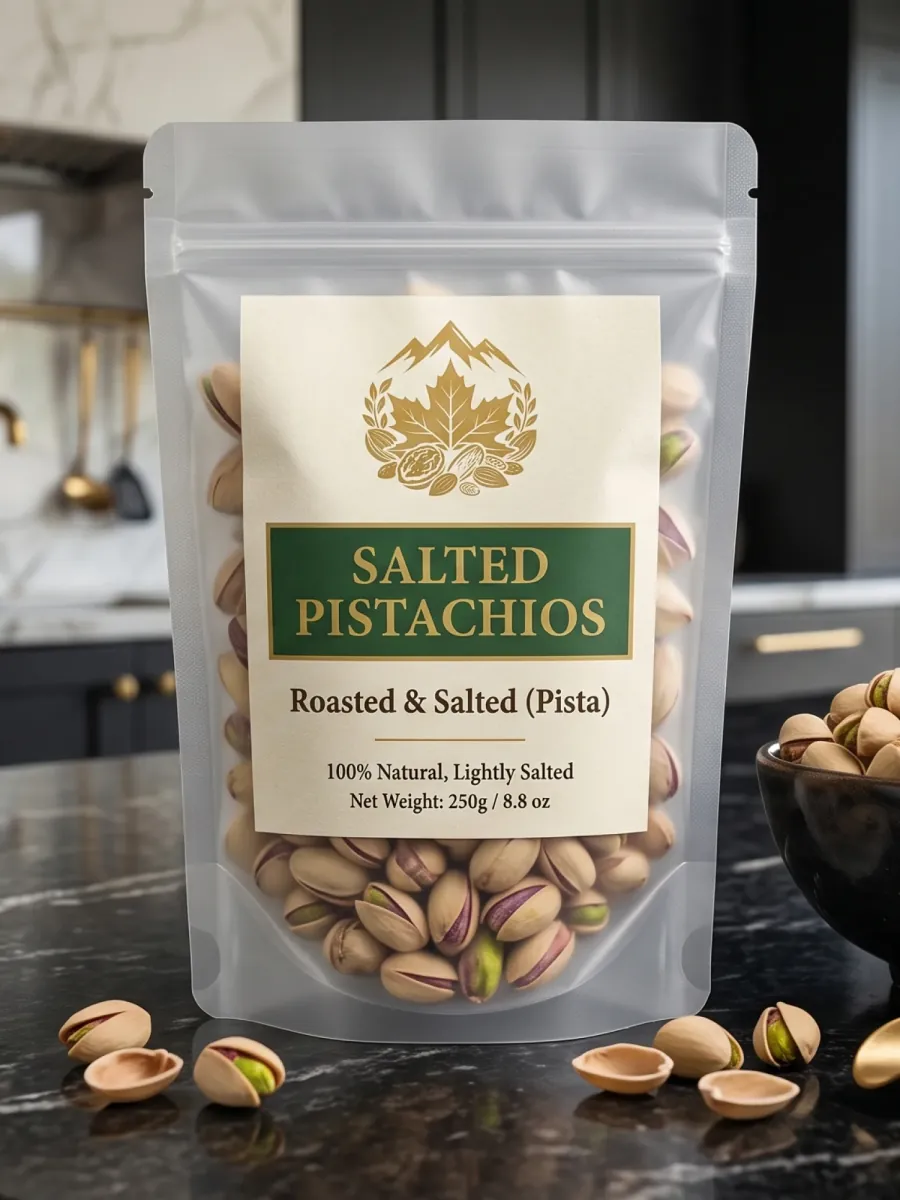
Half the weight in the bag is shell
Pistachio kernels vs in-shell pistachios is a choice most buyers make by price per kilo. The in-shell pack looks cheaper. The packet of shelled pista kernels looks dear. The two prices do not measure the same thing.
With in-shell pista, you pay for shell you will throw away. With kernels, you pay for someone else’s shelling. This guide compares kernel yield, cost per edible gram, shelf life, freshness checks and the right pick for snacking, mithai and gifting. It says plainly when the other form is the better buy. Our own range is on the Salted Pistachios page.
What is the difference between pistachio kernels and in-shell pistachios?
In-shell pistachios are whole nuts with the hard shell on, usually split open at one end. Pistachio kernels are the green edible seed, taken out of the shell. The food is the same. What changes is protection, effort, weight and price.
An in-shell pista is the natural pack. You split it open with your thumbnail and eat the kernel. Most in-shell pista sold in India is roasted and salted, because that is how people snack on it. Our guide to roasted salted vs raw pistachios explains what that does to the nut.
A pista kernel has been shelled, sorted and packed. Kernels are sold raw or roasted, plain or salted. Raw green kernels are what most sweet recipes call for, as their colour stays clean in the dish.
Valley Origin sells Salted Pistachios, which are in-shell. We do not sell shelled kernels. If you need kernels for cooking, this guide still tells you what to look for in any pack.
How much kernel is in 1 kg of in-shell pistachios?
About 450 g, if you use the 0.45 ratio that the US pistachio industry reports with. Nut size and variety change this. A gaping, well-filled nut gives more kernel than a small or half-empty one, so use 45% as a working average, not a fixed number.
The 0.45 comes from how the sector reports its numbers. Market analysts reporting US shipments say kernel weights are converted to in-shell equivalent using a 0.45 ratio. Divide the kernel weight by 0.45 and you get the in-shell weight. In plain terms, about 2.2 kg of in-shell pista makes 1 kg of kernel.
This is an industry reporting convention, not a lab yield for every pack in an Indian shop. We could not find a published yield table for pistachios sold in India. Your own pack will differ.
You can test it at home. Weigh 100 g of in-shell pista, shell all of them, and weigh the kernels. If you get 45 g, the average holds. If you get 35 g, the pack has many small or empty nuts, and its real price is higher than the label says. Closed shells are a related problem, covered in our post on why a pistachio shell does not open.
Are shelled pistachios as fresh as in-shell?
Not by default, and not always worse. The shell keeps air and smells off the kernel, which helps. But UC extension tables give in-shell and shelled pistachios the same time: about 1 year in the fridge and 3 years in the freezer. Freshness depends on drying, roasting and storage.
The University of California’s guide to nuts has a table of typical storage times. It lists pistachios, in-shell and shelled, at 1 year in the fridge and 3 years in the freezer. Both are US figures for cold storage in a sealed container.
The same guide says nuts keep quality for “up to a few months” at room temperature, and for less time in a warmer place. It adds that room-temperature storage makes nut oils go rancid quicker. Many Indian kitchens are warm from April to June, so read the cold-storage numbers as upper limits.
Many sellers say in-shell pista lasts longer than kernels on the shelf, and the idea is plausible. The shell shields the kernel from air and light. We found no controlled study that measured the gap, so we do not quote one.
The UC guide does note that shelled nuts absorb moisture and outside smells. It advises packing them in odour-tight glass or plastic containers. A shell does some of that job for free.
The shell has a weak side too. You cannot smell or see the kernel until you open it. A pretty split shell can hold a stale, shrivelled nut.
How do they compare on taste, effort and cost?
In-shell pista tastes freshest the moment you crack it and slows your eating down. Kernels are ready for the pan or the bowl. In-shell costs less per kilo, but kernels can cost less per edible gram once you count the shell you throw away.
Here is the side-by-side, drawing on the sources above.
| In-shell pistachios | Pistachio kernels | |
|---|---|---|
| Edible share by weight | About 45% (industry convention) | 100% |
| Fridge life (UC) | About 1 year | About 1 year |
| Freezer life (UC) | About 3 years | About 3 years |
| Protection | Shell guards the kernel | Needs an airtight, odour-tight jar |
| Effort | You open each nut | Ready to use |
| Quality check | Only after you open one | Smell and look before you buy |
| Best for | Snacking, sharing, festive bowls | Mithai, baking, cooking, travel |
The nutrition inside is the same in both forms. What differs is what has been done to the nut: raw or roasted, plain or salted. Sodium is the number to read on the label. If you must limit salt, ask your doctor which type and how much is right for you.
Which form costs less per edible gram?
Divide the in-shell price by 0.45 to get the cost of the kernel inside it. In-shell pista at Rs 1,000 per kg works out to about Rs 2,220 per kg of kernel. Compare that with the shelled price, not with the in-shell price.
Say you see in-shell pista at Rs 1,000 per kg. This is a made-up number for the sum. Only 450 g is kernel, so each kilo of kernel costs Rs 1,000 divided by 0.45, which is about Rs 2,220. If shelled kernels of a similar kind are priced at Rs 2,000 per kg, kernels are the cheaper buy and also save you the work.
If the in-shell pack is full of small or closed nuts and yields only 35%, the sum is worse: Rs 1,000 divided by 0.35 is about Rs 2,860. If the nuts are large and yield 50%, it is Rs 2,000. The honest answer is that it depends on the yield.
We have not quoted a current rupee range here. We could not verify one for each form, and pistachio prices move with origin, size, roasting and season. Compare the price per 100 g of kernel, and check the weight on the pack. For our own rates, see current prices on the product page.
Remember that salted, roasted in-shell nuts carry salt on the shell. That adds weight too, though a small amount.
Which pistachio form is better for snacking, mithai or gifting?
In-shell is better for snacking and sharing, because opening the nuts slows you down. Kernels are better for mithai, kheer, kulfi and baking. For gifting, in-shell suits a festive bowl and kernels suit a neat, ready-to-eat box. Pick by how the recipient will use it.
Match your situation to a pick.
Snacking in the evening. In-shell. The pause between nuts helps you eat fewer, and the pile of shells shows you how many you have had.
Mithai, kheer, kulfi, barfi. Kernels, and raw ones. You will not shell enough nuts by hand, and salted kernels would spoil the dish. Our post on Iranian vs American pistachios helps if you are comparing sizes.
Baking or topping a cake. Kernels. Chopped or slivered, they spread evenly.
A festive or family gift. In-shell works if the recipient likes to crack nuts and share a bowl. Kernels suit someone who cooks or eats at a desk. For a general checklist, read how to choose a dry fruit gift box. Corporate and bulk buyers can ask for a quote through the contact page.
Travel or office. Kernels in a sealed pouch. There is no shell to carry or clear up.
Children. Whole nuts are a choking risk for very young children, and pistachios are tree nuts. Ask your doctor or paediatrician before giving them.
How do you check each form before you buy?
Smell and look first, taste one nut last. Fresh pista smells mild and sweet. A sharp, sour or paint-like smell means rancid oil. Throw out anything mouldy, discoloured or shrivelled. Kernels you can check through a clear pack. In-shell nuts need a sample.
Rancid nuts are not unsafe, but UC says the sharp flavour is unpleasant to most people. Mould is a different matter. The WHO notes that tree nuts including pistachio can be contaminated by aflatoxin-producing moulds and advises you to discard nuts that look mouldy, discoloured or shrivelled.
For in-shell pista, check these:
- Shell colour. A natural shell is beige. A bright red or very white shell needs questions. See our guide to dyed pistachios.
- A sample. Open five or six from different parts of the pack. Smell and taste them.
- Empty shells. Many closed shells or light nuts mean a poor yield.
- Salt. Heavy white crust on the shell means a heavily salted pack.
For shelled kernels, check these:
- Colour. Raw kernels are green with a purplish skin. Brown, dull or oily kernels are old.
- Smell. Open the pack and smell before you use it.
- Shape. Shrivelled kernels are a sign of age or poor drying.
- Seller’s information. Ask what the pack contains and whether it is raw or roasted.
After you buy, store either form well. Our post on how to tell if pistachios are bad covers the signs, and the same airtight, cool, dry rule applies to both.
Frequently asked questions about pistachio kernels vs in-shell pistachios
Are shelled pistachios as fresh as in-shell?
Not by default. The shell protects the kernel from air and smells, but UC gives in-shell and shelled pistachios the same fridge and freezer life. A well-sealed pack of kernels can be as fresh as a badly stored bag of in-shell nuts.
Open a few nuts from any pack to check before you buy more. Smell matters more than the shell.
Which form is cheaper per edible gram?
Often the kernel, once you account for the shell. About 45% of in-shell pista by weight is kernel, so divide the in-shell price by 0.45 to compare. If the result is above the shelled price, kernels are the cheaper buy.
Yield varies by pack. Shell 100 g yourself to find yours.
Which keeps longer, kernels or in-shell?
UC tables show no difference: about 1 year in the fridge and 3 years in the freezer for both. At room temperature, expect a few months at best, less in summer. Roasted and salted nuts go stale sooner than raw ones.
Read all these as upper limits for a sealed container, and finish a pack within a few weeks of opening.
Which is better for baking or mithai?
Kernels, and raw ones for most sweets. They save the shelling and keep a clean green colour in kheer, kulfi and barfi. Salted in-shell pista suits snacking, not sweet dishes, since the salt will show in the dish.
If you only have in-shell pista, shell and rub off the skin, but expect it to take a while.
Which suits gifting better?
In-shell suits a festive bowl or a hamper for people who like to crack nuts. Kernels suit neat, ready-to-eat gifts and people who cook. Check for nut allergies, and ask any supplier about the packing date and what is in the pack.
For bulk or corporate orders, contact Valley Origin for a quote.
Pick the form you will finish
In-shell pista rewards patience. It slows your snacking and suits a bowl for sharing. Kernels reward convenience. They suit mithai, baking and busy kitchens, and the price gap often shrinks once you count the shell.
Whichever you choose, divide by the yield before you compare prices, smell before you buy and store it airtight, cool and dry. If you want in-shell pista, our Salted Pistachios are roasted and lightly salted, with pistachios and salt as the only ingredients. See current prices on the product page.