Kashmir grows nearly all of India’s almonds and walnuts, but the crop is small and slipping
Kashmir almond and walnut production is a story of two numbers. The valley grows almost every almond and walnut that India produces. Yet India produces only a small part of what it eats.
That gap explains a lot about what you find on a shop shelf. Most almonds sold in India are imported. A Kashmiri one is the exception. This guide sets out the production share, the orchard decline and what both mean for you as a buyer. It does not repeat the district-by-district map, which we cover in where Kashmiri walnuts grow. To see what Valley Origin sells today, start at the products page.
How much of India’s almond and walnut comes from Kashmir?
Kashmir grows about 94% of India’s almonds and about 92% of its walnuts, according to a 2022 ICAR article. The National Horticulture Board puts Jammu and Kashmir at over 91% of almonds, with Himachal Pradesh growing most of the rest.
An article in Indian Horticulture, published by ICAR in 2022, says Kashmir “enjoys a monopoly” in almonds (94.4%), walnuts (91.9%) and cherries. The article does not name the year of those shares. Read them as a recent picture, not an exact count.
A Gaon Connection report from November 2022 gives a similar split for almonds. It cites the National Horticulture Board: over 91% from Jammu and Kashmir, about 9% from Himachal Pradesh.
The sources differ by a few points. The message does not. If an almond or walnut is grown in India, it was almost certainly grown in Kashmir.
How far has the almond crop shrunk?
Almond area in Jammu and Kashmir fell from over 20,000 hectares in the 1990s to about 5,400 hectares by 2023. That is a drop of roughly three quarters. The figures come from news reports quoting official horticulture data.
The Gaon Connection report says area was above 20,000 hectares in the mid-1990s and a little over 5,000 hectares by 2020-21. A FreshPlaza report from March 2023, carried from Rising Kashmir, quotes the Director of Horticulture, Kashmir, at 5,411 hectares across ten districts.
Those are news-report figures, not a table we could check at the source. We did not find a clean, official yearly series for almond tonnage, so we do not give one.
One more limit matters. None of these sources separate Mamra from other Kashmiri almond types. We cannot tell you how many hectares are Mamra. Our own guide to types of almonds in India explains why that distinction matters.
Why are almond orchards declining?
Growers and officials point to cold, wet weather at bloom, a lack of frost-resistant varieties, apples paying better, and no organised market. Almond trees also take 8 to 10 years to bear, so a bad run is costly to recover from.
Take the weather first. Almond blooms early, often in March. The same ICAR article, on untimely snowfall, records that snow on 8 and 16 March 2015 damaged almond blossom. Cold weather cut bee activity, and fruit set was low. It adds that bees stop flying below 12 degrees Celsius and pollen does not germinate below 5 degrees. A late cold spell can cost a whole crop.
The Rising Kashmir report adds three more causes. Frost-resistant, late-blooming varieties are not available. Local farmers say apples are more profitable. And the valley has no central dry-fruit market where almond growers can sell.
A March 2026 FreshPlaza report repeats these points. It also quotes a Pulwama grower who fears that “in a few years, even these few orchards will disappear”. That is one farmer’s fear, not a forecast.
Is the walnut crop declining too?
Yes, but more slowly. Horticulture department figures show Jammu and Kashmir walnut output fell 19% in nine years, from 2.22 lakh tonnes in 2010-11 to 1.80 lakh tonnes in 2019-20. Ageing trees and cheaper imports are the main causes.
That series comes from a 2022 report by 30 Stades, which cites the J&K Horticulture Department. The same report lists the causes growers gave. Old trees carry disease. Walnuts take about 6 years to first fruit and 12 to 13 years to full maturity, so replanting is slow. Growers also say cheaper, more uniform imported kernels are preferred by buyers.
The 2026 FreshPlaza report agrees on ageing trees and falling yields. It notes that the government has imported about 10,000 Chandler walnut saplings for distribution after quarantine.
Be careful with the numbers. Other reports quote higher totals for later years, and they do not line up with this series. Our post on Kashmiri walnut districts lists several of them. The direction is a slow slide, not a collapse.
Does Kashmir grow enough almonds and walnuts for India?
No. India produces less than 10% of the almonds it consumes, and walnut production meets about 80 to 85% of demand, according to a March 2026 FreshPlaza report. Imports fill the rest.
The almond gap is wide. The Gaon Connection report cites official data, via Statista, showing almond imports rising from 34,360 tonnes in 2008 to 167,830 tonnes in 2020. Over the same years, Kashmir’s almond area was shrinking.
So both things are true at once. Kashmir holds nearly all of India’s almond crop. That crop is a very small part of what India eats.
The result is simple. A generic “almond” in an Indian shop is almost certainly an import. A Kashmiri almond is a specialist product, grown in small volumes. The same is less true for walnuts, where Kashmir still meets most of the country’s demand.
What does this mean for price and supply?
We found no source that tracks Kashmiri retail prices against orchard area, so we cannot say prices will rise. What the sources show is a small, ageing crop, flat farm-gate prices and heavy competition from imports.
The only farm-gate price in these sources is one grower’s. A Pulwama farmer told Gaon Connection that almonds fetch about Rs 6,000 to 6,500 per mann (40 kg), roughly unchanged since 2016. That is one voice, not a market series.
Here is what the evidence does support. A shrinking crop means fewer genuine Kashmiri almonds in a year with a bad bloom. And a low price for a “Kashmiri” almond is a warning, not a bargain.
For current market ranges, read our guides to almond price per kg in India and Kashmiri walnut price per kg. They explain what drives each range.
How should buyers respond?
Regard “Kashmiri” as a claim to test. Ask for the variety, the district and how the seller sources. Expect a small supply of true Kashmiri almonds and a fair price. Buy walnuts on freshness and kernel quality.
The decline makes three habits worth having.
- Ask what the almond is. Mamra, Gurbandi and California almonds look and taste different. Our guide to how to identify real Mamra Badam gives six checks you can do at home.
- Ask where it was grown. A seller with a real source names a district. “Kashmir” alone is a thin answer.
- Be wary of a price far below the range. A low price on a scarce crop usually means a different almond.
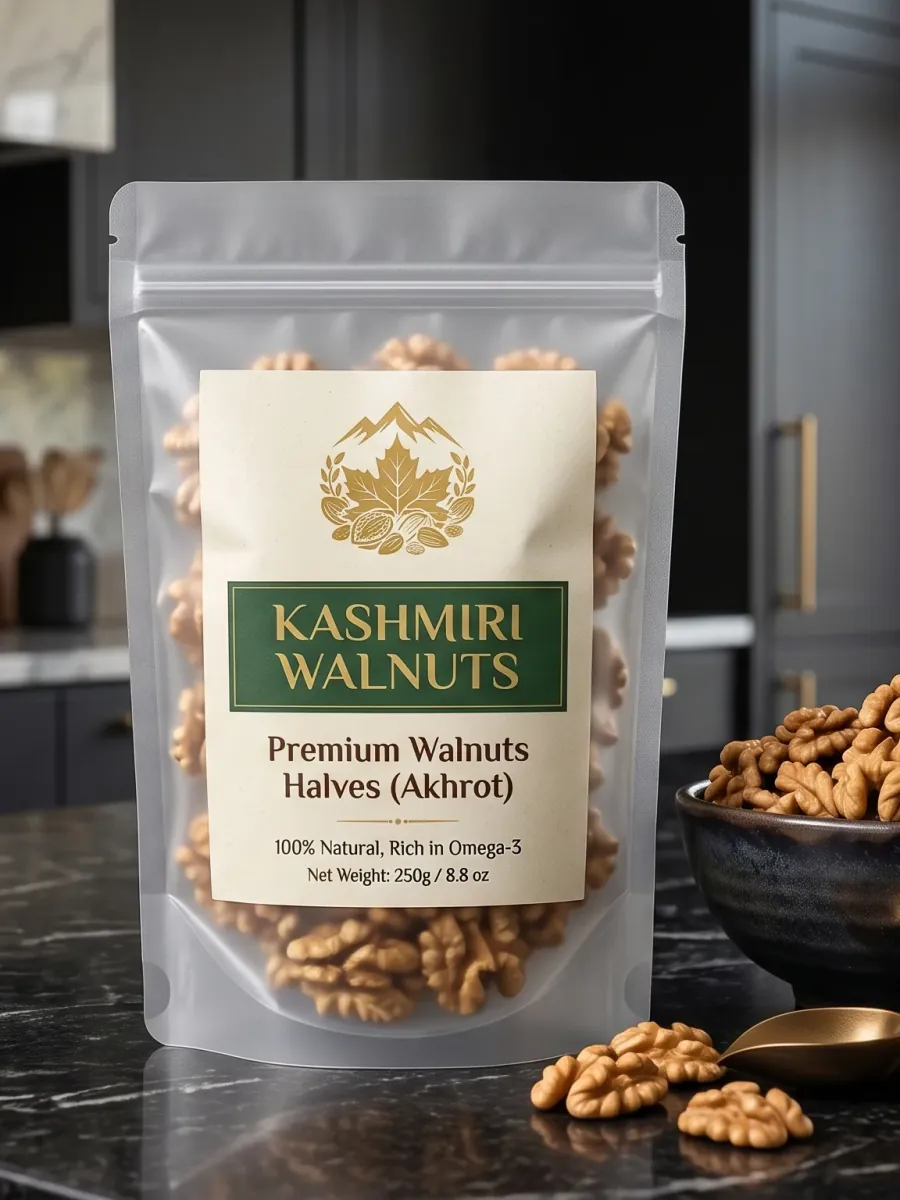
Valley Origin is a family business that began in Kashmir in 1975. It sources direct from growers, with no middlemen. Its Mamra Badam grows at altitudes above 1,800 metres and is Grade A, hand-graded and hand-inspected. Its walnut halves are superior grade, from Srinagar, and inspected by hand. You can read more on the story page.
If you have a nut allergy or a medical condition, check with your doctor before changing what you eat.
Frequently asked questions about Kashmir almond and walnut production
What percentage of India’s almonds are grown in Kashmir?
About 94%, according to a 2022 ICAR article. The National Horticulture Board figure quoted by Gaon Connection is over 91%, with about 9% from Himachal Pradesh. Kashmir grows nearly all of India’s almonds.
The share is high, but the total crop is small.
How much of India’s walnut comes from Kashmir?
About 92%, according to the same ICAR article, which gives 91.9%. A horticulture department figure quoted in 2022 also puts Jammu and Kashmir at 92% of India’s output in 2021-22.
Other states, mainly Himachal Pradesh and Uttarakhand, grow the rest.
Are Kashmir’s almond orchards disappearing?
They are shrinking. Almond area fell from over 20,000 hectares in the 1990s to about 5,400 hectares by 2023. One grower fears the orchards will vanish. No source we found predicts that outcome.
Government schemes, including a 50% subsidy on high-density plantations, aim to slow the fall.
Does India import almonds and walnuts?
Yes, heavily. India produces less than 10% of its almond consumption, and walnut production meets about 80 to 85% of demand, per a March 2026 FreshPlaza report. Imports cover the gap.
Almond imports reached 167,830 tonnes in 2020, per official data quoted by Gaon Connection.
Will Kashmiri almond and walnut prices go up?
We cannot say. No source we found links Kashmiri retail prices to orchard area. A smaller crop can mean tighter supply in a bad year, but imports also set the price you pay.
For ranges, see our price guides linked above.
A small crop is a reason to check, not a reason to panic
Kashmir grows almost every almond and walnut that India produces. The almond crop is a fraction of what it was, and the walnut crop is slowly ageing. India fills the gap with imports.
For you, that means one habit. Ask what you are buying, where it grew and who sourced it. Origin is only worth paying for when someone can show it. When you are ready, see current prices for Kashmiri Mamra Badam and Kashmiri Walnut Halves, or browse the full range.