A good gift box is judged by what is inside, not the lid
You need to choose a dry fruit gift box for Diwali, and every listing looks the same. Gold ribbons, a glossy lid, a photo of cashews and pista. The photo tells you nothing about what you will actually receive.
This guide is for a buyer who wants to get it right: a family choosing for relatives, or an HR or admin person ordering for staff and clients. It is a checklist of seven things to verify before you pay. It does not list box ideas or prices.
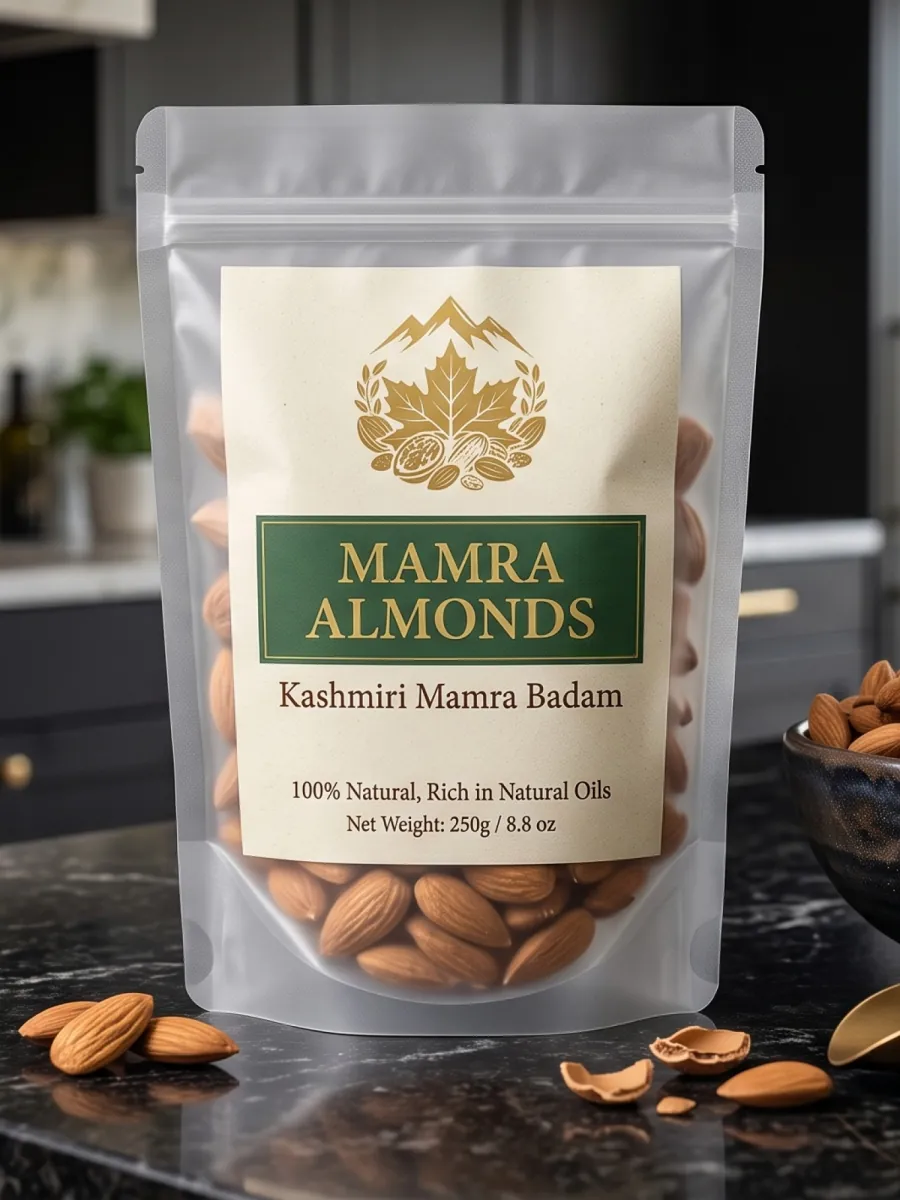
If almonds are part of your plan, see what a premium almond looks like on our Kashmiri Mamra Badam page first. It gives you a standard to compare with.
Why do dry fruits work as a Diwali gift?
Dry fruits keep far longer than mithai, suit most diets and are familiar to almost every Indian household. That is why they sit beside sweets at Diwali. The gift only works if the nuts are fresh, so quality is the whole point.
A sweet box must be eaten within days. A sealed pack of nuts can sit in a cupboard through the festival week and beyond. The recipient can share it, serve it to guests or keep it for later.
That long life is also the risk. A box can sit in a warehouse for months before it reaches you. The lid looks identical on a fresh box and a stale one.
If you are choosing for relatives, our guide to a Diwali dry fruit gift for family covers who to give what. For staff and clients, see corporate Diwali dry fruit gifts for employees.
What should a good dry fruit gift box contain?
A good box holds three or four firm, familiar items in clear, equal portions: usually badam (almond), kaju (cashew), pista (pistachio) and akhrot (walnut). Raisins or figs can join if well packed. Fewer items in better quantity beat a crowded box.
Start with the recipient. A box for parents can be one premium nut in a larger pack. A box for a client or a large team needs a safer mix that nobody will find strange.
This table is a planning guide for the mix. It is not a pack list or a price list.
| Recipient | A sensible mix | Watch for |
|---|---|---|
| Parents, elders | One premium nut, such as almonds | Packing date and grade |
| Close relatives | Two or three firm nuts | Equal weight of each nut |
| Clients | Three nuts in a neat, sealed box | Plain, uncoated nuts |
| Staff | Two nuts in a smaller sealed pack | Labels you can read |
What are the seven checks before you order?
Check the nut mix, the packing date, additives and coating, the share of soft or sweet fruit, the seal, the shelf life and the label. Together they show whether a box is premium or just well dressed. Do all seven before you pay.
Each check takes a minute. Do them in this order, because the first ones decide whether to go further.
1. Is the nut mix honest?
Ask for the weight of each nut in the box. A mix that names its items but not their quantities often hides cheap filler. A fair box lists every nut with a net weight, and the heavy, costly nuts are not a token handful.
Look at what the mix is made of. Cheaper items such as peanuts, roasted chana or small raisins can fill space at a fraction of the cost of almonds and pista. Say a box lists “premium dry fruits” and shows four nuts on the lid. If the label then lists a dozen items without weights, you cannot tell what you paid for.
2. Is there a packing date?
Look for a date of packing, not only a best-before date. Nuts hold natural oils that turn stale with heat and time. A recent packing date is the simplest proof that the box was not sitting in a warehouse.
A best-before date alone says when the seller thinks the food should be eaten by. It does not say when it was packed. Our guide to how to store Mamra Badam explains why oils go off. If the seller will not give a packing date, take that as your answer.
3. Are there additives or coatings?
Plain nuts show their own colour. Shiny, oily, very white or very bright nuts may be coated, dyed or polished to hide age or defects. Ask whether anything is added, and prefer nuts with nothing on them.
Pistachio shells are a common case. A shell that is unnaturally bright or chalky is worth a question. Roasted and salted nuts can also mask staleness, because salt and heat hide a flat taste. For gifting, plain raw nuts are the safer base because there is nothing to disguise.
Dried fruit such as figs, apricots and raisins may carry sulphur dioxide, a preservative that stops browning and mould. Hong Kong’s food safety centre notes that people hypersensitive to it may have breathing difficulty. Read the ingredient list for it.
4. How much is sugar-coated or soft fruit?
Count the sweet and soft items. Sugar-coated nuts, candied fruit and very soft figs or dates spoil faster, stick together in humid weather and can disappoint a recipient. Keep them small or leave them out.
Diwali often falls while some coastal and eastern cities are still damp. Soft fruit takes up moisture and turns sticky. Coated pieces can also hide broken nuts underneath.
If you are unsure about a recipient with diabetes, check with them or their doctor and pick a plain nut box.
5. Is the packing sealed and sturdy?
Look for individual sealed pouches inside the box, a tight lid and a pack that does not rattle loose. Air and moisture are what ruin nuts. An open tray under cling film is a poor sign for a gift sent across India.
Press a pack if you can. Nuts should feel loose and dry, not clumped or sticky.
6. How long will it stay fresh?
Ask how long the specific box stays at its best from the packing date, and how to store it. Raw nuts in sealed packs keep for weeks in a cool, dry cupboard. Anything promising a very long life with no reason deserves a question.
A seller who knows the product can answer plainly. Keep gifts away from a stove, a hot car and direct sun until you hand them over. Our guides on how to tell if pistachios are bad and how to identify good quality cashew nuts list what stale nuts look and smell like, so you can help the recipient too.
7. Does the label carry what the law requires?
A packaged box should show the product name, ingredients, net quantity, batch or lot number, date marking, a vegetarian symbol and the FSSAI logo with licence number. A missing item is a reason to ask questions before you order.
India’s food regulator lists these particulars in its guidance on packaged food labels. It says all ingredients must be declared in descending order by weight, which makes the ingredient line a quick test of the nut mix. A company ordering for staff may also want this record for its files.
How do you spot cheap filler in a hamper?
Look at the ingredient order, the sizes of the nuts and the share of low-cost items. If peanuts, small raisins or roasted chana come first, or the premium nuts are a thin top layer, the box is mostly filler.
Ingredients are listed by weight, so the first item is the heaviest. A box that leads with a cheap item is mostly that item, whatever the lid says.
Check the nuts for size and shape. A premium box has even, whole kernels. Broken pieces, shrivelled kernels and mixed sizes mean the sorting was loose. If a top layer looks perfect and the layers below are untidy, ask to see a sample or a photo of a cut-open box.
What should you ask the seller before ordering?
Ask six things: the net weight of each nut, the packing date, whether anything is added or coated, the origin and variety, the shelf life, and whether the seller can invoice with GST. A seller who knows the product answers all six quickly.
Send the questions in one message and compare answers across sellers.
- What is the net weight of each nut in the box?
- What is the date of packing?
- Is anything added, coated, flavoured or polished?
- Where did the nuts grow, and which variety are they?
- How long does the box stay at its best, and how should it be stored?
- Can you give a GST invoice and deliver to several addresses?
Vague answers, or an offer to “adjust the price” instead of answering, tell you what you need to know. Origin matters here, because a seller who buys direct can usually name the region and the harvest season.
For companies: how do you plan a bulk order?
Decide the headcount, budget tier and delivery addresses first, then order early. Festive stock and couriers both tighten before Diwali. Ask for a sample, a GST invoice and a delivery plan in writing. This is general guidance, not a promise from any seller.
Say you are buying for 50 employees spread across three offices. Count the people, split the budget into tiers (one for senior clients, one for staff), and confirm the addresses before you talk to any seller. Changing the list late is what causes most delays.
Ask early for a GST invoice if your finance team needs one. Ask whether personalisation, such as a printed card, adds time. A line on the card listing the nuts inside lets anyone with an allergy pass the box on.
Is a ready box better than packing your own?
It depends. A ready box saves time and looks finished, but you must check weight, date and contents. Packing your own gives control over quality and quantity. If the seller answers all seven checks, a ready box is fine.
A ready box suits a tight deadline or a long list. Your own pack suits a smaller list where you care about one premium nut. Buy sealed packs of each item, and arrange them in a plain box with a card.
The honest rule is this. If the seller cannot answer the seven checks for a ready box, your own pack of sealed nuts is the better gift.
What mistakes should you avoid?
The common mistakes are choosing by the lid, ordering late, mixing too many items, ignoring allergies and storing the boxes badly. Each has a simple fix.
Choosing by the lid. Compare the net weight of nuts, not the size or shine of the box.
Ordering late. Stock and couriers get slow before the festival. Order early and leave a buffer for other cities.
Too many items. A crowded box has small amounts of everything. Pick three or four.
Ignoring allergies. Note the nuts inside on the card. Anyone with an allergy, or a pregnant relative, can ask their doctor what is safe.
Storing boxes badly. Keep parcels in a cool, dry cupboard until you hand them over, away from heat and sun.
How does Valley Origin handle gifting orders?
Valley Origin supplies dry fruits for festive, wedding and corporate gifting. Enquiries go through the contact page, where you can share your list, budget and date and ask for a quote. We do not publish gift packs or prices here.
Valley Origin is a family business that began in Kashmir in 1975. It sources Mamra Badam and walnut halves direct from growers, with no middlemen. Its Mamra Badam is Grade A, hand-graded and hand-inspected, with no additives, no preservatives and no artificial coating. Its walnut halves are superior grade and inspected by hand.
That lets us answer checks three and four plainly. Our signature product is Kashmiri Mamra Badam, grown above 1,800 metres. See current prices and read our story for how we source. For delivery details, see the shipping policy.
Frequently asked questions about choosing a dry fruit gift box
What should a good dry fruit gift box contain?
Three or four firm, plain nuts in clear, equal portions, such as almonds, cashews, pistachios and walnuts. Each should have a stated net weight, and the box should show a recent packing date. Fewer items in better quantity is the better gift.
Add raisins or figs only if they are sealed well.
How do I spot cheap filler in a hamper?
Read the ingredient order and look at the nuts. If a low-cost item such as peanuts or small raisins comes first, or the premium nuts form a thin top layer, the box is mostly filler. Ask for weights of each item.
Even, whole kernels point to careful sorting.
How long should a gift box stay fresh?
Sealed raw nuts keep for weeks in a cool, dry cupboard, but the exact time depends on the nut, the pack and the weather. Ask the seller for the shelf life from the packing date, and avoid heat and damp.
Soft or coated fruit lasts a shorter time than firm nuts.
What should I ask the seller before ordering?
Ask for the net weight of each nut, the packing date, whether anything is added or coated, the origin and variety, the shelf life and a GST invoice. A seller who knows the product answers all six without delay.
Send them as one message so you can compare sellers.
Is a ready box better than packing my own?
It depends on your time and list. A ready box saves effort if the seller passes the seven checks. Packing your own gives more control. If a ready box fails the checks, sealed nuts in a plain box are the better gift.
For a large list, a ready box is usually the practical choice.
Choose the contents, then the box
The best dry fruit gift is simple: fresh, firm, plain nuts, sealed and clearly labelled, in a quantity that suits the recipient. Run the seven checks, ask the six questions and ignore the shine of the lid.
To see what Valley Origin’s quality looks like, start with the Kashmiri Mamra Badam. Once you know your list, budget and dates, contact us for a gifting quote.