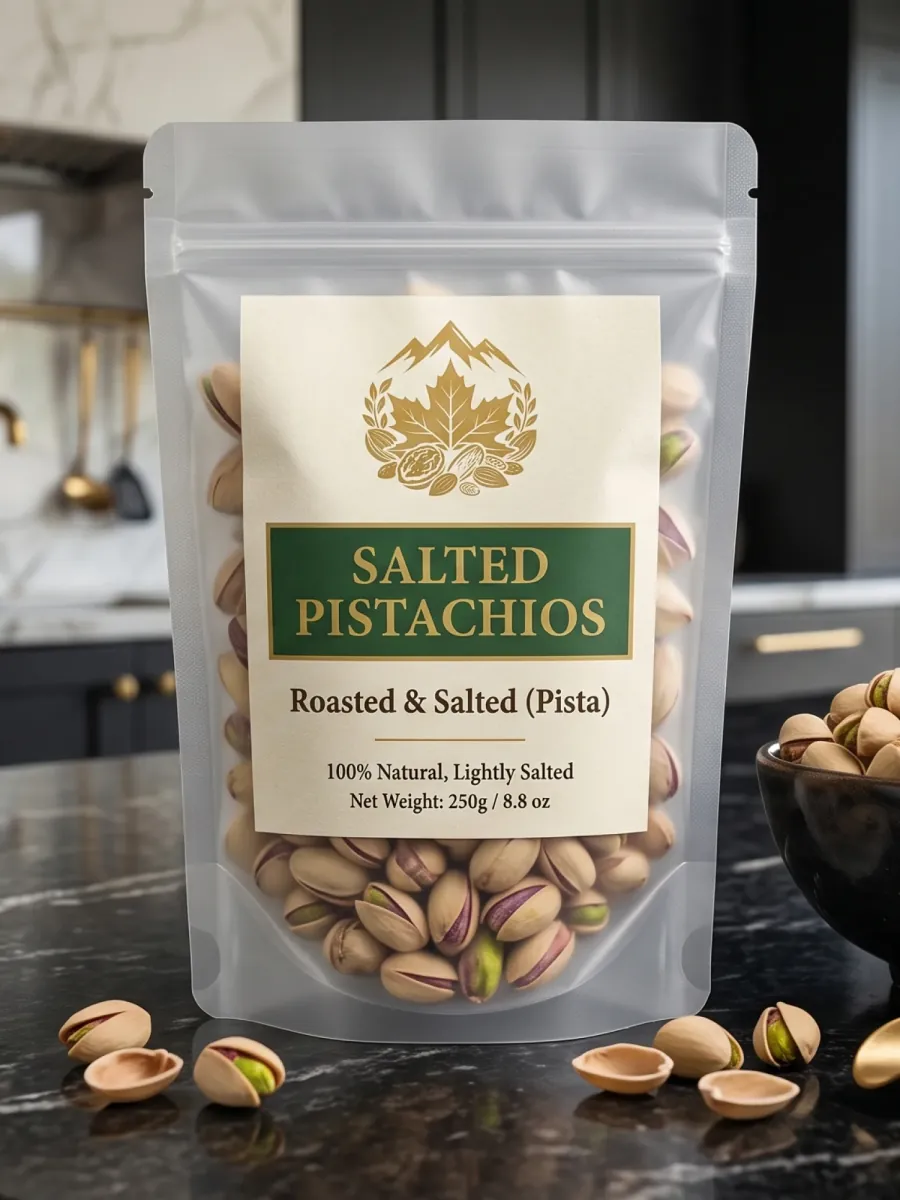
Two bags of pista, two countries, one confusing shelf
Iranian vs American pistachios is a choice most Indian buyers meet around Diwali. One bag says Iranian and looks smaller and creamier. The other says American and looks larger and paler. Both say pista, and the prices differ.
So what are you paying for? This guide compares size, shell, taste, nutrition and price, and says honestly when either bag is the right one. Valley Origin does not sell pistachios yet, so see our products page for what we do sell. The advice here applies wherever you buy.
What are Iranian pistachios, and what are American pistachios?
Both are Pistacia vera, the edible pistachio. American pistachios come mostly from California, where one cultivar, Kerman, dominates. Iranian pistachios come from several cultivars grown in Iran. The species is the same. The variety, drying and grading are what differ.
A University of California cultivar review calls Kerman “our” main variety. It lists Momtaz, Ohadi and Kalehghouchi as major cultivars in Iran. It says Ohadi nuts are slightly smaller than Kerman, and Kalehghouchi nuts are larger.
So “Iranian” is not one nut. Indian sellers also use trade names such as Akbari (a long, premium nut) and Fandoghi (a small, round one). We could not find these two names in a primary source, so read them as market terms, and ask the seller what they mean.
The American Pistachio Growers, a trade body, says American nuts are on average larger and plumper. It says they are more uniform because of strict grading. That is a fair description of a one-variety crop, but it is a trade body’s view.
How do their size, shell and taste compare?
American pistachios are usually larger, paler and more uniform, with a high share of split shells. Iranian pistachios vary more by variety and are often yellower in the shell. Taste differences are smaller than sellers claim, and freshness matters more than country.
Size and shell. Kerman is bred to be large and even. Iranian lots are mixed, so the same bag can hold big and small nuts. Shell colour also differs. The American trade body says its shells are naturally tan and never bleached. It says Iranian nuts are often bleached to mask discoloration. That is a competitor’s claim about another country, so check any bag yourself instead of trusting it.
Splits. A split shell means the nut ripened fully. The same trade body says irrigation gives American orchards a high share of split nuts, and that drought leaves more unsplit nuts in Iran. Unsplit nuts are not bad. They just take effort to open.
Taste. The same UC review reports a taste-panel study (Kader and others, 1982) that found no significant difference in overall flavour among Kerman, Red Aleppo, Trabonella and Bronte. No Iranian cultivar was in that test. It shows that flavour is partly subjective, and that cultivar alone does not guarantee a winner.
Sellers say Iranian pista tastes richer and American pista tastes milder and sweeter. Many buyers agree, but we found no primary source that settles it. Taste one nut from each bag before you commit.
How do they compare on nutrition?
No primary source shows one origin is more nutritious. USDA data for raw pistachios gives about 560 kcal, 45.3 g fat, 20.2 g protein and 10.6 g fibre per 100 g. Those values describe the species, not a country.
Several seller pages quote different oil or protein figures for each country. We found no primary source behind them. So the table uses only USDA FoodData Central values for raw pistachio nuts.
| Nutrient | Per 100 g | Per 30 g handful (calculated) |
|---|---|---|
| Energy | 560 kcal | about 168 kcal |
| Total fat | 45.3 g | about 13.6 g |
| Protein | 20.2 g | about 6.0 g |
| Fibre | 10.6 g | about 3.2 g |
| Potassium | 1,025 mg | about 308 mg |
Variety, soil, harvest year and roasting all shift these numbers a little. Salted and roasted pista adds sodium and changes the picture, so read the label.
Pistachios are energy-dense, so a handful is a serving. If you have a nut allergy, take medication or manage a medical condition, check with your doctor before you change what you eat.
How do they compare on price?
Origin does not set a fixed price gap. Price follows variety, size, in-shell or shelled, raw or roasted, and the season’s crop. Compare the cost of the edible kernel, not the weight on the bag, and check current rates before you buy.
We have not quoted a rupee range, because we found no primary source for current Indian pistachio prices. Seller guides give figures that vary widely, and prices move with each harvest.
Do three sums before you buy.
- In-shell vs shelled. Shells weigh a lot. A kilo of in-shell nuts gives far less than a kilo of kernel, so compare in-shell with in-shell only.
- Raw vs roasted and salted. Salt and roasting add weight and flavour, and can hide age. Compare raw with raw.
- Size grade. Large nuts cost more per kilo. They do not taste better by size alone.
A price far below the rest of the shelf is a warning. Cheap pista is often old, mixed in size or heavily salted.
Which pista should you buy?
It depends on the job. Buy larger, split, in-shell nuts for snacking and gifting. Buy smaller or broken kernels for sweets, kheer and baking, where shape does not show. Fresh pista of either origin beats stale pista of the other.
Here is how the choice plays out in four everyday situations.
- Daily snacking: choose raw, split, in-shell nuts you can open by hand. American Kerman is easy to find in this form. A good Iranian lot works equally well.
- Sweets, kheer and halwa: buy small or broken kernels. Heat and milk hide size, and you are paying for green colour and flavour, not looks.
- Gifting: appearance counts, so pick large, evenly coloured, clean nuts. For gift planning, see our guide to choosing a dry fruit gift box. For bulk or festive orders, send an enquiry through our contact page.
- Stocking up for months: buy in-shell, and shell only what you will eat. The shell protects the kernel from air.
Honestly, if the Iranian bag is fresh and the American bag smells stale, buy the Iranian one. The same holds the other way round.
How do you check pistachio freshness before you buy?
Check four things: the shell is clean, with a natural tan or cream colour, the kernel is green to yellow-green and plump, the smell is mild and sweet, and the taste is creamy. A sharp, sour or paint-like smell means rancid oil.
- Look at the shell. A natural shell is cream to tan, with small colour variation. A chalk-white or very uniform shell may be bleached. Ask the seller.
- Look at the kernel. A deep green to yellow-green kernel is good. Brown, grey or shrivelled kernels are old.
- Smell the bag. Fresh pista is faintly sweet. A sharp or musty smell means walk away.
- Taste one. It should be creamy. Bitterness means stale.
For the full set of warning signs, read how to tell if pistachios are bad. The storage logic from our guide to storing Mamra Badam applies here too: airtight, cool and dry.
What Valley Origin can say about pista, and what it can’t
Valley Origin is a family business that began in Kashmir in 1975. It sources Kashmiri dry fruits direct from growers, with no middlemen. It does not sell pistachios, so we cannot vouch for any pista bag.
What we can offer is a set of questions to ask any pista seller: who grew it, which harvest and what was done to it afterwards. You can read the background on our story page.
Frequently asked questions about Iranian and American pistachios
Which pista is better for sweets and which for snacking?
For sweets, small or broken kernels are enough, since heat, milk and sugar hide size. For snacking, choose large, split, raw nuts that open easily. Either origin works if the nuts are fresh and not over-salted.
Roasted and salted pista suits snacking only if you like salt. Raw gives you control.
Why are some pistachio shells bleached or dyed?
Sellers may bleach shells to make old or stained nuts look clean and uniform. A very white or very even shell is a clue. Bleaching is a claim made by one trade body about Iranian nuts, so verify by checking smell and kernel.
The kernel inside tells you more than the shell. If it smells fresh and looks green, the shell colour matters less. Ask the seller whether the shells were bleached or dyed.
What do Afghan and Turkish pistachios taste like?
We did not find a reliable primary source on how Afghan pistachios taste. The UC review says Turkish buyers prefer the Uzun and Kirmizi cultivars, and that Red Aleppo nuts are somewhat smaller than Kerman. Taste a sample before you buy.
The same review says wild pistachio germplasm is found from Turkey to Afghanistan, and that Middle Eastern nuts are larger with a yellowish kernel, which some consider less flavourful.
Is Kerman the same as an American pistachio?
Mostly yes. Kerman is the main pistachio cultivar in California. So an American pista is usually a Kerman. The name also appears on some Iranian bags, so check the country of origin on the label.
The UC review names Kerman as the main American variety, and notes that a cultivar that does well in one country may not do the same in another.
Are pistachios safe if I have a nut allergy?
No. Pistachio is a tree nut and can trigger allergy in people who are sensitive to tree nuts. Check with your doctor before eating pistachios if you or your child has a nut allergy, whichever country the bag says.
Origin does not change this. Cross-contact with other nuts can also happen in packing.
Buy the fresh bag, not the flag on it
Iranian and American pistachios are the same species grown in different ways. American pista is mostly large, even Kerman. Iranian pista is a wider mix. Choose by shell, kernel colour, smell and harvest, and pay for the kernel, not the shell.
If you are reading this to plan a gift or a festive order, start with a clear brief and a fresh sample. When you are ready to see what Valley Origin sells today, begin with the Kashmiri Mamra Badam or browse the full range.