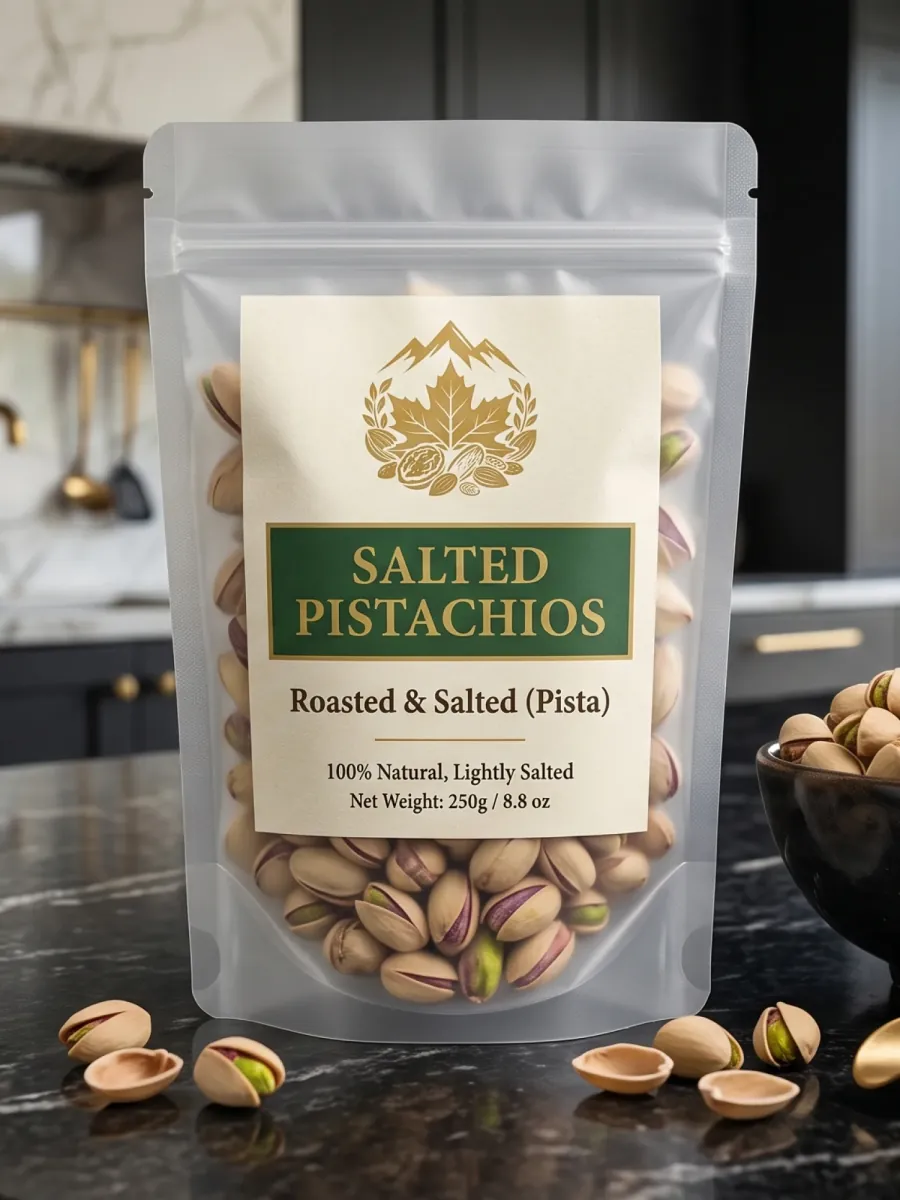
Every bowl of pista has a few that will not open
A pistachio shell not opening is one of the small irritations of snacking. You press a thumbnail into the seam, the shell does not give, and you put the nut aside. By the end of the bowl, there is a little pile of closed ones.
Those closed nuts are not a packing error. They are a normal part of how pistachios grow, and every in-shell pack has some. What matters is how many, and what is inside.
This guide explains why the shell splits, what a closed one tells you, and whether to eat it. It also covers how to open one safely and how to judge a pack. If you want to see our in-shell pack, the Salted Pistachios are in the catalogue, and the products page lists the rest.
Why are some pistachio shells closed?
Pistachio shells split on the tree when the kernel inside swells and pushes them apart. A shell that stays shut usually belongs to a nut that did not fill out, because it set late, lacked water or nutrients, or grew in a cool season. Many closed nuts hold a small kernel or none.
University of California advisers who work with pistachio growers say the shell opens because of the physical expansion of the kernel, not because a separate joint snaps. Their list of things that lower the share of split nuts is practical: low boron and zinc, too little water from July to harvest, a cool growing season and late bloom. This comes from a UC Cooperative Extension Kings County task list.
Late bloom matters because nuts on one tree do not set together. The adviser’s view is that late nuts have less time to develop, and growers cannot delay harvest for them. He links them to a higher share of closed shells.
A 2004 report in MIT Technology Review describes the same pattern from the eater’s side. In every handful, it says, a few shells are completely closed.
Is the closed nut unripe?
Usually, yes, or at least underdeveloped. A closed shell most often holds a kernel that did not grow enough to push the shell open. The kernel can be thin, shrunken or absent. It is not a fault in the shell alone, and it is not a sign that your pack is old.
The USDA standard for pistachios in the shell gives the trade’s own words for this. It defines a “blank” as a non-split shell with no kernel, or with a kernel that fills less than half the shell cavity. It calls a kernel “immature” when it is excessively thin, or fills between half and three-fourths of the cavity.
So a closed nut may be empty. It may hold a half-filled kernel. In some cases it holds a fine kernel that simply did not split. You cannot tell which from outside.
The only sure way to know is to open the nut, which is why many people simply skip them.
What are the types of pistachio shell you will meet?
A pack can hold fully split nuts, partly open nuts, nuts that split in the wrong place and nuts that never split. The USDA standard names each of them. Only the fully split ones open easily, and the rest need a little help or go to the discard pile.
These are the shell types in the USDA standard for in-shell pistachios, in plain words:
| Shell type | What it means | Easy to eat? |
|---|---|---|
| Split on the seam | Opens along the natural suture | Yes |
| Partly open | A gap too narrow for a thin gauge to slip in | Needs help |
| Non-split | Shell closed, or only partly opened | No |
| Not split on suture | Cracked somewhere other than the seam | Often awkward |
| Artificially opened | A separate USDA grade for nuts opened by other means | Yes |
The standard gives a gauge test. A shell counts as non-split if a gauge 0.018 inch thick and 0.25 inch wide will not slip into the opening. So a “slightly open” nut can still count as non-split, and it will fight you.
The same standard has a separate grade for artificially opened nuts. So some open pista you buy were not opened by the tree. Packs differ, and the label may not say.
Are closed pistachios safe to eat?
A closed shell is not a safety warning on its own. The risk comes from mould or spoilage, which can show up in any nut, open or shut. Check the kernel after you open it. If it smells musty or looks fuzzy, powdery or discoloured, discard it.
One kitchen guide, quoting a health site, says fully closed pistachios are still edible, though they may lack the richer flavour of mature nuts. Take that as a general food-writing view, not a lab finding.
The real danger sits elsewhere. The World Health Organization lists pistachio among tree nuts regularly affected by aflatoxins, which come from moulds. It advises you to check nuts and discard any that look mouldy, discoloured or shrivelled.
Look at the kernel, not the shell. A pale green to yellowish kernel with a mild, sweet smell is fine. A dark, dry, shrunken or musty one is not. For more on spoilage, see our guide on how to tell if pistachios are bad.
If you have a nut allergy, check with your doctor before you eat any pistachio.
How do you open a closed pistachio?
Use an empty half shell as a lever. Slip the thin end into the gap at the seam and twist gently. If the shell will not give, accept the loss and move on. Do not use teeth or nails, and do not smash the nut.
Follow these steps:
- Find the seam. The shell opens along its seam, so aim for the narrow line on one side.
- Take a spare shell. Pick an empty half shell from your discard pile.
- Slip the thin end into the line. Press it in at the narrow end of the nut.
- Twist the lever. A quick, small twist often pops the shell. This tip comes from a Tasting Table guide.
- Check the kernel. If it is shrunken, dark or musty, leave it.
- Stop after two tries. A shell that resists is usually not worth the effort.
The same guide warns against prying with your fingernails or teeth. It also says hitting a nut with a heavy pan could shatter it. Both are poor ideas, since you risk a chipped tooth or a ruined kernel.
Honestly, most closed nuts are not worth opening. The reward is often a small kernel. The effort is better spent on the next open nut in the bowl.
Does roasting open a closed pistachio shell?
There is no good evidence that roasting opens a shell that never split. Heat dries the nut and can make a loose shell crack more easily, but a tightly closed one usually stays closed. Roasting is not a fix for a pack with many closed nuts.
We did not find a university or USDA source saying roasting opens closed shells. So we will not claim it does. What we do know is that the tree, not the roaster, decides whether the shell splits, and that the kernel’s growth drives it.
If a roasted pack looks suspiciously open, that does not prove anything either. As the table above shows, USDA has a grade for nuts opened by other means, so open shells do not always come from the tree.
What share of a pack should be closed?
A few percent is normal, and it varies by season and grade. In one UC adviser’s September report, closed shells ran from about 5% in one batch to 10% in an early harvest, and as high as 20% in some fields. A good retail pack has fewer.
Those figures come from a single UC Cooperative Extension report of one season’s grade sheets, in California fields, before sorting. They show the spread at harvest, not what you will find in a shop pack.
The USDA standard sets limits for graded nuts. By weight, the top grade, U.S. Fancy, allows up to 1% non-split nuts. U.S. Extra No. 1 allows 2%, U.S. No. 1 allows 3% and U.S. Select allows 4%. These are USDA tolerances for graded lots. Many Indian packs do not state a US grade, so a number on the pack may mean nothing here.
A simple test works at home. Tip out a handful and count. If one in five nuts is shut, the pack is poor value. Two or three in a hundred is ordinary. Our comparison of Iranian and American pistachios covers size and shell differences that also affect how many open.
How can you pick a pack with fewer closed nuts?
Choose in-shell packs where most shells are visibly open, with a clean gap along the seam. Look for plump, pale kernels, a mild smell and a sealed pouch. Ask the seller what share is closed, and whether they sort.
Run through these checks:
- Look at the open shells. A wide, even gap down the seam means a well-filled nut.
- Compare nut sizes. Very small nuts often hold thin kernels, and closed ones are common among them.
- Smell the pack. It should smell faintly sweet and nutty, never sharp or musty.
- Check for dust and debris. Loose shell bits and powder suggest rough handling.
- Ask about sorting. A seller that sorts for split nuts can tell you how.
Roasted salted pistachios have their own trade-offs. See our guide on roasted salted vs raw pistachios.
Valley Origin sells Salted Pistachios (pista): natural pistachios in the shell, roasted and lightly salted. The ingredients are pistachios and salt, nothing else. They come sealed in a pouch in 250 g, 500 g, 1 kg and 2 kg packs, and you can see current prices on the product page.
Frequently asked questions about pistachio shells not opening
Why are some pistachio shells closed?
The kernel did not grow enough to push the shell apart. Late setting, cool weather, low water or missing nutrients on the tree all lower the share of split nuts. Closed shells are a normal part of every harvest, not a defect in your pack.
University of California advisers link split rates to bloom time, water and boron and zinc supply. Every grower sees some closed nuts each year.
Are closed pistachios safe to eat?
Yes, if the kernel looks and smells normal, though many are small or empty. The safety question is about mould, not the shell. Discard any kernel that is dark, shrunken, musty, fuzzy or discoloured, as the World Health Organization advises for nuts.
Check the kernel after opening. Anyone with a nut allergy should ask a doctor first.
Is the closed nut unripe?
Mostly yes, or underdeveloped. The shell stays shut because the kernel did not swell enough to split it. The USDA calls a non-split shell with a tiny or missing kernel a blank, and a thin kernel immature.
Some closed nuts do hold a good kernel, so the label is not certain. Open one to find out.
How do you open a closed pistachio?
Slip the thin end of an empty half shell into the seam and give a small twist. Do not use your teeth or nails, and do not smash the nut. If it will not open after two tries, discard it.
Many closed nuts are not worth opening, because the kernel inside is often small.
Does roasting open the shell?
Not reliably. We found no university or USDA source saying roasting opens a shell that never split. The tree decides that. Open shells in a roasted pack may be natural, or the nuts may have been artificially opened.
Judge a pack by its kernels, smell and share of closed nuts, not by the roast.
Count the closed ones, then decide
A pistachio shell not opening tells you about the tree, not about your kitchen. The kernel did not fill out, so the shell stayed shut. A few per bowl is normal, and the nut is safe if the kernel looks and smells right.
Use a spare shell as a lever, give each nut two tries and let the rest go. If more than a fifth of a pack is shut, you paid for shell, so buy a different pack next time. To see our in-shell pack, visit the Salted Pistachios page and check current prices there.