One kilo of shell is not one kilo of walnut
Walnut kernels vs in-shell walnuts is a choice most buyers make by price tag alone. The in-shell pack looks cheap per kilo. The packet of akhrot giri (shelled walnut kernels) looks dear. The two numbers are not measuring the same thing.
Part of what you pay for in-shell walnuts is the shell, which you throw away. Part of what you pay for kernels is someone else’s cracking. This guide compares kernel yield, shelf life, freshness, cost per edible gram and gifting. It says plainly when in-shell is the better buy. You can see our shelled option on the Kashmiri Walnut Halves page.
What is the difference between walnut kernels and in-shell walnuts?
In-shell walnuts are whole nuts with the hard shell on. Walnut kernels are the edible part, taken out of the shell. Kernels come as halves or broken pieces. The kernel is the same food in both cases. What changes is protection, effort, weight and price.
An in-shell walnut is the natural pack. You crack it, pick out the kernel and eat it. Kashmir sells thin-shelled types called kagzi (paper-shell) and thicker ones called burzul and wonth. Our guide on where Kashmiri walnuts grow covers the region.
A shelled walnut has been cracked, sorted and packed. Halves are whole half-kernels. Pieces are broken. Our post on walnut kernel grades explains the colour and shape terms on a pack.
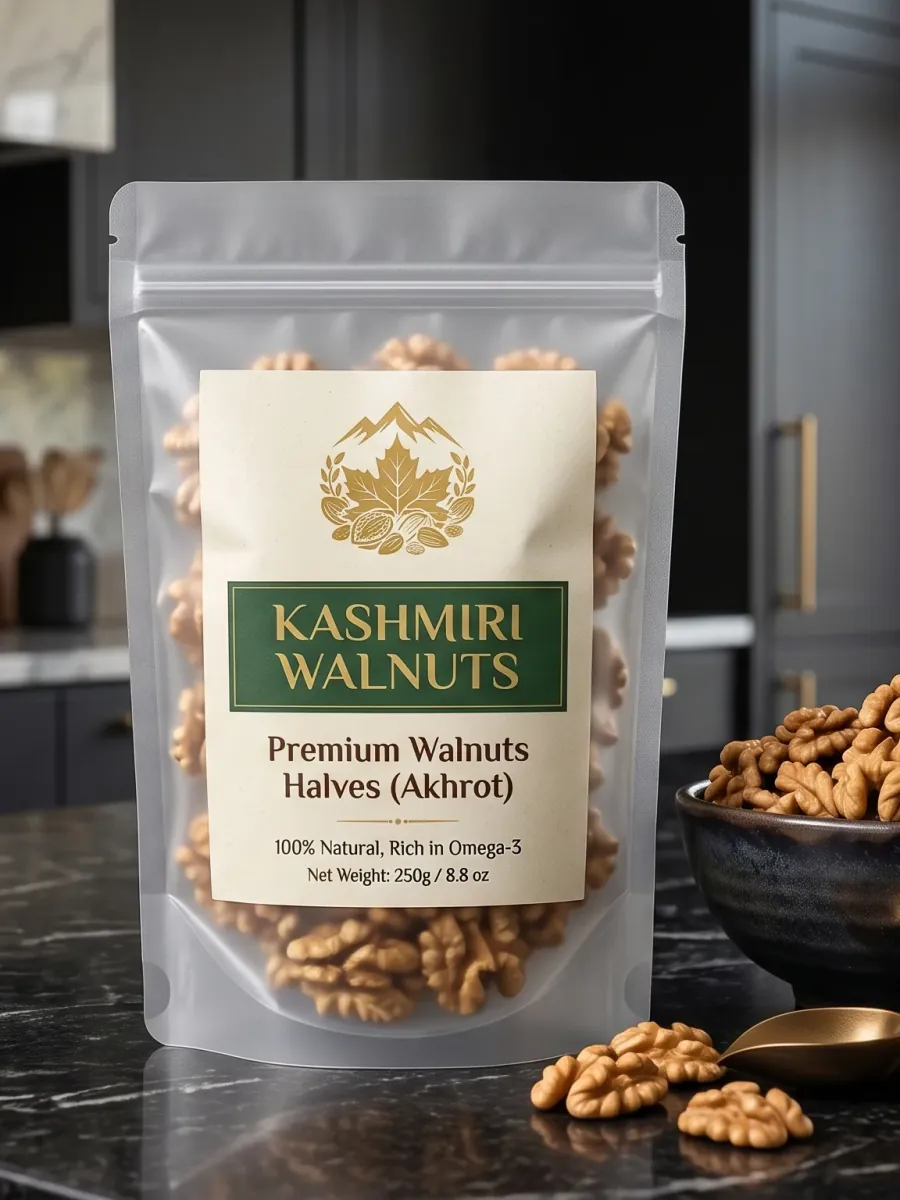
Valley Origin sells Kashmiri Walnut Halves, which are shelled kernels. We do not sell in-shell walnuts.
How much kernel is in 1 kg of in-shell walnuts?
About 430 g, if you use the 43% average that the US Department of Agriculture applies to India. Thin-shelled types give more. Thick-shelled types give less. Indian research found kernel shares between roughly 30% and 61% across 44 walnut types.
The 43% comes from a conversion factor of 2.34 in the USDA’s Tree Nuts Annual report for India, dated September 2025. Divide 1 by 2.34 and you get about 0.43.
Individual walnuts vary a lot. A study by Indian Agricultural Research Institute scientists in the Indian Journal of Horticulture measured 44 walnut germplasms. Shell thickness ran from 1.40 to 2.73 mm, and kernel percentage from 30.43% to 61.42%. The best type gave about twice the kernel of the worst.
So a kilo of thin-shelled walnuts can hold far more kernel than a kilo of thick-shelled ones. Weigh a handful, crack it, and weigh the kernel. That is your own yield.
Are in-shell walnuts fresher than shelled walnuts?
Not necessarily. The shell keeps air and light off the kernel, which helps. But extension storage tables give in-shell and shelled walnuts the same time: about a year in the fridge and over two years in the freezer. Freshness depends on harvest, drying and storage, not the shell alone.
The University of California’s nut handling guide has a table of typical storage times. It lists walnuts in shell and shelled at 1 year in the fridge and 2 years or more in the freezer. Oregon State University says the same for dried walnuts: up to a year in the fridge and two years frozen.
Both are US guides for cold storage. At room temperature UC says nuts keep quality for only “a few months”, and less in a warm place. Many Indian kitchens are warm from April to June.
The shell does give one real edge. A shelled kernel absorbs moisture and smells from the air, so UC says to pack it in odour-tight containers. A shell does part of that job for free.
The shell has a weak side too. You cannot see or smell the kernel until you crack it. A shell can hide a stale or shrivelled kernel. Oregon State also warns that in-shell nuts left in the open can be infested by Indian meal moth, so keep them in a closed container.
How do they compare on taste, effort and cost?
Freshly cracked walnuts taste sweetest and crunchiest, and you control the cracking. Shelled walnuts save time and suit baking and gifting. In-shell is cheaper per kilo, but shelled can be cheaper per edible gram once you account for the shell.
Here is the side-by-side, drawing on the sources above.
| In-shell walnuts | Shelled kernels | |
|---|---|---|
| Edible share by weight | About 43% on average, 30% to 61% by type | 100% |
| Fridge life (UC) | About 1 year | About 1 year |
| Freezer life (UC) | 2 years or more | 2 years or more |
| Protection | Shell guards the kernel | Needs an airtight jar |
| Effort | You crack and pick | Ready to use |
| Quality check | Only after cracking | Smell and look before you buy |
| Best for | Slow snacking, gifts with ritual | Baking, daily eating, gifting |
On taste, a walnut cracked an hour ago is hard to beat. The oils are fresh and the skin is crisp. But that holds only if the nut was stored well. A kernel from a sealed, well-kept pack can taste just as good.
Which costs less per edible gram?
Divide the in-shell price by 0.43 to get the cost of the kernel inside it. A kilo of walnut in shell priced at Rs 400 means about Rs 930 per kilo of edible kernel. Compare that with the shelled price, not the in-shell price.
Say you see in-shell walnuts at Rs 400 per kg. This is a made-up number for the sum. Only 430 g is kernel, so the kernel costs Rs 400 divided by 0.43, which is about Rs 930 per kg. If shelled kernels are sold at Rs 1,000 per kg, the real gap is small, and shelled saves you the work.
If the in-shell nut is thin-shelled and gives 55% kernel, the sum changes: Rs 400 divided by 0.55 is about Rs 730. Then in-shell wins on price. The honest answer is that it depends on the yield.
Walnut prices also swing by season. Our post on Kashmiri walnut price per kg shows sourced ranges for shell and kernel, and why the gap exists. For our own rates, see current prices on the product page.
Your time has a price too. Cracking 500 g of walnuts takes a while, and broken kernels from a rough crack lose value. If you only crack a handful a day, in-shell is a pleasant routine. If you need 2 kg for Diwali baking, shelled is simpler.
Which should you buy: kernels or in-shell?
Buy in-shell if you eat a few walnuts a day, want the best price per kilo and have a thin-shelled type. Buy shelled kernels for baking, gifting, children’s tiffins and busy kitchens. For most households that use walnuts weekly, shelled is the practical choice.
Match your situation to a pick.
You eat three or four walnuts with breakfast. In-shell works. Crack a week’s worth, keep the rest closed and cool.
You bake, or make halwa, laddoo or chutney. Buy shelled. You will not crack enough nuts by hand. Pieces are fine here, since shape disappears.
You are gifting. Shelled halves in a sealed pack look neat and are easy to eat. In-shell suits a traditional gift if the recipient likes cracking. Our gifting posts are a good next read, and corporate buyers can ask for a quote through the contact page.
You want zero waste and have a hammer. In-shell, if the type is thin-shelled.
You have a small kitchen and no fridge space. Shelled in a freezer bag takes less room than a kilo of shells.
Walnuts are tree nuts. If anyone at home has a nut allergy, check with your doctor before buying either form.
How do you check each form for rancidity?
Smell and taste decide. Fresh walnuts smell mild and sweet. Rancid ones smell sharp, sour or like paint and taste bitter. For in-shell nuts, crack two or three from the pack. Shelled kernels you can smell through the pack before buying.
Rancidity is oil breaking down with air and heat. UC says rancid nuts are not unsafe but have a sharp flavour that most people find unpleasant. Throw out nuts with mould.
For in-shell walnuts, check these:
- Weight. A heavy shell with a rattling kernel inside is a shrivelled nut.
- Cracks and holes. Small holes or fine webs point to moth.
- A sample. Crack a few from different parts of the pack. Smell and taste them.
For shelled kernels, check these:
- Smell through the pack. Ask the seller if you can smell it, or check on opening.
- Look. Dark, shrivelled or oily kernels are old. A slightly darker skin is not proof of rancidity, as our kernel grades guide explains.
- Packing date. Ask for one in writing.
After you buy, store either form well. See our guide on how to store walnuts in India.
Frequently asked questions about walnut kernels vs in-shell walnuts
Are in-shell walnuts fresher?
Not by default. The shell protects the kernel from air and smells, but UC gives in-shell and shelled walnuts the same fridge and freezer life. A well-sealed pack of kernels can be as fresh as a poorly stored bag of in-shell nuts.
Crack a few from any in-shell pack to check before you buy more.
How much kernel is in 1 kg of akhrot?
On average about 430 g, going by the USDA’s 43% figure for India. Thin-shelled types give more and thick-shelled ones give less. Indian research found kernel shares from about 30% to 61% across types.
Weigh your own handful to find the true yield.
How long do shelled walnuts last?
UC and Oregon State put shelled walnuts at about a year in the fridge and two years or more in the freezer, in airtight packing. At room temperature expect weeks to a few months, less in summer.
Read those as upper limits and shorten them in a hot kitchen.
Which is better for gifting?
Shelled halves are usually easier to gift because they are ready to eat and look uniform in a sealed pack. In-shell walnuts suit traditional gifts if the recipient enjoys cracking. Check for nut allergies and ask your supplier for a packing date.
For bulk or corporate gifting, contact Valley Origin for a quote.
How to check walnuts for rancidity?
Smell one walnut. Fresh ones smell mild and sweet. Rancid ones smell sharp, sour or like paint and taste bitter. Discard anything with mould. For in-shell nuts, crack a few to check.
A bitter finish is a clearer sign than colour.
The right form is the one you will finish
In-shell walnuts reward patience. They are cheaper per kilo if the type is thin-shelled, and they suit people who like to crack. Shelled kernels reward convenience. They suit baking, gifting and busy homes, and the cost gap often shrinks once you count the shell.
Whichever you pick, buy what you will finish in a few months and store it cold and sealed. Valley Origin is a family business from Kashmir, sourcing direct from growers since 1975. Our Kashmiri Walnut Halves are superior grade, inspected by hand, with no preservatives or coating. See current prices on the product page.