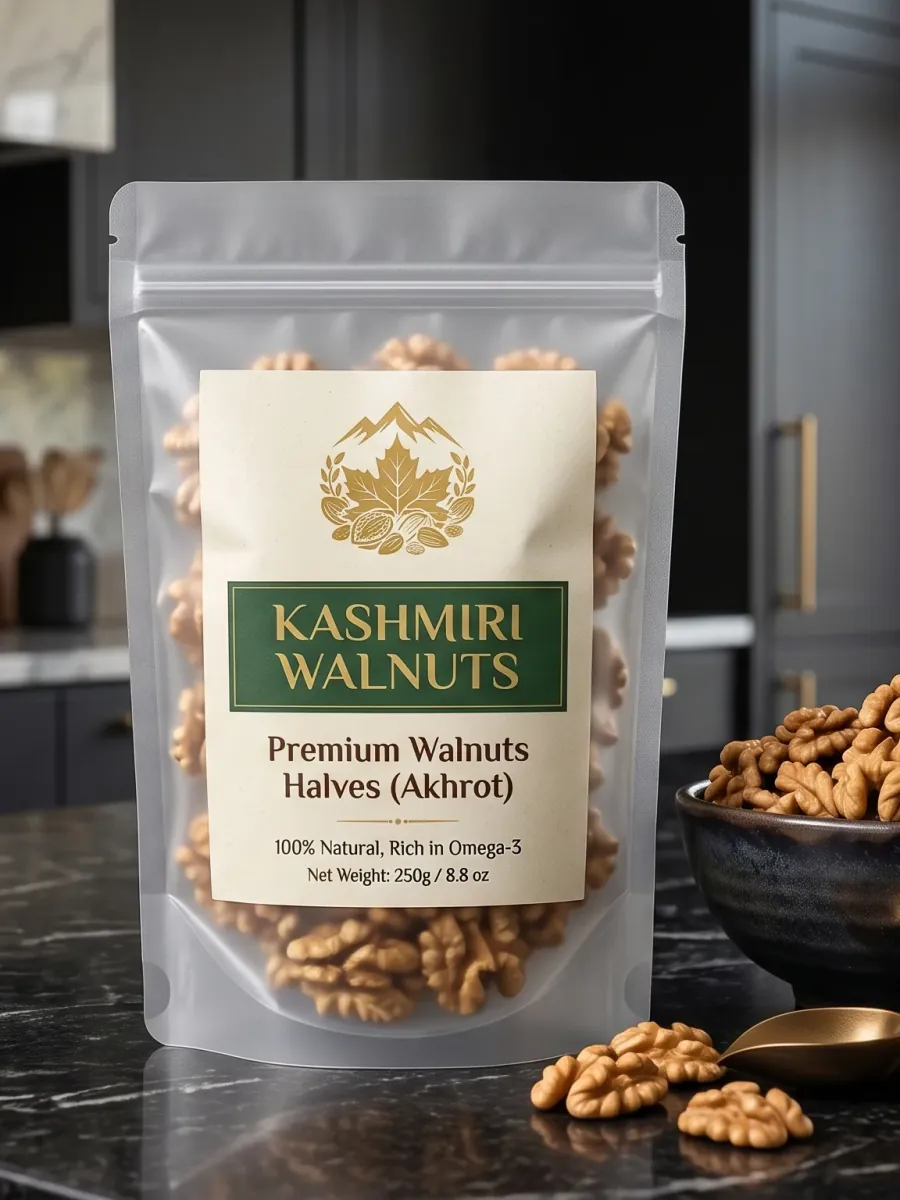
The pack says light halves, and nobody explains what that means
Walnut kernel grades confuse most buyers. A pack of akhrot giri (shelled walnut kernels) says “light halves”. The one beside it says “light amber pieces” and costs far less. Both are walnuts. So what separates them?
The answer is two simple things: the colour of the skin on the kernel, and how whole the kernel is. This guide explains both, using the official US standard that trade terms come from. It says plainly when the cheaper grade is the better buy. You can see what Valley Origin sells on the products page, and we say below what we do and do not stock.
What do light halves and light amber mean?
“Light” and “light amber” are colour classes. “Halves” is a shape class. Light is paler than light amber. Halves means whole half-kernels, and pieces means broken bits. So “light halves” is the palest, most whole grade, and “light amber pieces” is darker and broken.
Every walnut kernel is wrapped in a thin skin, called the pellicle. The colour grade is the colour of that skin, not the nut inside. The United States Department of Agriculture (USDA) standard for shelled walnuts names four colour classes: extra light, light, light amber and amber. A kernel may not be darker than the darkest shade allowed for its class on the USDA Walnut Color Chart.
The standard also sets size classes by shape. Indian sellers borrow these words. We could not find an Indian government standard for kernel colour that we could open, so the US text is the clearest public definition.
Read a label in two parts. The first word or two give the colour. The last word gives the shape. “Light halves” and “light amber pieces” are two different pairs, not two names for one thing.
How are walnut kernels graded?
Kernels are graded on colour, size and defects. Colour has four classes. Size has four classes: halves, pieces and halves, pieces and small pieces. Defects such as mould, insect damage and rancidity are limited by grade. Each class allows only a small share of kernels outside it.
The USDA standard sets limits by weight. A lot sold as “light” may still contain up to 15% of kernels darker than light, and 2% of that can be darker still. Amber lots allow 10% darker than amber. No lot is perfectly even, and the standard says so.
Size classes are defined the same way. This table shows the four from the USDA standard.
| Size class | What it means |
|---|---|
| Halves | 85% or more of the weight is half-kernels, the rest three-fourths halves |
| Pieces and halves | At least 20% halves, the rest larger pieces |
| Pieces | Broken portions that do not pass a 24/64 inch (about 9.5 mm) round hole |
| Small pieces | Portions that pass that hole but not an 8/64 inch (about 3 mm) one |
A “half kernel” here is a half with no more than one-eighth broken off. A small chip does not stop a half from counting.
Quarters, “LHP” and other shorthand are common on Indian packs. We found no source that defines them, so ask the seller what share of the pack is whole halves.
Is a darker walnut kernel older or worse?
A darker kernel is a lower colour class, and it can be older, but colour alone does not prove it is bad. Rancidity is a taste fault, and the USDA standard defines it by taste. A light amber kernel that tastes sweet is fine. A pale kernel that tastes bitter is not.
Kernels do darken as they age. A study of Chandler and Howard walnuts in Postharvest Biology and Technology found that kernel colour moved from light to amber during storage at 25 or 35 °C. Kernels whose skins were damaged in shelling browned more and lost more phenolic antioxidants. Darkening was faster in Howard than in Chandler.
So colour is a hint about handling and storage. It is not a verdict. Colour also differs by variety and by how the kernels were shelled. A dark kernel from a good lot can taste better than a pale one from stale stock.
The USDA standard is blunt about rancidity. It defines it as a kernel that is “noticeably rancid to the taste”. It also warns against confusing rancidity with the slight astringency of the skin, or with staleness, where the flavour is flat but not unpleasant. That slight bitterness at the skin is normal in walnuts.
Which walnut grade should you buy for daily eating?
For daily eating, light amber halves or pieces are usually enough. Colour does not change the taste much, and you will not see it in a bowl of oats or a laddoo. Pay for light halves only if looks matter. Smell and taste decide quality.
Say you eat five or six walnut halves with breakfast. Nobody inspects the skin colour. A light amber kernel that smells fresh gives you the same crunch as a light one. The price gap between the two is mostly cosmetic.
Pieces suit cooking. They go into halwa, cakes, chutney and stuffed parathas, where shape disappears. Small pieces cost the least and work well in anything blended or baked.
Pick halves if you eat them whole, or if you plan to serve them. A bowl of even, pale halves looks better on a plate with tea.
If anyone at home has a nut allergy, check with your doctor before buying walnuts. Walnuts are a tree nut.
Which grade is best for gifting?
For gifting, choose light or extra light halves, because appearance is the point. Even colour and whole halves look clean in a box. Whatever you choose, smell the kernels first. A pretty gift of stale walnuts is a poor gift.
A gift is judged by eye first. Uneven, dark or broken kernels in a gift tin look careless, even when they taste fine. This is the one case where paying for the paler grade is easy to justify.
Planning a larger order? Our guide to choosing a dry fruit gift box covers what to check, and gifting enquiries can go through our contact page.
What does a better walnut grade cost?
Light, whole kernels cost more than dark or broken ones. Trade reports describe a wide premium for high-grade Kashmiri kernels over lower grades. We have not quoted a rupee range, because the listings we found mixed grades, pack sizes and dates.
A May 2026 market report from CMB News says light, well-graded Kashmiri kernels sit at the top of the Delhi wholesale price band. Darker, broken or mixed-origin pieces trade near the floor. It adds that light colour is the main driver of the premium.
That matches what you see on shop shelves. You are paying for appearance and sorting, which takes work.
Compare like with like. Check the colour class, the shape class, the pack weight and the date. A “light halves” pack at a price near light amber pieces needs a question.
How do you spot rancid or mixed-grade walnut kernels?
Smell and taste catch what colour cannot. Fresh kernels smell mild and slightly sweet. Rancid ones smell like old paint or stale oil and taste sharp. Mixed grades show as uneven colour and a pile of broken pieces in a pack sold as halves.
Try these checks when the pack arrives.
- Smell first. Open the pack and smell a handful. A sharp, painty or stale-oil smell means the oils have oxidised.
- Taste two or three. A little skin bitterness is normal. A harsh, lingering bitterness is not.
- Check the shape. Tip the pack on a plate. If a pack sold as halves holds mostly small pieces, it is a mixed grade. The USDA halves class needs 85% half-kernels by weight.
- Look for insect signs. Webbing, fine powder or tiny holes point to insect damage. The standard counts insect injury as a serious defect.
- Look at the spread of colour. A few darker kernels are allowed. Many dark ones in a pack sold as light are not.
Keep the invoice and a photo. Store the rest cool and sealed. Our guide on how to store walnuts in India explains how to slow the darkening and the rancidity.
Where Valley Origin stands on walnuts
Valley Origin does not sell walnuts today, and we will not suggest otherwise. Our hero product is Kashmiri Mamra Badam (almond). We write this guide because the same habits protect you when you buy any dry fruit.
We began as a family business in Kashmir in 1975. We source Mamra Badam and walnut halves direct from growers with no middlemen. Our Mamra Badam is Grade A, hand-graded and hand-inspected, with no additives, preservatives or artificial coating. Our walnut halves are superior grade and inspected by hand.
To learn more about where akhrot grows, read where Kashmiri walnuts grow. To see how we work, read our story.
Frequently asked questions about walnut kernel grades
What is the difference between light halves and light amber walnuts?
Light halves means pale-skinned, whole half-kernels. Light amber is a darker colour class, and the shape is separate. So light amber halves and light halves differ in colour only, while light halves and light pieces differ in shape only.
Colour and shape are graded separately, so read both words on the pack.
Is a darker walnut kernel less healthy?
There is no good evidence that a darker skin makes a kernel less nutritious. One study found that browned kernels with damaged skins lost more phenolic antioxidants, but that does not make light amber kernels unhealthy. Judge by smell and taste.
For any medical question about diet, check with your doctor.
Why are walnut halves more expensive than pieces?
Halves cost more because whole kernels look better and sorting them out takes work. Pieces have the same flavour and are the better buy for cooking.
Pay for halves only when you will serve or gift them whole.
Do walnut kernels go bad faster than whole walnuts in shell?
Yes. Shelled kernels have lost their shell, so their oils meet air quickly. The Ortiz study notes that kernels are more perishable, and damaged skin speeds browning and rancidity. Keep shelled kernels sealed, cool and dry, and use them soon.
For longer storage, a fridge or freezer slows the change.
Can you tell walnut grade from the price alone?
No. Price follows colour, shape, size, season and seller margin, and listings often mix them. A very low price for light halves is a warning. A high price proves nothing. Ask for the colour class, shape class and pack date.
Compare packs of the same weight on the same day.
Buy the grade that matches how you will use it
Walnut kernel grades are simpler than the labels suggest. Colour tells you the class of the skin. Shape tells you how whole the kernel is. Neither proves freshness, which only smell and taste can check.
Choose light halves for gifting and serving, and light amber halves or pieces for daily eating and cooking. Valley Origin does not sell walnuts, but it does sell Kashmiri Mamra Badam, direct from growers. See the Mamra Badam page for current sizes and prices, or browse the full range of products.