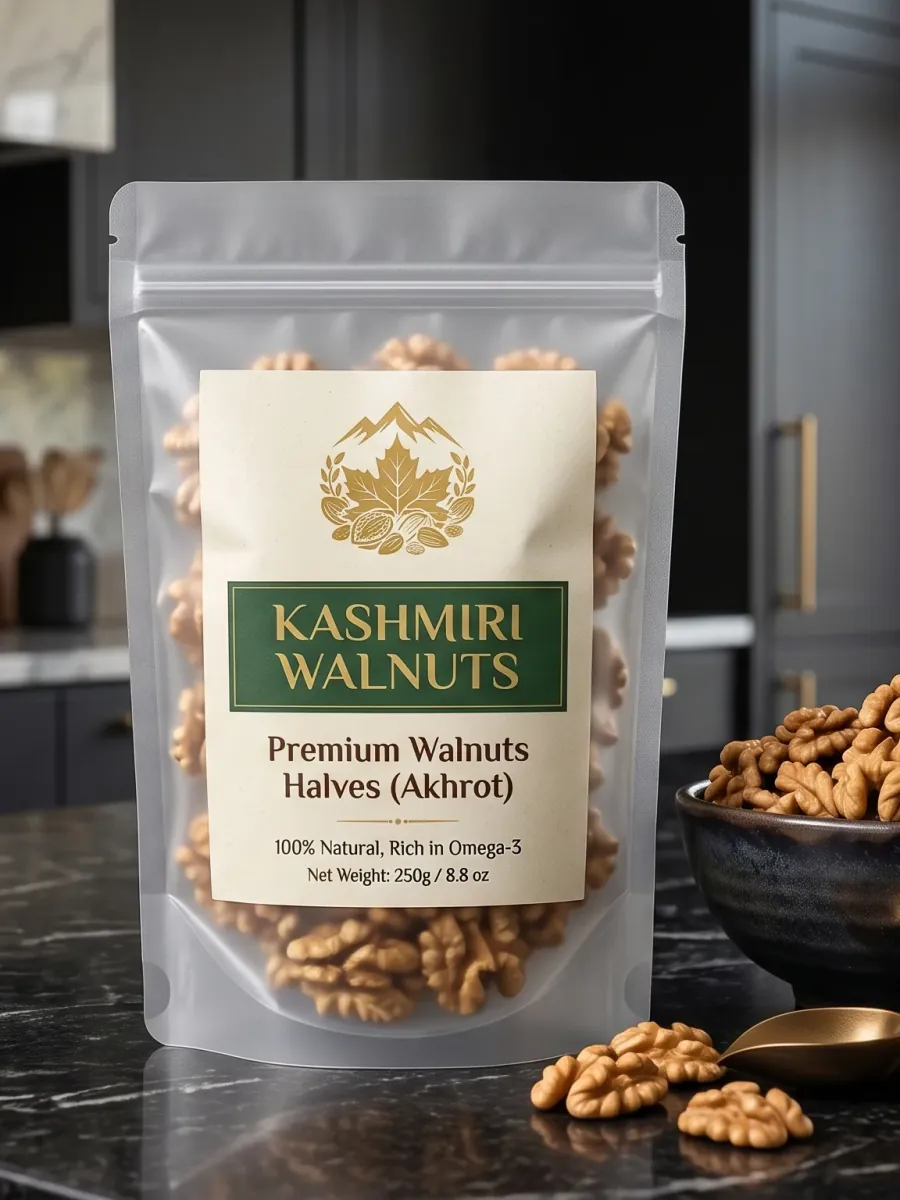
Kashmir grows most of India’s walnuts, and the label still tells you little
Where do Kashmiri walnuts grow? In the hill districts of the Kashmir valley. Almost every walnut grown in India comes from this one region. Yet the bag in your hand usually says only “Kashmiri akhrot” (walnut).
That is a thin claim. This guide names the districts, walks through the harvest, and shows where the numbers disagree. It also gives you five questions to test an origin claim. Valley Origin’s current range is on the products page. This guide is about walnuts in general.
Where do Kashmiri walnuts grow?
Kashmiri walnuts grow in the Kashmir valley’s hill districts: Anantnag, Kupwara, Pulwama, Shopian, Baramulla, Budgam, Srinagar and Ganderbal. Anantnag, Kupwara and Pulwama are named as the main hubs. Jammu and Kashmir accounts for over 90% of India’s walnut production.
A Kashmir Observer report from the 2025 harvest names Anantnag, Kupwara and Pulwama as the primary hubs. It adds Shopian, Baramulla, Budgam, Srinagar and Ganderbal as other key areas.
Rankings between districts differ from source to source. A J&K Policy Institute note puts Anantnag first, then Kupwara, then Kulgam. Older and newer reports shuffle the order. Read any “number one district” claim as a snapshot of one year.
So “Kashmiri” covers a whole valley of different orchards and soils. Kupwara, Shopian and Pulwama are real places on the map, but a bag that says only “Kashmir” does not tell you which one.
What are the walnut varieties of Kashmir?
Kashmir grows three commonly named types: Wonth, Kagzi and Burzul. Kagzi is the paper-shell type, named after kagaz, the Hindi word for paper. Burzul has a hard shell that needs a hammer. These are shell types, not brands.
The three names appear in the Kashmir Observer harvest report and in Business Kashmir’s account of the harvest. Both spell them slightly differently (Kaghazi, Kagazi, Barzul), because there is no single standard spelling in English.
A kagzi shell cracks in your hand. A burzul shell protects the kernel better but takes effort. Neither name tells you the district, the year or the freshness. For a closer look at how shell type affects what you pay, see our guide to Kashmiri vs California walnuts.
If a seller calls a hard-shell walnut “kagzi”, ask again.
When is the walnut harvest in Kashmir?
The Kashmir walnut harvest peaks in September. Nuts ripen on the tree, the green hull loosens, and pickers knock the nuts down with long sticks. The nuts are then hulled and dried in the open before storage and sale.
Reports describe the harvest as “in full swing” in September. The Kashmir Observer describes pickers, known as walnut thrashers, climbing trees and using long cedar or willow sticks to knock ripe walnuts down. It also reports that they work at heights of 30 to 45 metres, and that falls can cause serious injury.
That is the human cost behind a bag of walnuts.
After picking, the nuts go through three steps, as set out by Business Kashmir:
- Hulling. The outer covering is removed from each walnut.
- Drying. The nuts are dried on an open surface until they reach the right moisture.
- Storage. The dried nuts are stored for distribution and sale.
Drying matters more than it sounds. A walnut packed with too much moisture goes mouldy or turns rancid sooner. If you want to see what rancid walnut oil smells like, our guide on how to tell if pistachios are bad describes the same fat-oxidation signs.
So a September harvest means the freshest walnuts reach shops from October onwards. By late summer next year, the same nuts are almost a year old.
Does origin change the taste and quality of a walnut?
Partly. Variety, shell type and freshness change a walnut more than the district does. We found no study that proves Kashmiri walnuts taste better or carry more nutrients than other walnuts. Origin matters most as a promise of traceability.
All of these walnuts are the same species, Juglans regia. What differs is the tree, the soil, the weather in that year and how the nuts were dried and stored.
Seller pages often claim that Kashmiri walnuts have more omega-3 or a richer taste. We did not find a primary source that backs this. Without one, we do not repeat it.
What origin does give you is a place to ask questions. A seller who knows the district and the harvest year can tell you how old the nut is. A seller who cannot tell you either is guessing. That is a real quality signal, even if it is not a nutrition claim.
If you have a nut allergy or a medical condition, check with your doctor before changing what you eat.
How many walnuts does Kashmir produce, and why do the figures disagree?
Published figures run from about 1.8 lakh to 2.8 lakh tonnes a year, on areas from about 46,000 to over 89,000 hectares. They differ by year, by who counted and by what counts as walnut area. No single figure is final.
Here are four figures, each from a different source:
- A Rising Kashmir article gives 46,197 hectares and an average of 182,659 tonnes a year for Kashmir.
- The J&K Policy Institute cites a 2017 National Horticulture Board report: 206.43 thousand tonnes for J&K, over 61,723 hectares.
- Business Kashmir says about 2.66 lakh tonnes on 89,000 hectares.
- Greater Kashmir quotes official figures of 2.8 lakh tonnes for J&K in 2022.
The same Greater Kashmir report says around 36,000 tonnes of walnuts are imported into India each year, according to a 2022 GAIN report. So walnuts sold in India are not all from Kashmir, however the bag looks.
Growers are also seeking a Geographical Indication (GI) tag. According to that report, a GI tag would give legal protection against unauthorised use of the name “Kashmir walnut”. Until then, the word is a seller’s claim, not a protected one.
Here is the honest summary. The crop is large and concentrated in one region. The exact tonnage depends on which year and which report you read.
How does a walnut reach your kitchen from the Kashmir orchard?
A walnut can pass from the grower through traders, graders and packers before it reaches a seller. “Direct from growers” removes the traders. Each step adds time and handling, so the harvest year matters as much as the district.
We did not find a published official grading standard for Kashmir walnuts. So any “Grade AA” or “premium” on a bag is the seller’s own rating. Ask what it means.
Here is what each step can do to a walnut:
- At the orchard: harvest timing and drying decide the moisture of the kernel.
- At a trader: nuts from many orchards can be mixed into one lot, and the lot may lose its district.
- At the packer: shelling, sorting and packing decide the look. Heat in a warehouse speeds up oxidation.
- At your home: storage decides the last few months of freshness.
Valley Origin is a family business that began in Kashmir in 1975. It sources dry fruits direct from growers in Kashmir, with no middlemen. You can read more on the story page. The same questions apply to any seller of any dry fruit.
How can you tell an origin claim on a walnut bag is real?
Ask five things: which district, which harvest year, which variety, who graded it and what the grade means. A seller with a real source answers in one line. A vague reply, or “Kashmiri” alone, is a weak claim.
These questions work for almonds and saffron too. The same logic runs through our guide on how to identify real Mamra Badam.
- District. “Kupwara” or “Anantnag” is a specific answer. “Kashmir” is not.
- Harvest year. This year’s crop is on the market from October. Last year’s is not fresh.
- Variety. Kagzi, Wonth or Burzul should match the shell in your hand.
- Grading. Ask who graded it and by what rule.
- Traceability. Ask whether the lot can be traced to a grower.
Then use your own senses. Crack one nut. A pale, even kernel and a mild, sweet smell are good signs. A sharp, paint-like smell means rancid.
Frequently asked questions about where Kashmiri walnuts grow
Which districts grow Kashmir walnuts?
Anantnag, Kupwara and Pulwama are named as the main hubs. Shopian, Baramulla, Budgam, Srinagar and Ganderbal also grow walnuts. Rankings change between sources and years, so no single district holds the title for certain.
Kulgam also appears in some reports. Ask the seller which district your batch is from.
What is kagzi akhrot?
Kagzi akhrot is the paper-shell walnut of Kashmir. Kagzi comes from kagaz, Hindi for paper. The shell is thin enough to crack by hand. It is one of three commonly named Kashmir types, with Wonth and Burzul.
It is a shell type, not a guarantee of origin or freshness.
When is the walnut harvest in Kashmir?
The harvest peaks in September. Nuts are picked by knocking them from the tree, then hulled and dried in the open. Fresh-crop walnuts therefore reach shops from October, so buy then and ask the harvest year.
Older stock is common by the following summer.
Does origin change walnut quality?
It can, but freshness, variety and drying matter more. We found no primary study proving that Kashmiri walnuts are tastier or more nutritious. Origin is most useful as a way to ask who grew the nut and when.
If a seller makes a nutrition claim, ask for the source.
Is a bag labelled Kashmiri walnut always from Kashmir?
No. Kashmir walnut has no GI protection yet, and India imports around 36,000 tonnes of walnuts a year. The label is a claim. Ask for the district, harvest year and variety before you pay a premium.
A real source can usually answer all three in a sentence.
Origin is a question to ask, not a word to trust
Kashmiri walnuts grow in the hill districts of the valley, are harvested in September and make up most of India’s crop. That is a strong starting point. It is not proof about the bag you are holding.
Judge a walnut by what you can check: shell, kernel colour, smell and harvest year. Then ask the seller for the district and the variety. The same habit protects every purchase of dry fruit, almonds included. When you are ready to see what Valley Origin sells today, start with the Kashmiri Mamra Badam or browse the full range.