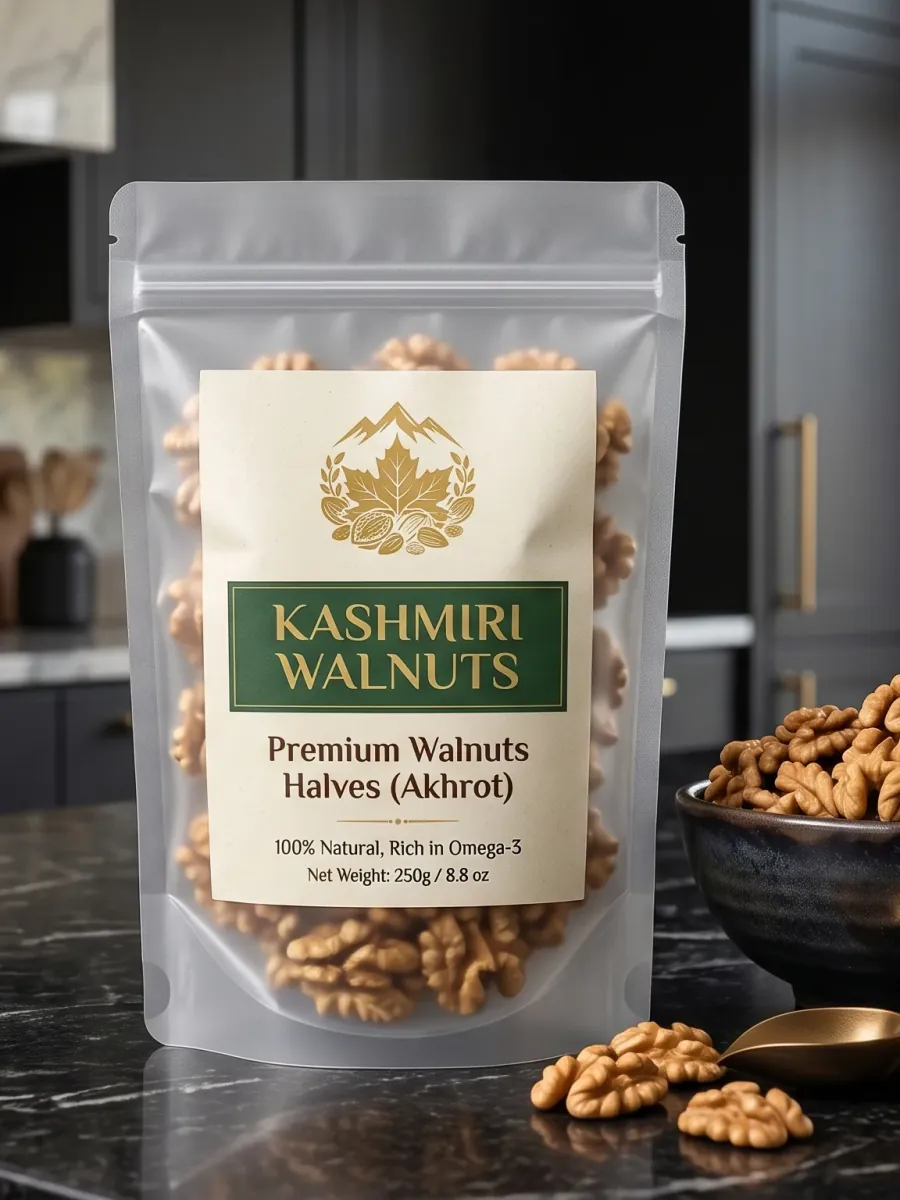
Two walnut prices can both be honest, and still be 2.5 times apart
Kashmiri walnut price per kg is a confusing search. One seller lists akhrot (walnuts) at Rs 450. Another asks Rs 1,200 for what looks like the same nut. Neither need be lying.
The first price is usually for walnuts in the shell. The second is for kernels, the nut meat you actually eat. Grade, colour and harvest year move the number further.
This guide gives sourced ranges for both, explains the gap, and shows how to judge a fair rate. We do not sell walnuts yet, and you can see what we do sell on our products page.
What is the price of Kashmiri walnuts per kg?
At the time of writing, supplier listings for Srinagar ask about Rs 400 to 520 per kg for Kashmiri walnuts in the shell, and about Rs 980 to 1,520 per kg for shelled kernels. These are asking prices, not mandi rates, and they change with each harvest.
We opened one trade directory page of Srinagar supplier listings, last updated 9 October 2026. It shows no sale prices, only what suppliers ask. Read the numbers as a yardstick:
| Type (asking price, October 2026) | Rs per kg |
|---|---|
| In shell, most listings | 400 to 520 |
| Kernels, most listings | 980 to 1,520 |
| Kernel listings with a grade or shape named | 980 (snow white) and 1,180 (halves) |
A few listings sat outside these bands. One in-shell listing asked Rs 245. One kernel listing asked Rs 400. Many listings did not say whether the nut was shelled, so we left those out.
Prices move more than you might expect. The Greater Kashmir report of September 2025 says walnuts at the Lagama market in Uri sold at about Rs 600 per kg for years, then Rs 1,200 that season. It does not say whether those were kernels or shells.
In 2023 the picture was the opposite. FreshPlaza reported that top-quality kernels fell from Rs 1,200 to Rs 700 per kg in a season. So read any one price as a snapshot. See our guide on where Kashmiri walnuts grow for why the crop varies each year.
Why do kernels cost more than in-shell walnuts?
A kernel is only part of the walnut. The shell, which you do not eat, makes up more than half the weight. USDA uses a factor of 2.34 to convert shelled walnuts to an in-shell basis, so about 43 kg of kernel comes from 100 kg of walnuts in shell.
The figure comes from the US Department of Agriculture’s Tree Nuts Annual report for India, dated 18 September 2025. Divide 1 by 2.34 and you get about 0.43.
Now do the sum with a hypothetical price. Say you see in-shell walnuts at Rs 450 per kg. To get 1 kg of kernel, a seller must buy about 2.34 kg of shell walnuts. That is roughly Rs 1,050 of raw nuts, before cracking, sorting, grading and packing.
So a kernel price near Rs 1,000 is not a markup. It is the shell arithmetic. A kernel price far below it is a question you should ask.
Shelling is also skilled work. Kernels break when cracked, and halves sell for more than pieces. Our guide to walnut kernel grades explains why.
Why are imported walnuts often cheaper?
Imports arrive in large volumes from Chile and the United States, and in some seasons they have undercut Kashmiri kernels. India still charges 100% basic customs duty on both in-shell and shelled walnuts, so imports are cheaper in some years, not all.
USDA’s report shows how large the import trade is. India produced about 34,000 tonnes of walnuts in shell in 2024-25 and imported about 65,000 tonnes. Jammu and Kashmir grows 98% of India’s walnuts.
Between September 2024 and June 2025, Chile supplied 46% of imports by quantity, the United States 27% and Afghanistan 15%. Most of the Chilean and US walnuts came in the shell. Afghan walnuts mostly came shelled.
The same report says traders face customs duty evasion, and that authorities have tightened document checks. Industry groups want a duty fixed per kilogram instead of a share of invoice value. That tells you two things. A 100% duty is a big cost to imports. And invoice values can be understated to dodge it.
That is why prices swing. The Greater Kashmir report links the 2025 rise to fewer imports, with local traders pointing to a 50% US tariff on Indian goods. In 2023 the Kashmir Walnut Growers Association blamed heavy kernel imports for the fall. Our comparison of Kashmiri and California walnuts covers taste, shell and kernel share.
How do grade and colour change the price?
Lighter kernels and whole halves cost more. In India, kernel colour is a key quality signal, so light halves sell above amber pieces. Colour is not taste, though, and a fresh amber kernel can beat a stale pale one.
USDA’s report says Indian buyers link lighter kernels with higher quality, freshness and taste. It also says that, in India’s shelled exports, 35 to 40% are light halves, 35 to 40% are amber halves or light broken, and the rest are amber halves. So grade mixes are normal in one lot.
Shape matters as much as colour. A pack of halves costs more than a pack of pieces because halves are harder to produce.
Here is the honest part. If you cook, bake or grind walnuts, pieces and amber kernels are usually the better buy. They taste the same fresh and cost less. Pay for light halves only when looks matter, such as a gift.
Freshness is the other price driver. Old walnuts turn bitter, whatever the colour. Our guide on how to store walnuts in India shows how to keep kernels fresh through summer.
What should a fair price look like, and when is cheap a warning?
Compare per kg of kernel, grade for grade. A fair Kashmiri kernel price should sit above the raw-nut cost of roughly 2.34 times the in-shell price. A kernel priced near or below the shell price per kg is a warning to ask about origin, age and grade.
Use three tests:
- The shell test. Multiply the in-shell price by 2.34. The kernel price should be higher than that number.
- The label test. “Kashmiri” on a pack tells you origin. It does not tell you grade. Ask for the colour and shape grade in words.
- The season test. Walnuts harvested in late August to September are fresh in October. A very cheap kernel in June could be last year’s crop.
Lower grades are not fakes. They can be honest products: darker, broken or older. The problem starts when a lower grade is sold under a higher grade’s name. Ask what is in the pack and the answers should be plain.
What should you ask a seller before paying?
Ask five things: where the walnuts grew, which grade the pack is, which harvest it comes from, whether anything is added, and what happens if you are unhappy. A seller with nothing to hide answers each one plainly.
- Origin: ask for the region, not only the word “Kashmiri”. Imported walnuts can be repacked and relabelled.
- Grade: ask for the colour class and the shape, such as light halves or amber pieces.
- Harvest: ask for the year. Kernels lose freshness faster than walnuts in the shell.
- Additives: kernels should carry no coating, bleaching or added colour.
- Returns: ask for the written policy before you order.
Then divide each quote by the weight of kernel. Compare per kg of kernel, never per pack.
Where Valley Origin stands on price and origin
Valley Origin does not sell walnuts at present, and we will not imply it. We sell Kashmiri Mamra Badam, and you can read the product page for current sizes and prices.
What we can share is how we answer the same questions for the dry fruit we do sell. We buy Mamra Badam and walnut halves direct from growers in Kashmir, with no middlemen. Our Mamra Badam is Grade A, hand-graded and hand-inspected. Nothing is added to it: no additives, no preservatives, no artificial coating. Our walnut halves are superior grade and inspected by hand. Our family business began in Kashmir in 1975, and the story page tells more.
Those are the answers worth asking from any seller of any premium food, walnuts included.
Frequently asked questions about Kashmiri walnut prices
What is the price of Kashmiri akhrot per kg today?
At the time of writing, trade listings in Srinagar ask about Rs 400 to 520 per kg in shell and Rs 980 to 1,520 per kg for kernels. Rates change with each harvest, so check a few current quotes before you buy.
The ranges come from asking prices, not mandi data. We found no official 2026 rate series for kernels.
Is 1 kg of in-shell walnuts the same as 1 kg of kernels?
No. About 43% of an in-shell walnut by weight is kernel, using USDA’s factor of 2.34. A kilo of walnuts in shell gives roughly 430 g of kernel, so shell and kernel prices cannot be compared directly.
The share varies with variety and shell thickness, so read 43% as an average, not a promise.
Are Kashmiri walnuts costlier than imported ones?
Sometimes. Kashmiri walnuts have cost more in some seasons and less in others. India charges 100% basic customs duty on imported walnuts, which narrows the gap, but supply and demand still move prices each year.
Check the grade and the harvest year first. Compare in-shell with in-shell, and kernel with kernel.
Why is my walnut kernel cheaper than the in-shell price suggests?
It may be a lower grade, an older harvest, or an imported walnut. A kernel priced below 2.34 times the in-shell rate does not cover the raw nuts alone, so ask about origin, age and grade.
A low price can still be honest. Broken amber pieces cost less. Ask for the grade and the harvest year in writing.
Are walnuts safe for everyone to eat?
Walnuts are a tree nut, and tree nut allergy can be serious. If anyone in your home has a nut allergy, is pregnant, or is managing a medical condition, check with a doctor before adding walnuts.
Otherwise they are an ordinary food. Buy fresh, store them cool, and use them in sensible portions.
Pay for kernel, grade and harvest, not the word Kashmiri
Walnut prices swing because crop size, imports and duty keep changing. A single number tells you little. Kernel weight, grade, harvest year and origin tell you far more than the price tag.
Do the shell sum, ask the five questions, and compare kernel with kernel. The same habit protects you when you buy any premium dry fruit. If you want almonds with a clear origin, see the Kashmiri Mamra Badam page for current sizes and prices.