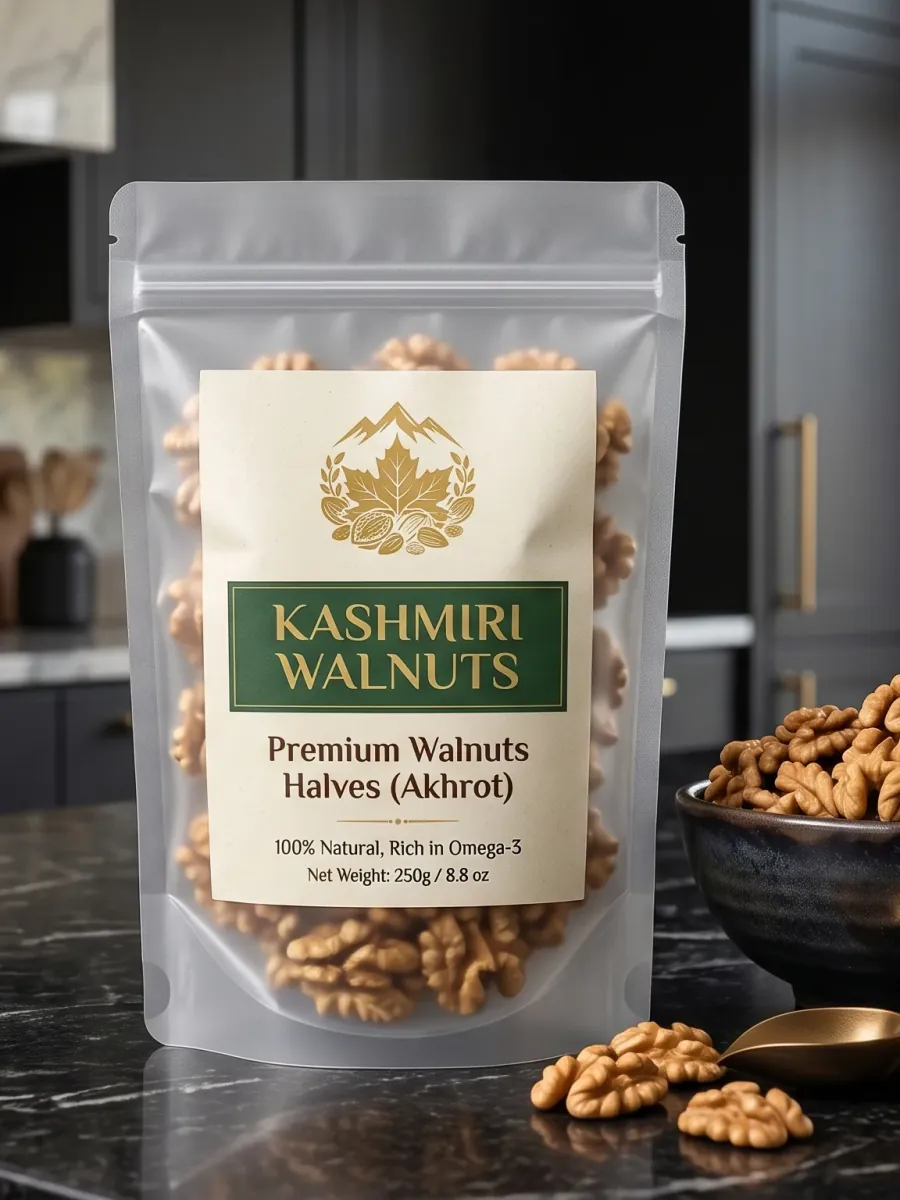
Why walnuts turn bitter in an Indian summer
If you want to store walnuts in India, the season matters more than the jar. A packet of akhrot (walnuts) that tastes sweet in January can taste bitter and flat by June, even though nobody opened it.
Walnuts are rich in oil, and that oil reacts with air and heat. Heat is the faster of the two. A steel dabba on a shelf near the gas stove is one of the worst places in the house.
This guide gives a plan for hot weather: where to keep walnuts, how long they last, and how to tell when they have turned. Valley Origin does not sell walnuts yet, so for our range see the products page. The storage habits below work for any walnut you buy.
How do you store walnuts in an Indian summer?
Move walnuts into an airtight glass jar or thick freezer bag, press out the air, and keep them in the fridge. Use a cupboard only if it stays cool, dark and dry. Buy only what you will finish in a few weeks if you have no fridge space.
Follow these steps in order.
- Check the nuts first. Smell a few. They should smell mild and sweet. Do not store nuts that already smell sharp.
- Decant on day one. Move walnuts out of the shop pack into a clean, dry glass jar or a thick freezer bag. UC Agriculture and Natural Resources advises odour-tight, moisture-free packaging, such as glass or plastic containers, because shelled nuts absorb moisture and smells.
- Split the stock. Keep a small jar for the week. Seal the rest in a second container or bag.
- Choose the cold spot. For the fridge, use a shelf, not the door. The door warms every time it opens.
- Seal well. Fridge smells travel into walnuts. A loose lid means walnuts that taste of last night’s sabzi.
- Let a cold jar warm up. Leave it closed on the counter for 20 to 30 minutes before you open it. This stops water condensing on the nuts.
- Use a dry spoon. A wet spoon carries moisture into the jar, and moisture invites mould.
If you must use a cupboard, pick the coolest, darkest, driest one, well away from the stove, the microwave and any sunny window.
Why does heat make walnuts go rancid?
Walnut oil is made mostly of unsaturated fats that react with oxygen, and heat speeds that reaction up. The result is rancidity: a sharp, bitter, paint-like smell and taste. It is unpleasant rather than unsafe, but there is no reason to eat it.
UC’s guide notes that room-temperature storage makes nut oils go rancid quicker, and that rancid nuts are not unsafe but have a sharp flavour most people find unpleasant. Oregon State University’s nut guide adds that the greatest storage losses come from rancidity, mould and Indian meal moth.
A published walnut study shows how fast temperature acts. Researchers stored two walnut varieties at 5 °C and 23 °C and tasted them monthly. Howard kernels kept at 23 °C were judged rancid and bitter as early as month one. Kernels kept at 5 °C were not, at that point. The study used 50% humidity and fluorescent light, so it is a guide, not a promise.
Many Indian kitchens run warmer than 23 °C from April to June. If anything, the risk is higher here.
How long do walnuts last in the fridge, freezer or cupboard?
Dried walnuts keep their eating quality for up to a year in the fridge and up to two years in the freezer, says Oregon State University. At room temperature, UC says nuts hold quality for a few months, and for less in a warm place.
Those figures come from extension services, not from Indian trials. Use them as a ceiling and shorten them for a hot kitchen.
| Where you keep them | How long, per the sources | Our advice for Indian weather |
|---|---|---|
| Cool, dark cupboard | A few months at most, less if warm (UC) | Cool months only. In summer, finish within weeks |
| Fridge, airtight | Up to about a year (Oregon State) | Best default from March to October |
| Freezer, airtight | Up to about two years (Oregon State) | For big lots bought in season |
Oregon State also says that if you cannot refrigerate, keep walnuts in as cool a room as possible, at 55°F (about 13 °C) or lower, and dry. Most Indian homes cannot manage that in summer, which is why the fridge is the practical answer.
Should you keep walnuts shelled or in-shell?
In-shell walnuts are the safer buy for slow eating, because the shell keeps air and moisture off the kernel. Shelled walnuts are easier to use but need colder, tighter storage. The extension guides give similar fridge and freezer times for both.
Oregon State says walnuts can be stored in the shell or as kernels. For in-shell nuts, it advises a closed container, since otherwise the Indian meal moth will make nuts wormy within one season. For shelled nuts, it advises freezer bags or jars.
So the shell helps, but it does not replace a container. Crack only what you need for the week. Once cracked, handle the kernels as shelled nuts and keep them in the fridge.
Our post on Kashmiri walnuts vs California walnuts explains how the two kinds look and taste.
Can you freeze walnuts?
Yes. Freezing is the best way to hold walnuts for long. Oregon State says frozen walnuts keep eating quality for up to two years at 0°F (-18 °C). Pack them in small, airtight portions so you thaw only what you need.
Divide the stock into bags of one or two weeks’ use. Press the air out, seal, and write the date on the bag. Do not stack them against strong-smelling foods.
For chopping into baking or cooking, you can usually use them straight from the freezer. For eating whole, let the sealed bag reach room temperature first. Opening a cold bag in a humid kitchen puts water on the nuts.
Avoid refreezing a bag you have thawed. Each cycle gives moisture a chance to creep in.
What mistakes make walnuts go bad faster?
The usual mistakes are leaving the pack open, keeping walnuts near the stove, buying too much at once, topping up an old jar with new nuts and storing them next to spices. Each lets in heat, air or smell, and each is easy to fix.
Keeping the shop pack as it is. Rolled-down packs let air and damp in. Fix: decant into a sealed jar on day one.
Storing near the stove or on a sunny shelf. Heat and light speed rancidity. Fix: use a lower cupboard or the fridge.
Buying a big lot for the whole year, then storing it warm. Fix: buy what you will finish in two to three months, or freeze most of it on arrival.
Topping up an old jar with fresh walnuts. Old nuts that have started to turn will spoil the new. Fix: finish or discard the old batch, then wash and dry the jar.
Putting a loosely lidded box in the fridge. Walnuts take up smells. Fix: use a tight lid, or a jar inside a bag.
How do you tell if walnuts have gone rancid?
Smell one walnut. Fresh walnuts smell mild and sweet. Rancid walnuts smell sharp, sour or like paint, and taste bitter. Mouldy, fuzzy or visibly spoiled nuts go in the bin whole. When in doubt, throw them out.
Use this order.
- Smell. A sharp, paint or nail-polish smell means the oil has oxidised.
- Look. Dark, shrivelled or oily-looking kernels are old. Fuzzy or powdery patches mean mould. Fine webs or small holes suggest moth.
- Taste. Chew a small piece. A bitter or biting finish confirms rancid.
A walnut with a naturally darker skin can still taste fine, so go by smell and taste, not colour alone. The walnut study above linked bitterness and rancid taste to the same oxidation changes, so a bitter nut is a spoiled nut, not just a strong-tasting one.
Small amounts of rancid walnut are unlikely to be a safety issue, per UC, but mould is different. Discard the whole lot, not just the nut that looks bad. If you have a nut allergy, are pregnant, or are feeding a child, check with your doctor about what is right for you.
Frequently asked questions about storing walnuts
Where should you keep walnuts in an Indian summer?
Keep them in an airtight jar or bag on a fridge shelf. A cupboard works only if it is cool, dark and dry, and that is rare in an Indian summer. Away from the stove, a lower cupboard is the second-best choice for small amounts.
The cold slows rancidity more than any jar can.
How long do shelled and in-shell walnuts last?
Oregon State says dried walnuts keep eating quality for up to a year in the fridge and two years in the freezer, whether shelled or in-shell. At room temperature, expect weeks to a few months, depending on heat.
Read all these numbers as upper limits. A warm kitchen, an old pack and a loose lid will cut them.
How do you tell if walnuts are rancid?
Smell and taste one. Rancid walnuts smell sharp, sour or like paint, and taste bitter. Fresh walnuts smell mild and sweet. If the smell is off, discard the batch. Mould is a separate problem and means the whole lot goes.
Do not rely on the best-before date. Trust your nose.
Can you freeze walnuts?
Yes. Frozen at 0°F (-18 °C) in airtight portions, dried walnuts keep their eating quality for up to two years, per Oregon State. Freeze in small bags, label them, and take out only what you will use soon.
Keep freezer bags sealed tight, because walnuts take on freezer smells.
Do you need to thaw frozen walnuts?
Not always. For chopping into baking or cooking, you can use them straight from frozen. For eating whole, leave the sealed bag at room temperature for 20 to 30 minutes first, so water does not condense on the nuts.
Do not thaw and refreeze the same bag.
Cold, sealed and dry keeps akhrot sweet
Walnuts rarely fail all at once. They fade, and your nose notices first. Learn the mild, sweet smell of a fresh pack, and you will catch the change early.
Keep the routine simple. Decant on day one, seal it airtight, put it in the fridge from spring to autumn, freeze the big lots, and use a dry spoon. Bin anything with mould.
Valley Origin is a family business from Kashmir, sourcing dry fruits direct from growers since 1975. Our own range starts with Kashmiri Mamra Badam, and the same storage habits apply there. See our guide on how to store Mamra Badam, and check current prices on the product page. To learn where Kashmiri akhrot grows, read where Kashmiri walnuts grow.