Two pista prices can both be fair, and still be far apart
You see pistachios at one price in a shop and at nearly double that online. Both say “premium pista”. The pistachio price per kg in India is hard to read because the two prices often describe different things.
One may be a closed-mouth nut and the other a wide-open one. One may be raw and the other roasted and salted. One may be in the shell and the other shelled kernel.
This guide explains what moves the rate, using sources we could open, and shows how to compare fairly. Our own range includes Salted Pistachios, but this guide is about any pista you buy.
Why do pistachio rates differ so much in India?
Rates differ because pista is not one product. Origin, nut size, open or closed shell, raw or roasted, and in-shell or kernel each change the price. India also imports nearly all its pistachios, so crop size, duty and the rupee reach your shelf.
Start with supply. The USDA’s New Delhi office says there is no commercial pistachio production in India, only limited unorganised growing in Jammu and Kashmir. Almost everything on sale is imported, mainly from the United States, Iran and the UAE.
Crop size matters most. A trade report of 5 June 2026 says the 2026/27 world pistachio crop is forecast at about 701,000 tonnes, down 36.4%. It puts the US crop down about 51.6% and Iran’s down about 42.2%. Both countries are in a low-yield year, and conflict around Iran is also disrupting export logistics.
The same report says European shelf prices rose roughly 40 to 50% since early 2026. That is a European figure, not an Indian one. We found no source that tracks Indian retail rates with the same care. But a short world crop is why a rate seen last year may not hold now.
What is the pistachio price per kg in India?
One seller guide dated April 2026 put raw in-shell US pista at Rs 1,350 to 1,500 per kg wholesale and Rs 1,800 to 2,200 retail. It put green kernels at Rs 2,800 to 3,500 wholesale. Take these as indicative, not official.
We could not find a government or market-board series for Indian pista rates. The best rupee figures we could open come from a dry-fruit wholesale price guide published in April 2026 by a seller. It says its prices are approximate and change daily.
| Type (April 2026 guide) | Wholesale, Rs per kg | Retail, Rs per kg |
|---|---|---|
| In-shell, raw, US | 1,350 to 1,500 | 1,800 to 2,200 |
| Roasted, Iran, premium | 1,200 to 1,400 | 1,600 to 2,000 |
| Shelled kernels, green | 2,800 to 3,500 | 4,000 to 5,000 |
One seller’s guide is a weak source, and we say so. Use it as a rough map of the ladder, not as a quote. Rates will have moved since April, and the crop outlook above points up, not down.
At the time of writing, we do not publish a Valley Origin pista rate in this guide. For ours, see the current prices on the product page.
Is in-shell pista cheaper than kernels per usable gram?
Usually not by as much as it looks. An in-shell nut is about half shell by weight, so you pay the in-shell rate for shell you throw away. Divide the in-shell price by the kernel share to see the true cost of the edible part.
How much is shell? The American Pistachio Growers’ trade brochure says the whole nut is around 47% shell. The USDA New Delhi report converts shelled to in-shell pistachios at a ratio of 2.0, which means a kernel share of about 50%. So take 50 to 53% as a working figure. Our guide to pistachio kernels vs in-shell pistachios uses a lower 45%, from US industry reporting. Nut size and fill change it.
Take a worked example. Say a seller lists in-shell pista at Rs 1,500 per kg. At a 50% kernel share, you pay about Rs 3,000 per kg of kernel. At 53%, it is about Rs 2,830. That is close to the kernel rates in the table above, which is why shelled pista is not as dear as it first looks.
The honest answer is “it depends”. In-shell wins if you want a slow snack and like cracking the nut. Kernels win for mithai, kheer or baking, where you would otherwise spend an evening shelling.
Does roasting and salting change the rate?
It can, in two ways. Roasting and salting add processing cost, and India charges a higher import duty on roasted pistachios than on raw ones. But origin and size can outweigh both, so a roasted nut is not always the dearer one.
The USDA New Delhi report says India levies a 10% basic customs duty on raw pistachios and 30% on roasted ones. It adds a Social Welfare Surcharge on that duty. That report is dated September 2024, so duty may have changed since. Check the current tariff before you rely on it.
Yet in the April 2026 seller guide, roasted Iranian pista was listed below raw US in-shell. So roasting alone does not set the price.
Salt is the other point. Our guide to roasted salted vs raw pistachios shows how much sodium comes with the salt. If you limit salt for any medical reason, ask your doctor which type and how much is right for you.
Which origin costs more, and why?
There is no fixed winner. Indian buyers have long preferred Iranian and Afghan nuts for taste and shape, while US pista is larger and more uniform. Which costs more changes with each crop, duty and exchange rate, so compare the quote, not the flag.
The USDA report says Indian consumers have traditionally preferred Iran- and Afghanistan-origin pistachios for taste, texture and colour. It says US nuts are larger, with a greener tint and a different texture. It names California’s grade 21-25 No. 1 as the preferred US type.
Those numbers are nuts per ounce, so a smaller number means a bigger nut. The June 2026 trade report quotes Iranian Ahmadaghaei at 24-26 about EUR 9.5 per kg, and at 28-30 about EUR 9.3, on an export basis. Bigger costs more, but only by a little here.
The same report lists closed-mouth Iranian nuts at about EUR 7.0 per kg, well below the open-mouth rates. If a shop sells you closed nuts at an open-mouth price, that is a poor deal. Closed shells have their own causes. For a fuller origin comparison, read our guide to Iranian vs American pistachios.
Export quotes are not shop prices. They leave out duty, roasting, packing, margin, GST and delivery.
What do cheap or mislabelled pistachios look like?
A rate far below the market is a warning. It can mean closed-mouth or half-empty nuts, old stock, nuts coloured to look fresher, or a smaller size sold as a larger one. Check the shell, the smell and the weight before you pay.
A low price is not a fake by itself. Smaller or closed nuts are honest products when labelled that way. The trouble starts when they are sold under a better name.
Look for these signs:
- Bright red or very white shells. Our guide to dyed pistachios shows why colour is a poor sign of quality.
- Many closed shells in a pack sold as open-mouth.
- Light, hollow nuts. Shake a few. A rattle can mean shrivelled kernels.
- A stale or paint-like smell when you open the pack. Our guide on how to tell if pistachios are bad covers smell, taste and storage.
Weigh a small handful before and after shelling if you doubt a pack. If the kernel share is far under half, the real price is higher than the label says.
How do you compare two pista sellers fairly?
Match origin, size, shell type, raw or roasted, and net weight, then divide each price by kilograms of edible kernel. Compare on one day, and add delivery and GST. A cheaper pack is only cheaper if all of that matches.
Use this short routine:
- Match the form. In-shell, kernel and pieces are different products.
- Match the treatment. Raw, roasted, and roasted and salted are not the same rate.
- Match size and shell. Ask for the count per ounce and whether the shell is open.
- Use net weight. A 200 g pouch at a good price per pack can cost more per kg than a 500 g pack.
- Convert to kernel. Divide an in-shell price by 0.5 for a rough edible-kernel cost.
- Count the extras. Add delivery and GST, and check the date, because Indian summers shorten shelf life.
Say you compare a 250 g in-shell pack and a 1 kg kernel pack. Convert both to a price per kg of kernel first. That single step catches most “cheap” offers that are not cheap.
What should you ask a pistachio seller?
Ask five things: the origin, the nut size, whether the shell is open, what is added, and the return policy. A seller with nothing to hide answers each one in plain words and puts the facts on the label.
- Origin: the country, not “imported”.
- Size: the count per ounce, or at least small, medium or large.
- Shell: open-mouth or closed, and whether the shell is dyed.
- Ingredients: raw, or roasted with salt and nothing else.
- Returns: the written policy, read before you order.
The same habit works for other nuts, as in our guide to cashew price per kg.
Where Valley Origin stands
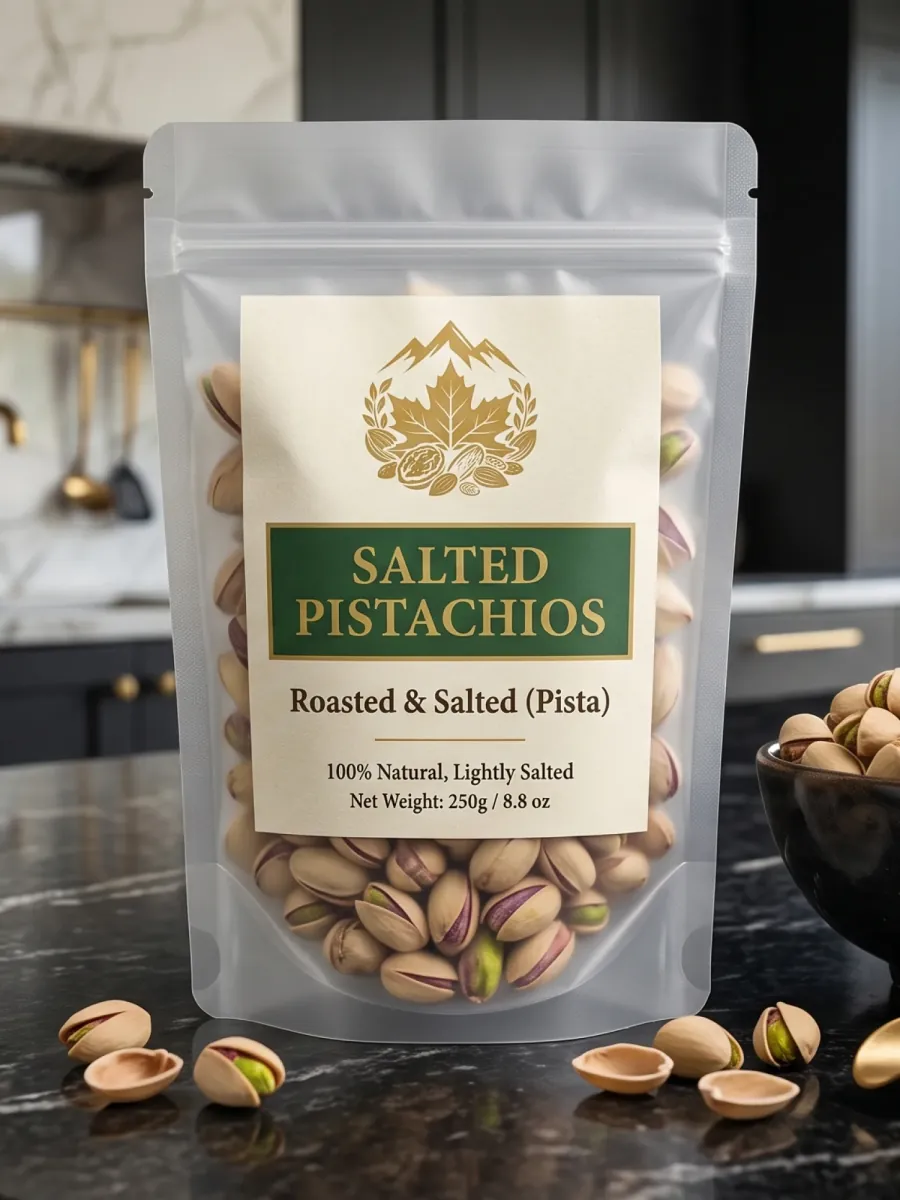
Valley Origin is a family business that began in Kashmir in 1975. Our Salted Pistachios (pista) are natural pistachios in the shell, roasted and lightly salted. The ingredients are pistachios and salt, nothing else.
We do not give a pistachio origin in this guide, and we do not publish a rate here because rates change. Ask us anything about a pack through our contact page. You can read our story to see how we work.
Frequently asked questions about pistachio price per kg in India
What is the pistachio price per kg in India today?
We found no official source for a current rate. One seller guide from April 2026 listed raw US in-shell pista at Rs 1,350 to 1,500 per kg wholesale and Rs 1,800 to 2,200 retail. Ask a dealer for the rate on the day you buy.
Rates have been under pressure from a short 2026/27 world crop, so an older figure may be low.
Why is pista so expensive now?
A short world crop is the main reason. A June 2026 trade report forecasts the 2026/27 crop down 36.4%, with the US and Iran both in low-yield years. Logistics disruption around Iran and firm demand add to it.
Prices can ease when a larger crop arrives, but the outlook for 2026/27 is tight.
Is Iranian pista costlier than American pista?
Not always. Indian buyers have long preferred Iranian nuts for taste and shape, but rates depend on the crop, size and duty. A roasted Iranian pack was listed below raw US in-shell in an April 2026 seller guide.
Compare the same size and treatment, on the same day.
Is salted pista cheaper than raw pista?
Not by default. Roasting adds cost, and the import duty on roasted pistachios was higher than on raw ones in a September 2024 USDA report. But origin and size can outweigh both, so a salted pack is not always the dearer one.
Compare net weight and the ingredient list, not the front of the pack.
Are pistachios safe for everyone?
Pistachio is a tree nut, and tree nut allergy can be serious. If anyone in your home has a nut allergy, is pregnant, or is managing a medical condition or a low-salt diet, check with your doctor before adding salted pista.
Otherwise they are an ordinary food. Store them airtight and cool.
Compare edible weight, not the headline rate
Pista rates move with crop size, origin, duty, grade, shell and treatment. One number on a pack tells you little. The kernel share, the size, the net weight and the packing date tell you far more.
Ask the five questions, convert to a price per kilo of kernel and compare on the same day. If you want pistachios with the ingredients stated in plain words, see the Salted Pistachios page for current sizes and prices, or browse our full range.