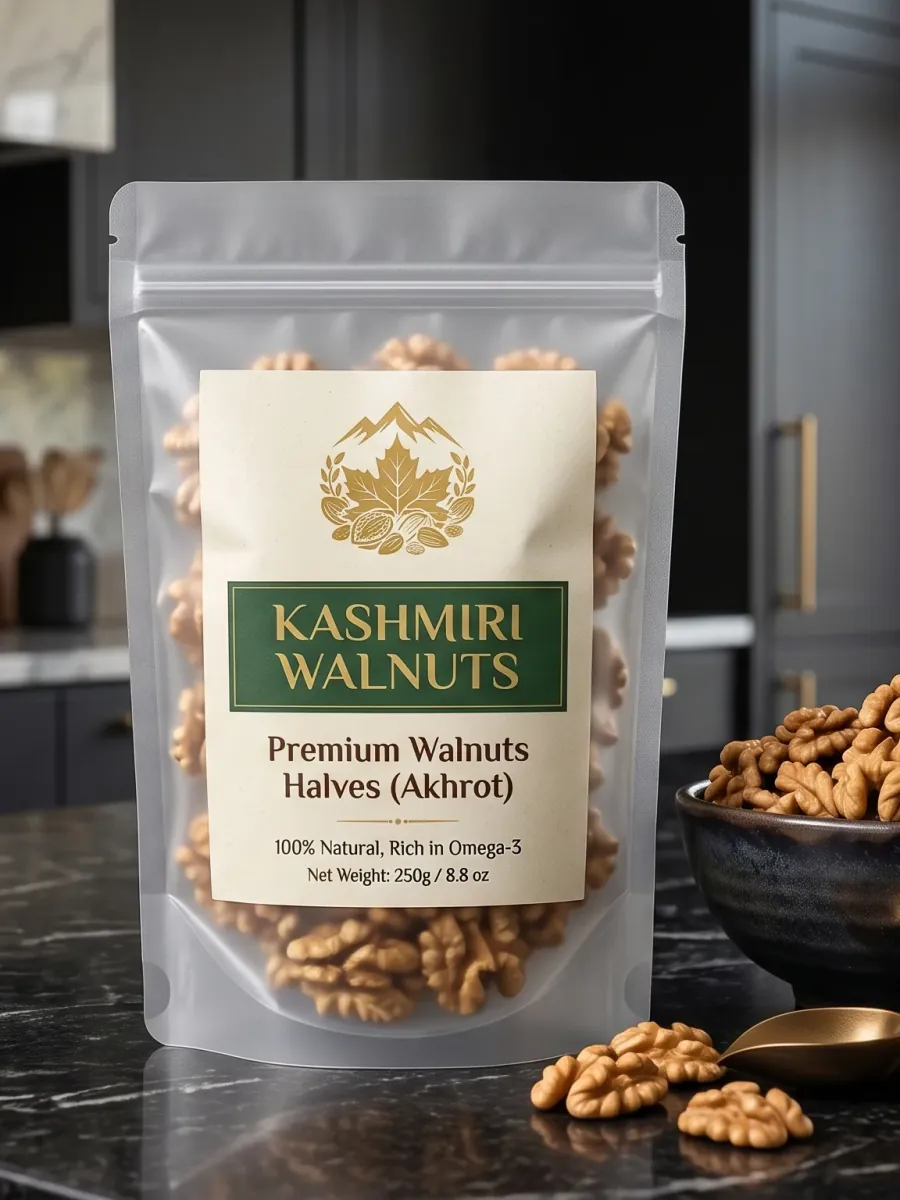
You are choosing between two bags, and the label says very little
Kashmiri walnuts vs California walnuts is a choice most Indian buyers face every winter. One bag says “Kashmiri akhrot” and costs more. The other says “California walnuts” and looks neater. Both are walnuts. So what are you paying for?
The honest answer is that the label tells you less than three things you can check yourself: the shell, the kernel and the smell. This guide explains each, and says plainly when the cheaper bag is the right one. Valley Origin’s current range is on the products page. This guide is about choosing walnuts well, wherever you buy them.
What are Kashmiri walnuts, and what are California walnuts?
Both are the English or Persian walnut, Juglans regia. Kashmiri walnuts are grown in the Kashmir valley, where J&K produces about 98% of India’s crop. California walnuts come from named commercial varieties such as Chandler and Howard. The species is shared. The varieties and handling differ.
Akhrot is simply the Hindi word for walnut. “Akhrot vs walnut” is not a real contrast: they are the same food. What differs is where and how it was grown.
According to a policy note from the J&K Policy Institute, J&K accounts for 98% of India’s walnuts, over roughly 61,700 hectares. Many Kashmiri trees are old seedling trees, so shells and kernels vary from tree to tree.
California orchards work the other way. Growers plant named varieties in rows, so the nuts are uniform. A published study of Chandler and Howard walnuts shows how closely California varieties are tracked and measured.
Neither is “fake”. They are two ways of growing the same nut.
What is kagzi akhrot?
Kagzi akhrot is a paper-shell walnut. “Kagzi” comes from kagaz, the Hindi word for paper. The shell is thin enough to crack between your fingers. It is a shell type, not a brand, and it is found among Kashmiri walnuts as well as other walnuts.
Shell thickness is a measurable trait. In an Iranian study of 362 walnut genotypes, shell thickness ran from 0.73 mm to 2.95 mm. The researchers sorted shells into four classes: paper (163 genotypes), soft (66), moderate (94) and hard (39).
So paper shells are common in the species. What matters is that your bag is the type you want. A paper shell cracks easily but protects the kernel less. A hard shell needs a nutcracker but keeps air and insects out for longer.
If a seller says “kagzi” and the shell needs a hammer, ask again.
How do Kashmiri and California walnuts compare on taste and texture?
Taste depends more on freshness than on origin. Fresh walnuts of either kind taste mildly sweet and buttery. Old ones taste bitter, papery and sharp. Many buyers say paper-shell Kashmiri kernels taste softer and sweeter, but your own bite test beats any claim on the bag.
The bitterness you notice in a bad walnut is usually oxidised oil. Walnut fat is mostly polyunsaturated, and polyunsaturated fat goes rancid faster than the fat in an almond. A stale Kashmiri walnut and a stale California walnut taste equally bad.
Here is a simple test. Crack one nut and look at the kernel. Light, even colour (pale gold to light tan) is a good sign. Dark brown or spotty kernels are old. Bite it: it should be creamy, not chalky. Skin that peels off with a dry, bitter note is another warning.
Shape differs too. Kashmiri kernels often come out in halves or pieces, depending on the shell. California kernels are more uniform in size and colour.
How do Kashmiri and California walnuts compare on nutrition?
No primary source shows that one origin is nutritionally better. USDA data for English walnuts gives about 654 kcal, 65.2 g fat, 15.2 g protein and 6.7 g fibre per 100 g. Claims that Kashmiri walnuts carry far more omega-3 are unproven here.
Several seller pages quote different oil and omega-3 figures for each origin. We have not found a primary source that backs them. So the table below uses only USDA FoodData Central values for English walnuts, which cover the species.
| Nutrient | Per 100 g | Per 30 g handful (calculated) |
|---|---|---|
| Energy | 654 kcal | about 196 kcal |
| Total fat | 65.2 g | about 19.6 g |
| Protein | 15.2 g | about 4.6 g |
| Fibre | 6.7 g | about 2.0 g |
| Magnesium | 158 mg | about 47 mg |
| Alpha-linolenic acid (ALA, a plant omega-3) | 9.08 g | about 2.7 g |
Variety, soil, harvest year and storage all change these numbers a little. In the Chandler and Howard study above, walnut fat ranged from 52 to 70 g per 100 g depending on sample and conditions. That spread is bigger than the gap sellers claim between countries.
Walnuts are energy-dense, so a handful is a serving, not a bowlful. If you have a nut allergy, take medication or are managing a medical condition, check with your doctor before changing what you eat.
How do they compare on price?
Kashmiri walnuts usually cost more per kilo than California walnuts, but the in-shell price misleads. Kernel share varies widely between walnuts, so compare the price per 100 g of kernel you actually get. Prices change by season, so check current rates before you buy.
We have not quoted a rupee range here, because we could not find a primary source for current walnut prices. Market rates move with each harvest.
The in-shell trap is real. In the Iranian genotype study, kernel share ranged from 25.75% to 62.53% of nut weight, with an average of 45.29%. A thin-shelled walnut gives you more kernel per kilo of shell. A thick-shelled one can leave half your money in the bin.
So do the sum. Divide the price by the kernel share to get the cost of the edible part. Then compare shelled bags with shelled bags.
Also ask the harvest season. A cheap bag from last year’s crop is not a bargain.
How do you check walnut freshness?
Check four things: the shell is clean and dry, the kernel is light and plump, the smell is mild and nutty, and the taste has no bitterness or paint-like edge. A sharp, oily or crayon-like smell means the fat has oxidised and the walnut is stale.
- Smell the open bag. Fresh walnuts smell faintly sweet. Rancid ones smell like old paint or crayons.
- Look at the kernel colour. Pale and even is good. Dark, shrivelled or spotted is old.
- Shake an in-shell nut. A loud rattle means the kernel has shrunk and dried out.
- Taste one. Any strong bitterness means stop.
Heat speeds up spoilage. In a University of California study, oxidation time roughly halved with each 10 °C rise in temperature. For Indian summers, that is a reason to keep walnuts cool and sealed. The same logic applies to almonds, so our guide to storing Mamra Badam is a useful model.
When is a cheaper walnut fine?
A cheaper walnut is fine when you are chopping it into halwa, cakes, chutneys or baking, where shape and colour do not show. It is not fine when it is old. Fresh, plainly graded California walnuts beat stale premium ones every time.
Here is how the choice plays out in four everyday situations.
- Daily snacking at home: choose fresh paper-shell walnuts you can crack by hand, Kashmiri or otherwise. The softer shell is the whole point.
- Baking and cooking: buy the cheaper, uniform kernels. Heat and sugar hide small differences.
- Gifting: appearance counts, so pick clean, evenly coloured kernels or good in-shell nuts.
- Stocking up for winter: buy in-shell, and shell only what you will eat. The shell protects the kernel.
Honestly, if the Kashmiri bag is old and the California bag is fresh, buy the California one. Freshness decides more than origin.
Where Valley Origin stands on origin
Valley Origin is a family business that began in Kashmir in 1975. It sources dry fruits direct from growers in Kashmir, with no middlemen. You can read the background on the story page.
Worth asking any seller: who grew it, which harvest, and what was done to it afterwards. Those three questions apply to walnuts as much as to almonds. For the same approach applied to the almond, see how to identify real Mamra Badam.
Frequently asked questions about Kashmiri and California walnuts
Is akhrot the same as walnut?
Yes. Akhrot is the Hindi word for walnut. The nut sold as akhrot in India is the English or Persian walnut, Juglans regia, the same species as the California walnut. Differences come from variety, shell and handling, not from the name.
When a label says “akhrot”, it is describing the same food as “walnut”. The word “Kashmiri” or “California” tells you the growing region.
Are Kashmiri walnuts healthier than California walnuts?
There is no primary source showing that. Both are Juglans regia, and USDA data for the species shows about 65 g fat and 15 g protein per 100 g. Freshness and portion size affect your diet more than origin does.
Walnuts are calorie-dense. Check with your doctor if you have allergies or a medical condition.
Should I buy walnuts in shell or shelled?
Buy in-shell if you will eat them slowly, since the shell protects the kernel from air. Buy shelled if you want convenience, but only in small quantities and from a seller who can tell you the harvest season.
In-shell walnuts need cracking, and the kernel share varies, so compare cost per 100 g of kernel.
Why do some walnuts taste bitter?
Bitterness is usually a sign of oxidised oil from age, heat or poor storage. Walnut fat is mostly polyunsaturated and spoils faster than many nuts. Some bitterness can also come from the thin skin, but a sharp, paint-like taste means rancid.
Throw rancid walnuts away. Roasting does not fix them.
How should I store walnuts in an Indian summer?
Keep them in an airtight container in the fridge. Heat speeds up oxidation, and one study found that oxidation time roughly halves for every 10 °C rise. Keep in-shell walnuts cool and dry, away from sunlight.
Use a clean, dry jar so no moisture gets in.
The label matters less than the nut
Kashmiri and California walnuts are the same species grown in different ways. Choose by shell, kernel colour, smell and harvest season, and pay for the kernel, not the shell. Buy Kashmiri paper-shell walnuts for snacking if they are fresh. Buy California kernels for cooking if they are cheaper and fresh.
Whichever you pick, ask the seller who grew it and when. That habit protects every purchase, from walnuts to almonds. When you are ready to see what Valley Origin sells today, start with the Kashmiri Mamra Badam or browse the full range.