A bitter akhrot is not always a spoiled one
You bite into a walnut and the taste is bitter. Now you wonder whether the whole packet has gone bad. The answer is: it depends on why walnuts taste bitter, and you can tell the two causes apart at home.
Akhrot (walnut) kernels wear a thin brown skin. That skin can taste bitter and dry even on a perfectly fresh nut. Rancid walnuts are a different case. Their oil has turned, and no amount of soaking will fix it.
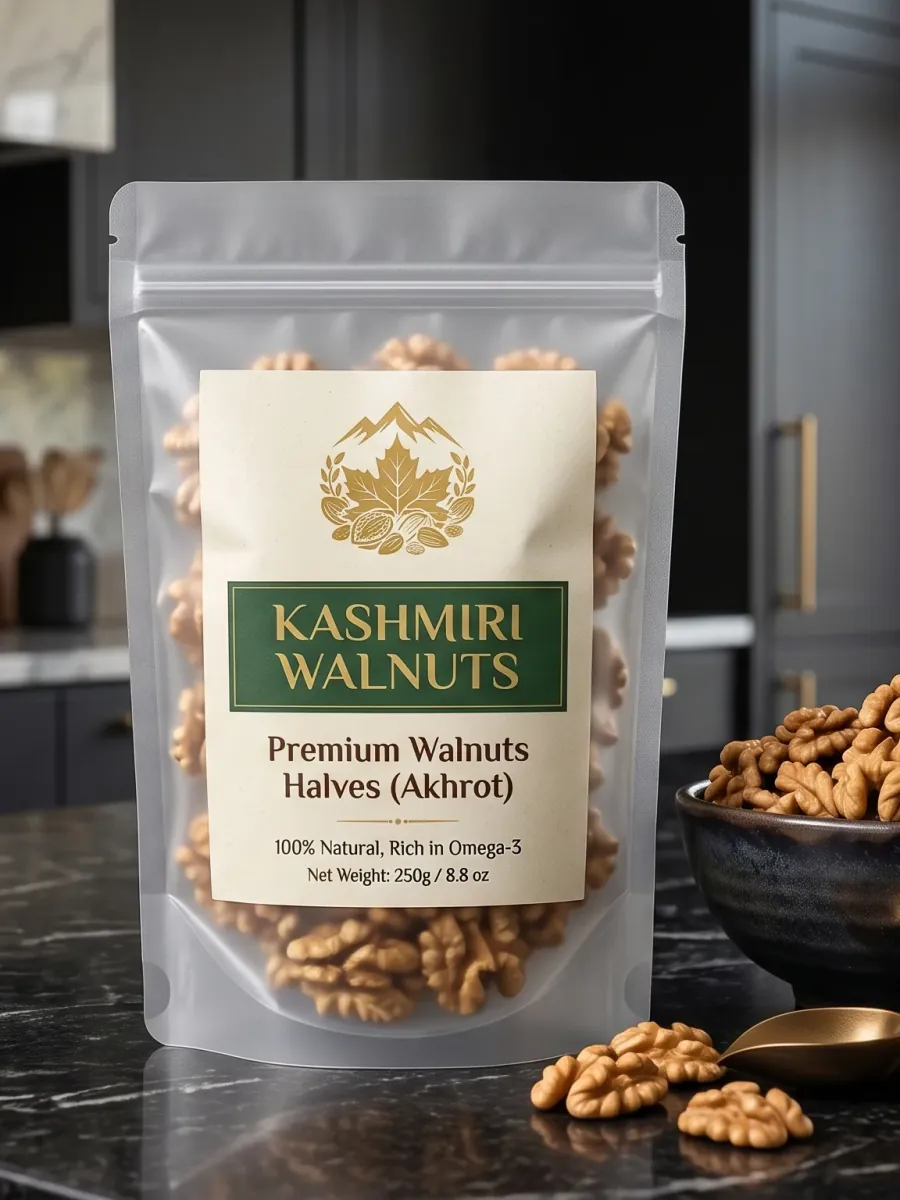
This guide gives a simple smell-and-taste test, what soaking and peeling really do, and when to throw the packet away. If you want a fresh pack to compare against, see our Kashmiri walnut halves.
How do you tell skin bitterness from rancid walnuts?
Smell first, then taste. Skin bitterness is mild and dry, like strong tea, and the nut still smells sweet and nutty. Rancid walnuts smell sharp, sour or like paint, and taste harsh. If the smell is off, stop and discard the packet.
Use this order. Stop at the first step that fails.
- Smell a small handful. Hold it close and breathe in. Fresh walnuts smell mild and faintly sweet. A sharp, sour, soapy or paint-like smell means rancid oil.
- Pick one half and look at it. Fuzzy or powdery patches mean mould. Fine webs or tiny holes point to insects. Either one means the packet goes.
- Taste a small piece, then wait a few seconds. Tannin bitterness feels dry. Your mouth puckers, like after black tea. Rancid bitterness is sharper and lingers with an off, oily taste.
- Rub off the skin of one half and taste it again. If the bitterness mostly goes, the skin was the cause. If the kernel underneath still tastes harsh, the oil is the cause.
- Compare with a fresh pack if you have one. Your nose learns quickly once it has a good reference.
Step 4 matters because the two causes overlap. A published walnut study found high positive correlations between bitterness, astringency and rancidity as walnuts aged. So bitterness alone cannot tell you. Smell is the more reliable test.
Why do walnuts taste bitter in the first place?
There are two causes. The skin (pellicle) holds tannins, which bind to proteins in your saliva and taste bitter and dry. Separately, walnut oil reacts with air over time and turns rancid, which also tastes bitter. One is natural, the other is spoilage.
The first cause is the skin. A 2024 review in Food & Medicine Homology says the walnut pellicle is rich in tannin compounds that react with salivary proteins to give a bitter and astringent taste. A 2021 paper in Molecules adds that the pellicle is only 5 to 8% of the kernel but the main source of its polyphenols. It says these can cause slight astringency and bitterness.
So a small, thin skin carries most of the bitter punch. The skin is not a defect. It is part of the walnut.
The second cause is the oil. Walnuts are rich in unsaturated oil, which reacts with oxygen. In the walnut study above, researchers stored kernels at 5 °C and 23 °C. Kernels held at 23 °C showed rancid taste, rancid aroma, astringency and bitterness as early as month one. Many Indian kitchens are warmer than 23 °C for months.
How long do walnuts stay fresh before they turn?
Extension guidance says shelled or in-shell walnuts keep eating quality for about a year in the fridge and two years or more in the freezer. At room temperature, nuts hold quality for a few months, and for less time in a warm place.
Those numbers come from US extension services, not Indian trials. Read them as a ceiling. A hot Indian summer will shorten them.
| Where you keep them | How long, per the sources | What we would do in India |
|---|---|---|
| Room temperature | A few months, less if warm (UC) | Cool months only, small packs |
| Fridge (4 °C or colder) | About 1 year (UC) | Best default for the rest of the year |
| Freezer (-18 °C) | 2 years or more (UC) | Large lots, in small bags |
The walnut study found sensory quality held up to three months at 5 °C under its test conditions. Its authors also linked rancid perception at 5 °C to high moisture in the kernel, so a damp pack is a risk even in the fridge.
Our full routine is in how to store walnuts in India.
What mistakes make walnuts bitter, and how do you fix them?
Most bitter walnuts come from six mistakes: a dark-skinned grade you dislike, an open pack, heat, trying to rescue rancid nuts, over-trusting soaking, and peeling by habit. Each has a simple fix. Rancid nuts, though, cannot be fixed.
Buying a grade whose skin you find too bitter. Some skin bitterness is normal. If it bothers you, choose by grade and check the smell. Our guide to walnut kernel grades explains the colour classes.
Leaving the packet rolled down. Air and damp get in, and the oil oxidises faster. Fix: move the nuts into an airtight jar on day one and keep a small jar for the week.
Storing walnuts near the gas or on a sunny shelf. Heat speeds rancidity. Fix: a lower cupboard for small amounts, the fridge for the rest.
Soaking or toasting walnuts that are already rancid. Neither removes rancid oil. We found no study showing that soaking or roasting undoes it. Fix: smell first, and bin the nuts if they fail.
Expecting soaking to fix skin bitterness. Soaking walnuts in water for a few hours is a common home trick. We could not find a study testing it on walnuts, so the effect is unproven. Soaking also adds moisture, which spoils nuts faster. Fix: if you soak, eat them the same day and do not store them wet.
Peeling by habit. Removing the skin lowers bitterness. It also removes the part that, per the Molecules paper, is the main source of the kernel’s polyphenols. For most cooking, leaving the skin on is fine. Peel only for a pale, mild result, such as a white sauce or a delicate dessert.
How do you know walnuts have gone bad?
Walnuts have gone bad if they smell sharp, sour or like paint, taste harsh or soapy, look dark and shrivelled, or show mould or insect webs. Smell is the best first test. When in doubt, throw them out.
Rancid walnuts are unpleasant rather than the main safety risk. UC’s nut guide says that rancid nuts are not unsafe but have a sharp flavour. Mould is different. Do not pick out the clean-looking nuts. Discard the whole lot.
Here is a quick guide.
- Fine to eat: mild, nutty smell, slightly dry or puckery skin, creamy kernel.
- Past their best: sharp, paint-like smell, harsh or soapy taste, dark and oily-looking kernels.
- Bin immediately: fuzzy or powdery patches, webs, tiny holes, or a musty smell.
If you have a nut allergy, are pregnant, or are feeding a child, check with your doctor before eating nuts you are unsure about. A bad nut is not worth the guess.
Frequently asked questions about bitter walnuts
Is it normal for walnuts to taste a little bitter?
Yes. The thin brown skin holds tannins, which taste mildly bitter and dry. A fresh walnut can have this edge and still be perfectly good. If the smell is sweet and nutty, a little bitterness is normal and the nut is fine to eat.
Bitterness that is sharp, soapy or paired with a paint-like smell is a different matter.
Are bitter walnuts safe to eat?
Skin bitterness is harmless. Rancid walnuts are not unsafe in the way mould is, according to UC, but they taste unpleasant and are past their best. Mould, webs or a musty smell mean you should discard the whole packet.
If you have allergies or a medical condition, check with your doctor.
Does soaking walnuts remove the bitterness?
It may soften the skin’s bite a little, but we found no study that tests this on walnuts, so read it as unproven. Soaking cannot fix rancid oil. It also adds moisture, so eat soaked walnuts the same day.
Smell the walnuts before you soak them. Do not soak a packet that already smells off.
Should you peel the skin off walnuts?
Only if you want a milder, paler result. Peeling removes most of the tannins that cause the bitterness. It also removes the part of the kernel that holds most of its polyphenols, so for everyday eating you can leave the skin on.
A popular way is to soak briefly in hot water and rub the skin off with a cloth. It is slow, so do only what you need.
When should you throw walnuts away?
Throw them away if they smell sharp, sour or like paint, taste harsh, or show mould, webs or holes. A packet with mould goes in the bin whole. If the smell is off and you are unsure, do not eat them.
A fresh pack costs less than a ruined recipe.
Smell first, then decide
Bitter does not always mean bad. A mild, dry bitterness with a sweet, nutty smell is the skin doing what skin does. A sharp, paint-like smell means the oil has turned, and you should let the packet go.
To keep the next pack sweet, seal it in an airtight jar, keep it cold, and buy only what you will finish. Valley Origin sells Kashmiri Walnut Halves (akhrot): superior grade, inspected by hand, with no preservatives or coating. They come from Srinagar, Kashmir, and our family has sourced from Kashmir growers since 1975. Read our story, see where Kashmiri walnuts grow, and check current prices on the walnut product page.