Two badam prices can both be real, and still be far apart
You search for the almond price per kg in India and get a mess. One shop says Rs 900. One site says Rs 1,500. Another says Rs 3,000 for what looks like the same almond.
Most of that gap is not a trick. It comes from the variety, the size, whether you get the shell or the kernel, and how fresh the pack is. Some of it is a warning sign, and we show you which.
This guide gives the numbers we could open, then a method to compare packs fairly. We sell one almond, Kashmiri Mamra Badam, and we will not put our own price in this post.
Why does almond price range so widely?
Almond rates range widely because “almond” covers different things: California kernels, Kashmiri Mamra, Gurbandi, shelled or unshelled, loose or packed. Variety, size, form, freshness and pack size each move the price, and a seller’s margin sits on top.
Start with variety. Most almonds sold in India are California almonds, which are smooth and mild. Mamra is a small, wrinkled, oil-rich almond. Gurbandi is small and round. Our guide to the types of almonds in India shows how to tell them apart.
Then comes form. In-shell almonds, kernels, halves and broken pieces are priced differently. A kilo of shelled kernels holds far more almond than a kilo of almonds in the shell.
Freshness and storage matter too. Almond oil turns rancid with heat and time, so old stock is worth less. Pack size changes the rate per kg, since a 250 g pack costs more per kg to fill and ship than a 1 kg pack.
Last, a sizeable part of India’s supply is imported. A September 2026 report says Indian almond imports are forecast to rise 8% this market year to 187,000 metric tons on a shelled basis, and about 89% of that comes from California. So world supply reaches your shelf price.
What do California, Gurbandi and Mamra cost per kg?
California kernels were quoted below Rs 1,000 per kg in New Delhi in mid-October 2026. We found no source we could verify for Gurbandi, and Mamra listings ranged from Rs 450 to Rs 4,000 per kg. Be careful with any single Mamra figure.
Here is what we could open, with its limits stated.
California. A trade report of 15 October 2026 says New Delhi kernel spot prices had weakened to below Rs 1,000 per kg. It adds that Maharashtra mandi data showed roughly Rs 975 to Rs 1,150 per kg. These are wholesale prices at the time of writing, not what a retail pack costs.
Earlier in the year the picture was different. A 21 August 2026 report put California kernels at about Rs 1,050 to Rs 1,060 per kg, up from about Rs 930 to Rs 940 in early August. Rates move in weeks, not years.
Gurbandi. We did not find a Gurbandi rate from a source we could open and trust, so we do not quote one. Ask a seller for the variety in words and the rate for that exact variety.
Mamra. On 22 October 2026 we looked at a public trade directory of seller listings for Mamra badam. Asking prices ran from Rs 450 to Rs 4,000 per kg, and most sat between Rs 1,000 and Rs 2,500. Many listings did not state a grade.
Those are asking prices from sellers, not sales. A spread that wide tells you the label “Mamra” covers very different products, including broken kernels, mixed lots and almonds from other origins. Our guide to Mamra Badam versus California almonds explains why the two are priced differently.
Why is Kashmiri almond supply tight?
Kashmir produces a small almond crop, and weather has cut it further. The August 2026 trade report says supplies of bold almonds from Jammu and Kashmir were nearly 50% lower than in previous years, which tightened the Indian market.
The same report says orchards there were hit by unfavourable weather, and that domestic output was unlikely to recover before the next marketing year. That is a trade report, not a government count.
The September report adds that India’s almond crop is expected to fall 2% to 3,900 tons, citing poor weather, ageing orchards and lower yields. It also says many farmers are switching from almonds to apples.
Small crops raise prices for honest sellers. They also raise the pull to sell something else under the Kashmiri name. That is one reason a very low “Kashmiri” rate deserves a second look.
How do you compare almond packs fairly?
Compare the same variety, the same form, the same weight and the same day, and divide each price by net kilograms. A pack is only cheaper if the variety, grade and freshness match as well.
Use these steps before you decide a rate is high or low:
- Name the variety. California, Mamra and Gurbandi are different almonds. “Premium badam” is not a variety.
- Match the form. In-shell, whole kernels and broken pieces are different products at different rates.
- Use net weight. Read the weight on the pack, not the box size.
- Divide to a cost per kg. Price divided by weight in kilograms gives the true rate.
- Add delivery. Some sellers charge for delivery, and some waive it above a limit.
- Compare on one day. Rates moved by Rs 100 or more within weeks in 2026, so a screenshot from last month is a poor yardstick.
Say you compare a 250 g pack at Rs 300 and a 1 kg pack at Rs 1,100 (a made-up example). The first works out to Rs 1,200 per kg. The second is Rs 1,100 per kg. The small pack looked cheaper and was not.
Cost per gram helps for daily eating. If you eat a fixed handful a day, you pay for the weight you actually eat. Weigh your handful once, then work out what it costs you per day.
When is a cheap almond a warning sign?
A rate far below the market for the variety named is a warning. It can mean a different variety, broken kernels sold as whole, old stock with rancid oil, or almonds that are bitter. Check variety, smell and taste before you buy more.
Lower grades are not fakes. They can be honest products sold under their real name. The trouble begins when they carry a better name.
Look for these signs:
- A “Kashmiri Mamra” rate close to a plain kernel rate. Real Mamra comes from a small crop. Our guide to identifying real Mamra Badam lists six checks.
- Mixed shapes and sizes in one pack sold as a single grade.
- A stale, paint-like smell, which suggests rancid oil.
- A bitter bite. Some almonds are naturally bitter, and some are stale. Our post on why almonds taste bitter shows how to tell.
- No variety on the label. “Badam” alone hides the one fact that sets the price.
Cheap is not the same as bad value, and dear is not the same as good. A fresh California almond at a fair rate beats a stale “Mamra” at a high one. Honestly, if you cook with almond paste or grind it into sweets, a California kernel is the better buy.
What should you ask an almond seller?
Ask five things: which variety, which form, the packing date, what is added, and what happens if you are unhappy. A seller with nothing to hide gives each answer in plain words and prints the variety on the label.
- Variety: California, Mamra, Gurbandi or another, in words.
- Origin: where it was grown, not only where it was packed.
- Form and grade: whole kernels, halves or pieces, and the size grade.
- Date: when it was packed, not only a best-before date.
- Additives and returns: whether anything is added, and the written policy before you order.
Then divide each quote by net kilograms. We use the same habit for Kashmiri walnut prices.
Where Valley Origin stands
Valley Origin is a family business that began in Kashmir in 1975. We source direct from growers in Kashmir, with no middlemen.
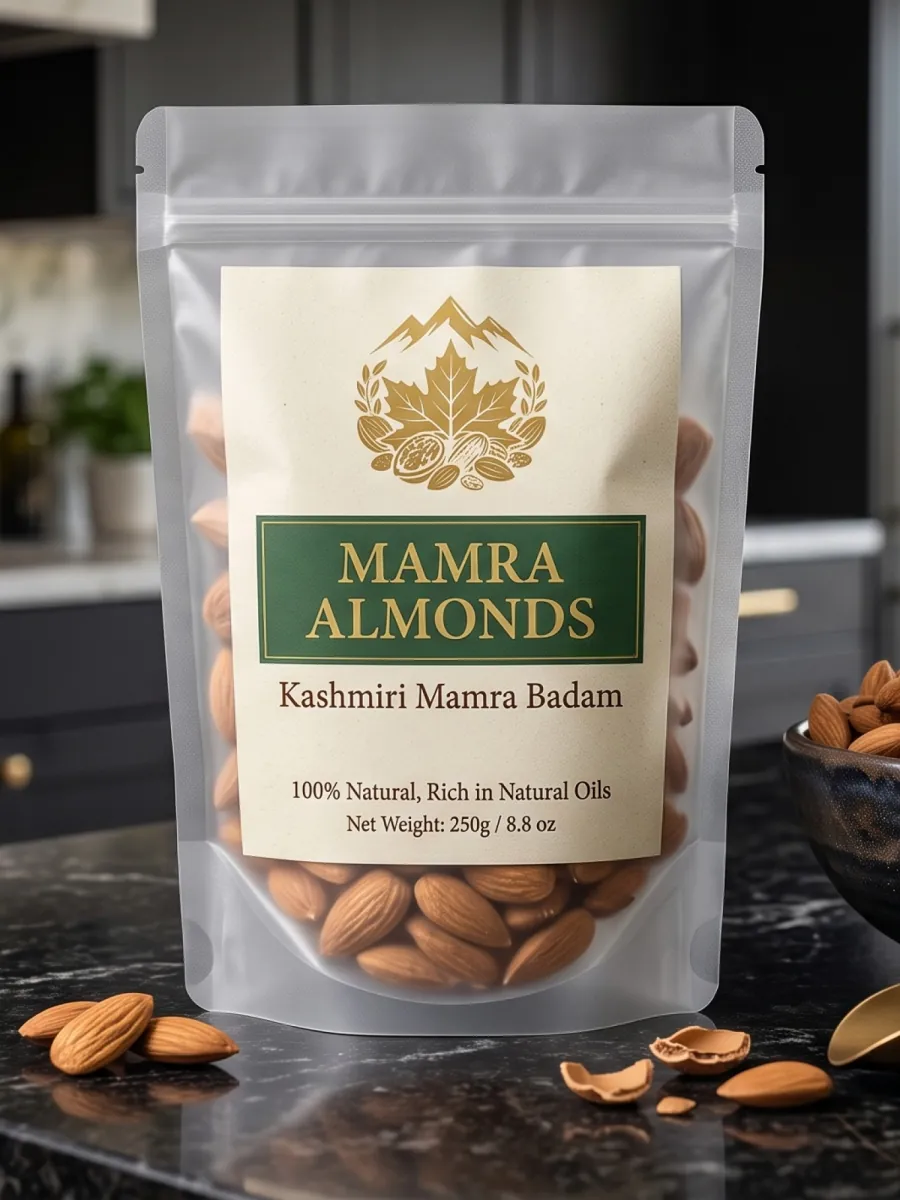
Our Mamra Badam is Grade A, hand-graded and hand-inspected, grown in Kashmir at altitudes above 1,800 metres. It has no additives, no preservatives and no artificial coating. It comes in 250 g, 500 g, 1 kg and 2 kg packs, and we ship across India, with free shipping on orders above Rs 999. Our shipping policy covers delivery.
We do not state our price here, because rates change. See current prices on the product page, and read our story for how we source.
Frequently asked questions about almond price per kg in India
What is the almond price per kg in India today?
In mid-October 2026, trade reports put New Delhi California kernels below Rs 1,000 per kg, and Maharashtra mandi data at about Rs 975 to Rs 1,150. Retail packs cost more, and Mamra costs more again.
These are wholesale figures at the time of writing. Check a current quote on the day you buy.
Why is Mamra badam more expensive than California almonds?
Mamra comes from a much smaller crop than California almonds, which are grown at very large scale. Smaller supply and closer grading raise the price per kg. The 2026 Kashmir crop was also hit by weather.
Our Mamra versus Gurbandi guide covers how those two almonds differ.
Are cheaper almonds lower in quality?
Not always. A lower rate can mean a larger crop, a different variety or broken pieces sold honestly. It is a problem only when the label hides it. Judge by variety, smell, taste and packing date.
Freshness matters more than the price tag. Store almonds airtight and cool.
Why did badam rates change so quickly in 2026?
Supply and demand moved. The August 2026 report links a rise to poor crops in key origins and tighter stocks, and the October report describes a slide as Indian demand weakened and imported stocks arrived.
Rates in October were lower than in late August, so waiting a few weeks can change the price.
Are almonds safe for everyone?
Almond is a tree nut, and tree nut allergy can be serious. If anyone in your home has a nut allergy, is pregnant, or manages a medical condition, check with your doctor before adding almonds.
Otherwise almonds are an ordinary food. Buy fresh and keep them in a cool, dry place.
Compare variety, form and weight, not the headline rate
Almond rates move with crops, imports and demand. A single number tells you little. The variety, the form, the packing date and the net weight tell you far more.
Ask the five questions, divide by kilograms and compare on the same day. If you want almonds with a clear Kashmiri origin, see the Mamra Badam page for current sizes and prices, or browse the full range of products.