The best Diwali gift for relatives is the one that tastes fresh
You are buying a Diwali dry fruit gift for family: aunts, uncles, in-laws, cousins and a few neighbours. The budget is fixed, the list is long and the festival date will not move. Dry fruits are the safe choice because almost every household eats them.
They are also easy to get wrong. A box that looks grand but holds stale or mixed-grade nuts says you bought the box, not the gift.
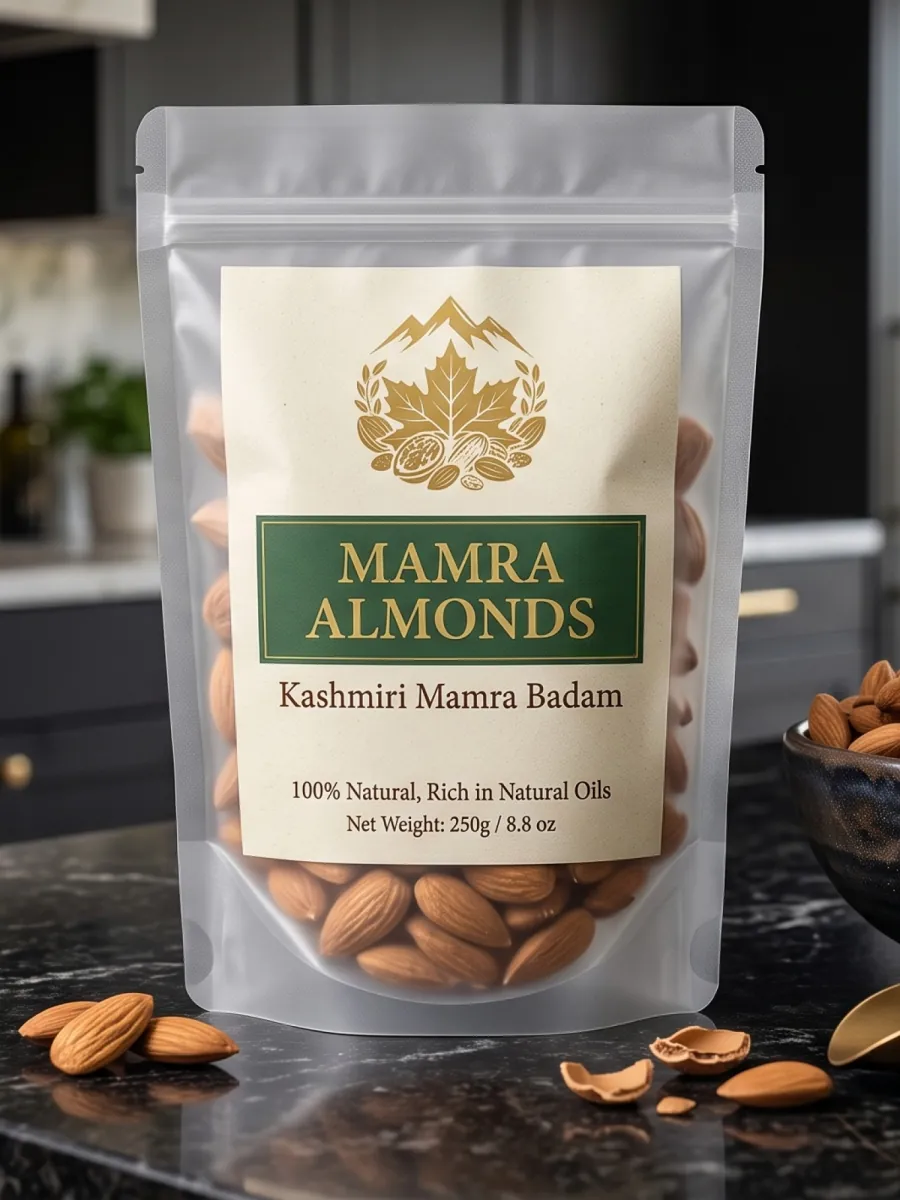
This guide is for families, not companies. It covers what to pick, how much to give, how to check freshness and what to leave out. If almonds are on your list, start with Kashmiri Mamra Badam and see what a premium almond looks like.
Which dry fruits make a good Diwali gift?
Choose firm, familiar nuts: badam (almond), kaju (cashew), pista (pistachio) and akhrot (walnut). Add kishmish (raisin) or anjeer (fig) only if they are well packed. Four good items beat ten average ones, and every relative can use them.
Dry fruits have long sat beside mithai in Diwali gifting. Their advantage is time. A sweet box must be eaten in days. Nuts keep, so the family can share them across the festival week and beyond.
Match the gift to the relationship. The table below is a planning guide, not a price list.
| Who you are gifting | A sensible choice | What to watch |
|---|---|---|
| Parents, in-laws | One premium nut, such as almonds, in a larger pack | Grade and packing date |
| Close relatives | Two or three firm nuts in one box | Equal weight of each nut |
| Extended family | A smaller single-nut pack for each household | Same quality as the bigger gifts |
| Neighbours, house help | Cashews or raisins in a sealed pack | Sealed, with a clear label |
For almonds, the variety matters. Our guide to Mamra Badam versus Gurbandi explains which one suits a gift and which suits daily eating. For cashews, see how to identify good quality cashew nuts.
If you plan to add saffron for elders, read how to identify real Kashmiri saffron first. Saffron is easy to fake, so learn the checks before you buy.
How much should you give each family?
For one household, 250 g of a single nut is a modest gift and 500 g is generous. In a mixed box, aim for 100 g to 150 g of each nut. This is a planning rule of thumb, not a fixed standard.
Quantity depends on how often you meet, and on the size of the household. Say you are visiting a relative with two children and two grandparents. A 250 g pack of almonds will last them a couple of weeks. Gifts for the main elders can be 500 g.
Keep the weight of dry fruit in mind, not the weight of the box. A box can weigh 500 g with its packing and hold far less nut. Ask for the net weight of the nuts alone.
Fairness matters inside a family. Giving one brother’s household 500 g and another’s 250 g is noticed. Pick a base gift for everyone and add a little for the elders. Count the households first, then divide the budget, rather than buying first and rationing later.
If you are posting gifts to relatives in other cities, see the shipping policy for delivery details. For a large list of addresses, ask us for a quote.
What separates a premium dry fruit gift from a cheap one?
Four things: grade, freshness, origin and packing. A premium gift states its grade, shows a recent packing date, names where the nuts grew and arrives sealed. A cheap gift hides all four behind a decorated box.
Grade is the size and soundness of each nut. Hand-sorted nuts look even in size and colour. Broken, shrivelled or dark pieces in a gift box are a bad sign.
Freshness is the biggest risk. Nuts hold natural oils, and those oils turn stale with heat and time. Our guide to storing Mamra Badam explains the process.
Origin tells you who grew it. A seller who buys direct can name the region and the harvest season. One who buys mixed lots often cannot. For walnuts, the Kashmiri versus California comparison shows what origin changes.
How do you check a boxed gift is fresh?
Open one pack if you can. Fresh nuts smell sweet and mild, snap cleanly and look evenly coloured. A sharp, paint-like or bitter smell means the oils have turned. Also read the packing date on the label before you buy.
A boxed gift hides the nuts, so you must check the label and the seal. These steps take two minutes.
- Look for the date of packing. A “best before” date alone tells you little about when the nuts were packed.
- Check the seal. A torn or loose pack lets in air and moisture.
- Press the pack gently. Nuts should feel loose and dry, not clumped or sticky.
- Smell one nut if the pack is open. Stale nuts smell like old oil or paint.
- Taste one. A bitter or flat taste is a warning.
Cashews and pistachios go off in telling ways. Our guides on how to tell if pistachios are bad and good quality cashew nuts list the signs.
Which nuts are poor gifts in humid weather?
Soft, sticky or coated items are the weakest gifts when the air is humid. Dried figs, dates, flavoured or sugar-coated nuts and salted mixes take up moisture and go soft or stale. Firm raw nuts in sealed packs hold up better.
Diwali falls just after the monsoon in many parts of India, and some coastal and eastern cities stay damp well into autumn. Moisture is the enemy of any dry fruit. A pack that is not sealed well will soften in a few days.
This is general guidance, and the exact risk depends on the pack and the weather in the recipient’s city. When in doubt, choose raw, unflavoured nuts.
Other items to skip:
- Coated or flavoured nuts. The coating can hide old or broken nuts.
- Mixed trail packs with no list of contents. You cannot judge quality.
- Very large tubs. A relative may not finish them before they go stale.
- Gifts for people you know have a nut allergy. Pick a non-nut gift for them.
On allergy, one point is worth knowing. A study of cashew allergy in children found that about one in five of the children sensitised to cashew were also sensitised to related nuts of the same plant family, which includes pistachio. Anyone with a nut allergy should ask their doctor which nuts are safe for them.
What should a gift box label show?
A packaged gift should show the name of the food, ingredients, net quantity, packer’s address, batch number and date of packing, along with an expiry or best before date and the FSSAI logo and licence number. Missing items are a reason to ask questions.
India’s food regulator sets these rules. FSSAI’s summary of its labelling rules says every package must carry the name of the food, a list of ingredients and nutritional information. It also needs a vegetarian or non-vegetarian logo, the packer’s name and address, and the FSSAI logo with licence number. Net quantity, lot or batch number and date marking must be shown too.
The rules say the “date of manufacture or packaging” and the “expiry or use by” date must both be declared. “Best before” may be added as extra information.
Beyond the legal minimum, you can ask for two more things: the nut variety and the origin. A seller who knows its supply chain will answer both without delay.
What mistakes should you avoid?
The common mistakes are buying late, choosing by the box, mixing too many items, ignoring allergies and storing the gifts badly before you hand them over. Each has a simple fix, below.
Buying late. Festive stock sells out and couriers get slow. Buy and dispatch well before Diwali, and keep a buffer for other cities.
Choosing by the box. Compare the net weight of nuts, not the size of the gift box.
Too many items. A box with eight varieties often holds small amounts of each. Pick three or four.
Ignoring allergies. Add a line in the gift note listing the nuts inside, so a relative with an allergy can pass the box on. If someone is pregnant or has diabetes, they can check with their doctor before eating more nuts than usual.
Storing gifts badly. Do not leave the parcels near a stove or in a hot car. Keep them in a cool, dry cupboard until you hand them over.
How does Valley Origin handle family and festive gifting?
Valley Origin supplies dry fruits for festive, wedding and corporate gifting. Enquiries go through the contact page, where you can share your list, your budget and your date and ask for a quote. We do not publish gift packs or prices here.
Valley Origin is a family business that began in Kashmir in 1975. It sources Mamra Badam and walnut halves direct from growers, with no middlemen. Its Mamra Badam is Grade A, hand-graded and hand-inspected, with no additives, no preservatives and no artificial coating. Its walnut halves are superior grade and inspected by hand.
The signature product is Kashmiri Mamra Badam, grown above 1,800 metres, in 250 g, 500 g, 1 kg and 2 kg packs. Those sizes map neatly to the quantities above. See current prices, and read our story for how we source.
Frequently asked questions about Diwali dry fruit gifts for family
What is the best dry fruit to gift for Diwali?
Almonds are the safest single choice, followed by cashews, pistachios and walnuts. They are firm, familiar and keep well. The best pick is whichever nut your relative already eats, bought fresh with a clear packing date.
Premium almonds such as Mamra Badam suit parents and elders. Cashews suit a wider range of neighbours and friends.
How much dry fruit should you gift per family?
Plan 250 g of one nut for a modest gift and 500 g for a generous one. For a mixed box, 100 g to 150 g of each nut works. Adjust for the size of the household.
These are planning figures, not rules. A joint family may use a 500 g pack within a few weeks.
Is it better to buy a ready box or build your own?
It depends. A ready box saves time, but you must check net weight, packing date and contents. Building your own gives more control over quality and quantity. Choose a ready box only if the seller answers those three questions.
If you build your own, buy sealed packs of each nut and arrange them in a plain box.
Can you gift dry fruits to someone with diabetes?
Plain, unsalted, uncoated nuts are the milder choice, and sweetened dried fruit is best avoided. Check with the person or their doctor first, since needs differ. A non-food gift is safer if you are unsure.
Sugar-coated nuts and candied fruit add sugar. Raw nuts do not.
How long can relatives keep a dry fruit gift?
Sealed packs of raw nuts keep for weeks in a cool, dry cupboard. After opening, an airtight jar helps. Check the expiry date on the pack, and ask your seller how long the specific nut stays at its best.
Our storage guide covers jars, the fridge and the freezer.
Pick fewer nuts and check the date
A good Diwali dry fruit gift for family is simple: fresh, firm nuts, sealed and clearly labelled, in a quantity that suits the household. Choose three or four items, read the packing date and ignore the size of the box.
To see what Valley Origin’s quality looks like, start with the Kashmiri Mamra Badam. When you know your list, your budget and your dates, contact us for a gifting quote.