The label says W320, and most buyers cannot read it
Learning how to identify good quality cashew nuts starts with one problem. Packs say “premium”, “jumbo” or “W320”, and each seller uses these words a little differently. Online guides repeat colour tips and skip the grade codes.
This guide explains what the codes mean, using a published trade specification. It also says what colour and smell can and cannot prove, and what to ask before you pay.
Valley Origin does not sell cashews yet. We write this because the same buying habits protect you with every dry fruit. You can see what we do sell on our products page.
How do you identify good quality cashew nuts?
Good cashews are whole, kidney-shaped, evenly ivory or pale white, and similar in size. They smell mild and slightly sweet, snap cleanly and taste creamy. Avoid kernels that smell sharp, oily or musty, or that show holes, dark spots or powder.
Here are six checks you can do at home, in the order that works best.
- Read the grade. Look for a W code such as W240 or W320, and for the word “whole”. A pack that says only “premium cashews” tells you nothing.
- Count the kernels. Weigh 100 g and count. The grade table below gives the range to expect for each grade.
- Look at the shape. A whole kernel has the full kidney shape. The trade standard allows up to one-eighth to be broken off and still calls it whole.
- Look at the colour. Pale ivory to white and even is best. Brown patches, blue tints and dark spots point to a lower colour class.
- Smell a handful. Fresh kaju smells faintly sweet and milky. A paint-like, sharp or stale-oil smell means the fat has started to go off.
- Taste two or three. They should snap, not bend, and taste creamy with no bitterness. A bitter or soapy aftertaste means stale stock.
One pass proves little. A fail on smell or taste is enough to return the pack.
What do W180, W240 and W320 mean?
The “W” stands for whole kernels. The number is the maximum count of kernels in one pound (about 454 g). A lower number means bigger kernels. W180 is larger than W240, and W240 is larger than W320. Size is not the same as taste or freshness.
The numbers come from the trade size table in the Association of Food Industries cashew specification. The Global Cashew Council’s standards page uses the same size codes, from 150 to 500.
Here is the table from the AFI specification, with the per-100 g range worked out from its per-kilo figures.
| Grade | Kernels per pound | Kernels per kg | Roughly per 100 g |
|---|---|---|---|
| W180 | 140 to 180 | 266 to 395 | 27 to 40 |
| W210 | 180 to 210 | 395 to 465 | 40 to 47 |
| W240 | 220 to 240 | 485 to 530 | 49 to 53 |
| W320 | 300 to 320 | 660 to 706 | 66 to 71 |
| W450 | 400 to 450 | 880 to 990 | 88 to 99 |
Say you buy a pack marked W320 and count 85 kernels in 100 g. That is closer to W450 size, so the label is wrong or the pack has smaller kernels mixed in. The same count in a pack marked W240 would be a clear mismatch.
The standard also allows some slack. Up to 10% by weight of a lot may be of the next lower size, and up to 10% may be broken. A few small or broken kernels in a pack do not mean fraud. Many of them do.
A bigger kernel is not a better-tasting kernel. W320 is a fine everyday size. Larger grades often cost more, but check that the price matches the grade on the pack.
What do colour and smell actually prove?
Colour tells you the colour class, not the age. Smell is the better freshness check, because fats in old nuts oxidise and turn rancid. A pale kernel can still be stale, and a slightly darker kernel can be perfectly fresh.
The trade specification sorts cashews into colour classes. First quality “fancy” kernels have a uniform colour, white, light yellow or pale ivory. Second quality “scorched” kernels can be yellow, light brown or deep ivory. Lower classes allow amber, brown and bluish kernels, and some blemishes.
So a light brown kernel is a lower colour class, but it is not unsafe. It may suit cooking, where colour matters less. Pay full price only for what the pack says it is.
Smell and taste catch what colour cannot. The same specification lists “rancid flavor” under serious damage, and it asks for kernels free of off-tastes and off-aromas. Rancidity cannot be seen. You must smell it.
What do poor quality or lower grade cashews look like?
Lower grade cashews are broken, unevenly sized, dull or blotchy in colour, or stale. Look for butts, splits and pieces mixed into a whole-kernel pack, brown or blue patches, shrivelled kernels, tiny holes or fine powder, which can be signs of insect damage.
The trade standard names these shapes. Butts are kernels broken crosswise. Splits are one half of a kernel split lengthwise. Pieces are smaller fragments. All of them are legitimate products when sold as such, and cheaper than wholes. The problem starts when they are mixed into a pack sold as whole kernels.
Look for shrivelled or very small kernels too. The specification describes lower classes as possibly “slightly shriveled, immature” and speckled.
Holes, webbing, frass (insect droppings) and a fine powder at the bottom of a pack point to insect damage. The standard lists this as serious damage. Return such a pack.
You may read online that fake cashews are sold. We found no source showing that. The common problems are mixed grades, small or broken kernels sold as whole, and old stock. Those are the ones to check for.
Does a low price mean poor cashews?
A price well below other sellers for the same grade is a warning, not proof. It can mean mixed sizes, broken kernels, old stock or a lower colour class. Compare the same W grade, the same pack weight and the same whole-kernel claim.
Cashew prices move with the harvest and the market, and sellers price grades differently. We have not quoted a price range, because the figures we found were inconsistent and changed often. Check a few sellers on the same day, for the same grade and weight.
Two cashew packs at very different prices may not be the same grade. A pack labelled “W320” at a far lower price than others should make you count kernels. A pack with no grade at all should make you ask why.
A fair price pays for sorting. Grading whole kernels by size and colour takes work, and the standard makes sizing compulsory for first quality kernels. If a seller skips that work, the price shows it.
What should you ask a seller before you buy?
Ask five things: the W grade and whether the kernels are whole, where the cashews were grown, when they were packed, whether anything is added, and what the return policy is. Clear, specific answers are a good sign. Vague ones are not.
- Grade: which W number, and are they whole kernels or a mix with pieces?
- Origin: where were they grown and processed? “Imported” or “premium” is not an answer.
- Packing date or best before: the specification expects airtight packing, and kernels last longest cool and dry. A pack with no date gives you nothing to hold the seller to.
- Additives: is anything added, such as salt, oil, flavour or coating? Raw kernels need none.
- Returns: what happens if the pack smells rancid or the grade is wrong?
Photograph the pack and keep the invoice. You will need both if you return it.
Store what you buy with care. The AFI specification cites the University of California Postharvest Center for tree nuts: the best storage temperature is 0 to 10 degrees Celsius, at 55 to 70% relative humidity. Most Indian kitchens are warmer and more humid, so use an airtight jar and a cool, dark place, or the fridge in summer.
Cashews are a tree nut. If anyone in your home has a nut allergy, check with your doctor before buying.
Where Valley Origin stands
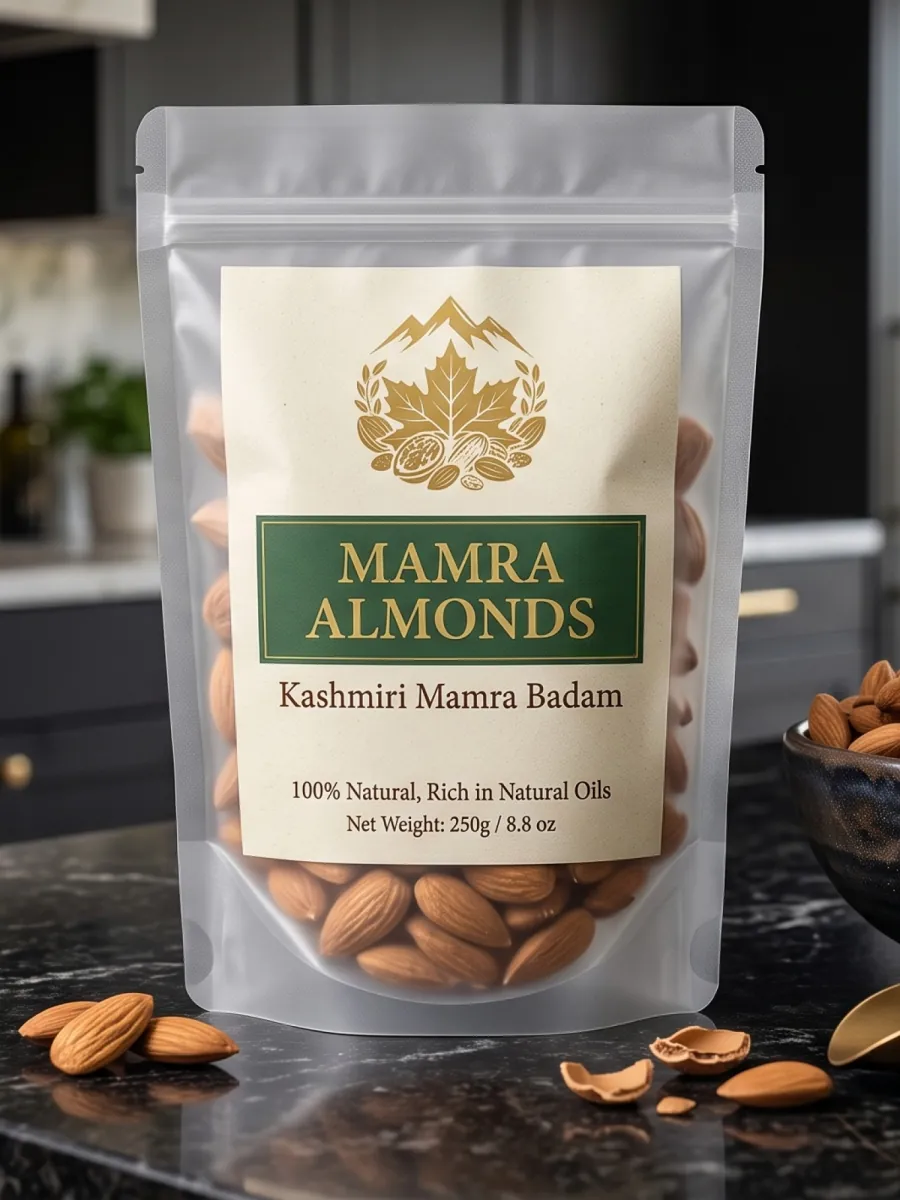
Valley Origin does not sell cashews today, and we will not suggest otherwise. Our hero product is Kashmiri Mamra Badam (almond). We can show how we answer the same questions for it.
We began as a family business in Kashmir in 1975. We source Mamra Badam and walnut halves direct from growers with no middlemen. Our Mamra Badam is Grade A, hand-graded and hand-inspected. Nothing is added to it: no additives, no preservatives, no artificial coating. Our walnut halves are superior grade and inspected by hand.
Those are the answers to expect from any seller. To see the same checks on an almond, read how to identify real Mamra Badam. To learn how we work, read our story.
Frequently asked questions about identifying good quality cashew nuts
How do you check the grade of a cashew?
Count the kernels in 100 g and compare with the grade table. W240 should give about 49 to 53 kernels, and W320 about 66 to 71. The count only confirms size grade, not freshness or colour class, so check smell as well.
Use a kitchen scale and spread the kernels on a plate. Remove only the broken pieces from the count if the pack claims whole kernels.
What do W320 and W240 mean?
They are size grades for whole kernels. W320 means up to 320 kernels per pound, and W240 means up to 240 per pound. W240 kernels are bigger. Both can taste the same, so choose by use and budget, not by the number alone.
For snacking and gifting, bigger kernels look better. For cooking, curries and sweets, W320 or smaller pieces are usually enough.
Why are some cashews yellow or brown?
Colour class is part of grading. Top grade kernels are white or pale ivory, and lower classes allow light yellow, light brown, amber and some blemishes. Darker kernels are not unsafe by themselves, but they are a lower grade and should cost less.
Judge freshness by smell and taste, not colour. A dark, bitter or stale-smelling kernel is the one to reject.
What does a rancid cashew smell like?
Rancid cashews smell sharp, stale or like old cooking oil, and taste bitter or soapy. The fat in the nut has oxidised. Do not eat them. Return the pack if it was new, and store future packs airtight, cool and dry.
Smell a handful as soon as you open the pack. Rancidity builds slowly, so smell your jar again every few weeks.
Are fake cashews a real thing?
We found no source showing that artificial cashews are sold. The real problems are old stock, broken kernels sold as whole, mixed sizes and wrong grade labels. Count, smell and taste catch most of them.
If you doubt a pack, return it with the invoice and a photograph.
Buy on grade and smell, not on the word premium
Good cashews are not hard to spot once you know the code. Read the W number, count a 100 g sample, look for whole kidney-shaped kernels in even ivory, and smell before you eat. Then ask the seller for grade, origin, packing date and returns.
The same rule holds for every dry fruit. Valley Origin does not sell cashews, but it does sell Kashmiri Mamra Badam, direct from growers. See the Mamra Badam page for current sizes and prices, or browse the full range of products.