A bulk order is won or lost on the supplier’s answers
You are an HR, admin or procurement lead with a headcount, a budget and a date. A corporate dry fruit gifts bulk order looks simple: pick nuts, pay, wait. The trouble starts when 200 boxes arrive and half the team asks what is in them.
This post is a question list, not a gift menu. It is for company buyers who will brief a supplier by email or phone and want every answer on paper. For a gift menu by festival, see our guide to corporate Diwali dry fruit gifts for employees.
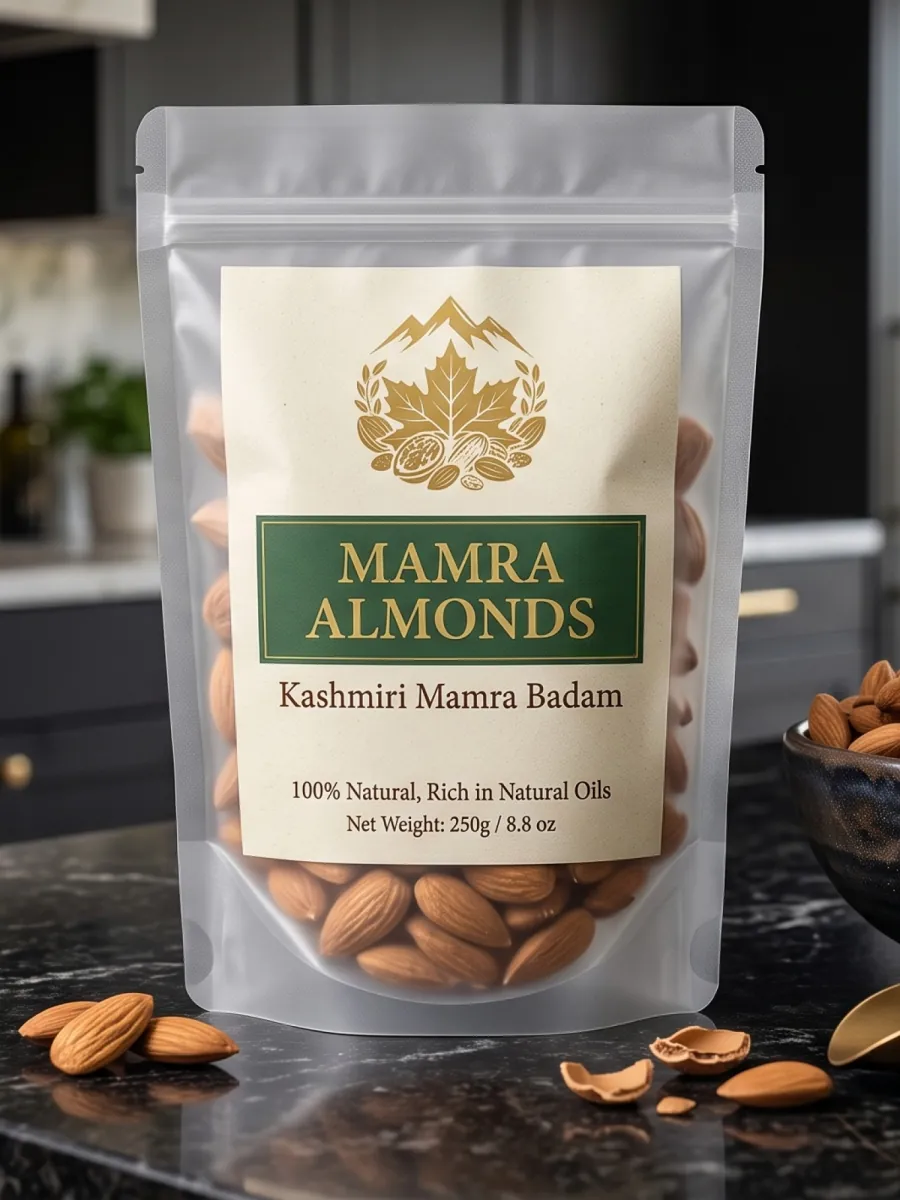
A good supplier answers all eight questions without fuss. A poor one changes the subject to the box. Quality starts with the nut itself, so first look at what a premium almond looks like on the Kashmiri Mamra Badam page.
Why are dry fruits a safe bulk gift for a company?
Dry fruits are vegetarian, need no cooking and last far longer than mithai (sweets). A sealed pack can travel to many cities and be shared at home. That makes them easy for a company to send, as long as the supplier gets the details right.
A sweet box must be eaten within days. A pack of nuts can sit in a cupboard through the festival. That is why dry fruits are the default for staff spread across offices.
The same long life hides a risk. A pack can sit in a warehouse for months before it reaches you. The eight questions below are how you check.
Which dry fruits suit a bulk order?
Choose firm, familiar nuts for a mixed team: badam (almond), kaju (cashew), pista (pistachio) and akhrot (walnut). Use soft fruit only if the supplier can show how it is packed. One good item in a larger pack often beats a crowded mix.
Say you are buying for 120 staff in four cities. A single premium nut keeps the order simple to check. A four-nut box means four grades to verify, four label lines and four ways for a substitution to slip in.
| Your team | A sensible start | What to confirm |
|---|---|---|
| Mixed team, one gift for all | One premium nut | Grade and dates |
| Senior staff and clients | Two or three firm nuts | Plain, uncoated nuts |
| Staff in many cities | Identical packs everywhere | Delivery to each pincode |
For a wider list by recipient, read how to choose a dry fruit gift box. Browse the full range to see what is sold singly.
What should you ask a supplier before a bulk dry fruit gift order?
Ask eight things: items and grade, dates on the pack, label contents, allergen declaration, additives and coating, substitutions, delivery to many addresses, and replacement of damaged boxes. Get each answer in writing and compare suppliers on the same eight points.
Send the list as one email. Ask for a reply to each numbered point. Vague answers are an answer too.
1. Which items, and which grade?
Ask for the exact item, the grade and how it is sorted. “Premium almonds” is not a grade. A named grade, sorted by hand or machine, lets you compare two quotes fairly and check what arrives against what was promised.
Grade means size and soundness. Ask what the supplier does with broken or shrivelled nuts. Ask for the same grade across the whole order, not just the sample. For almonds, our guide to types of almonds in India shows what to look for.
2. What dates will be on the pack?
Ask for the date of packing and the expiry or use-by date, printed on each pack. FSSAI’s labelling rules require date of manufacture or packaging and an expiry or use-by date. “Best before” alone is optional extra information.
That is the wording of the FSSAI Labelling and Display Regulations compendium, version of September 2021. Check the current text with your supplier.
Ask for a photo of a real printed pack, not a mock-up. The same rules let e-commerce sellers show dates after the sale, so get this in writing before you pay.
3. What will the label show?
A pre-packaged food label should carry the FSSAI logo and licence number, a net quantity and the dates. Ask for a photo of the label before you order, and check that the number on it is the supplier’s own.
FSSAI’s compendium requires the logo and licence number on the label, in a contrast colour. It also says the brand owner’s number appears, plus the packer’s if different. Mislabelled or unlabelled packs are a sign to walk away.
You can also ask who actually packs the product. A supplier who resells should say so plainly.
4. How are allergens declared?
Under FSSAI’s rules, tree nuts such as almonds, walnuts, pistachio and cashew must be declared separately as “Contains” and shown as “Nut”. Cross-contact may be shown as “May Contain”. Ask the supplier to show you this line on a real pack.
This comes from the same FSSAI compendium. The list also includes peanuts and sulphite at 10 mg/kg or more.
Tree nuts are among the foods the NHS lists as common allergy triggers. Staff with an allergy should check with their doctor. Add a line to the gift note so anyone can pass the pack on.
5. Is anything added or coated?
Ask for the full ingredient list of every item. Plain nuts should list the nut alone. Salt, sugar, polish, flavour or colour should be named. If a supplier will not list what is added, regard the gift as unverified.
Roasted and salted nuts are a fair product, but the ingredients should say so. Our post on roasted salted pistachios vs raw explains the difference.
Also ask what the nuts are packed in, and whether the pack is sealed against moisture and air. That decides how well the gift survives a month in a staff drawer.
6. Can the supplier swap items?
Ask what happens if an item runs short. A fair supplier tells you before substituting, offers a like-for-like grade, and gets your approval in writing. A silent swap of a lower grade is the risk to guard against.
Write the swap rule into the order. For example: no substitution without written approval, and any approved swap must match the grade and weight.
Ask whether the sample you taste is the product that ships. If the answer is “similar”, press for detail.
7. How does delivery to many addresses work?
Ask whether one order can ship to many addresses, what data they need per recipient, and how you will track each parcel. Send a clean sheet with name, full address, pincode and phone number.
Staff in smaller towns are where delays happen. Ask about pincode coverage before you finalise the headcount. Ask for tracking per parcel, and who handles a failed delivery.
This is general planning advice. Delivery times differ by supplier, so get the dates in writing and leave a buffer. Our shipping policy shows how Valley Origin describes its own delivery.
8. What happens if a box arrives damaged, and which invoice do I get?
Ask for a GST invoice in your company’s name with your GSTIN, and for the replacement or refund process for damaged or short boxes, in writing. Agree a reporting window and what proof, such as a photo, you must send.
Ask your accountant how the tax is handled. Do not rely on a supplier for that advice.
Decide who will chase a damaged parcel in a distant city. If that is not clear before the order, it will be you.
How long should bulk gifts stay fresh?
Nuts keep quality for only a few months at room temperature, and less in heat, according to University of California extension guidance. Cool, dry, airtight storage helps. Tell recipients to keep the pack sealed and out of warm kitchens.
The University of California publication on nuts says room temperature makes oils go rancid faster. It adds that rancid nuts are not unsafe, but taste sharp and unpleasant.
Indian summers are hot, so assume the shorter end of that range. Put a short storage tip in the gift note. Our guide to storing Mamra Badam explains the steps.
What mistakes spoil a bulk dry fruit order?
The common mistakes are comparing quotes without a stated grade, skipping a sample, ignoring the label, forgetting allergies, and ordering too close to the festival. Each has a simple fix.
Comparing quotes without a grade. Two prices for “premium” nuts mean nothing. Fix: ask every supplier to quote the same item, grade and pack weight.
Skipping the sample. Taste it, check the colour, and read the printed label. Fix: ask for a real pack, and read a refusal as a warning.
Ordering late. Suppliers fill up in festival weeks. Fix: send your eight questions at least a month before you need a quote, and leave time for approval and delivery.
No allergy plan. Fix: add an ingredient line to the gift note and let staff pass the pack on.
How does Valley Origin handle gifting orders?
Valley Origin supplies dry fruits for festive, wedding and corporate gifting. Enquiries go through the contact page. Share your headcount, items and dates there, and ask for a quote. We do not publish packs, minimum orders or prices here.
Valley Origin is a family business that began in Kashmir in 1975 and sources direct from growers, with no middlemen. Its Mamra Badam is Grade A, hand-graded and hand-inspected, with no additives, no preservatives and no artificial coating.
Its GSTIN is 01ABJFP3053A1ZX and its FSSAI registration number is 21026411000282. You can read more about how we source. Send the eight questions above to our contact page and judge the answers like any other supplier’s.
Frequently asked questions about corporate dry fruit gifts for a bulk order
What should I ask a supplier before a bulk dry fruit gift order?
Ask for the items and grade, the dates on the pack, the label contents, the allergen line, what is added, the substitution rule, delivery to many addresses, and the damage process. Get every answer in writing before you pay.
Use the eight questions above as your email.
How long should dry fruit gifts last on the shelf?
At room temperature, nuts hold quality for a few months, and for less time in heat. In a fridge they last longer. Ask the supplier for the expiry or use-by date and the storage conditions printed on the pack.
The University of California guidance gives a year or more for nuts in a refrigerator, but gift recipients rarely store them that way.
What must the label show?
A pre-packaged food label must show the FSSAI logo and licence number, the dates of packing and expiry or use-by, the allergen “Contains” line and more. Ask for a photo of the label before you order.
The full list sits in the FSSAI regulations. Your supplier should know it.
How do I handle nut allergies among recipients?
Add an ingredient and allergen line to the gift note and let staff pass the gift on. Anyone with a known allergy, or unsure, should check with their doctor. Do not guess who is safe.
You cannot know every employee’s health history, so a pass-on option is the kind answer.
Can a supplier swap items in a bulk order?
Only with your written approval. Ask for a like-for-like grade and weight if a swap is needed, and agree this before the order. An unannounced swap is a reason to claim a refund.
Put the rule in the purchase order, not in a phone call.
Ask the eight questions, then judge the answers
A bulk dry fruit gift reaches your team through a supplier, so the supplier’s habits matter more than the box. Send all eight questions, compare the written answers, and pick the one who is clear about grade, dates and labels.
To see the standard Valley Origin sets for almonds, start with the Kashmiri Mamra Badam page. When you know your headcount, items and dates, contact us for a gifting quote.