Cashew grades decide size, not flavour, so buy the one you will use
You stand in front of three jars of kaju (cashew). One says W180, one W240 and one W320. The price changes with every number. Cashew grades are the reason, and most sellers never explain them in plain words.
The answer you need is not which grade is best. It is which grade is best for what you plan to do with it. A kernel for a gift box and a kernel for a gravy have different jobs.
This guide matches each grade to a use. It does not repeat the full grade table or the quality checks, which we cover in how to identify good quality cashew nuts. Valley Origin does not sell cashews, and you can see what we do sell on our products page.
What are cashew grades?
Cashew grades are trade labels that sort kernels by size, shape and colour. The W codes sort whole kernels by size alone. Other letters mark broken kernels: B for butts, S for splits, and named sizes for pieces. A grade tells you what is in the pack, not how it tastes.
Three things are graded. The first is size, shown by the number. The second is shape: whole, butt, split or piece. The third is colour class, which runs from white to blemished.
The labels come from the trade, not from the kitchen. The Association of Food Industries (AFI) publishes a cashew specification that defines them. The Global Cashew Council’s standards page uses the same size codes.
A seller may add “premium”, “jumbo” or “special”. Those words are not part of the standard. Ask for the W number.
What does the W number in W180, W240 and W320 mean?
The “W” means whole kernel. The number is the maximum count of kernels in one pound, about 454 g. A smaller number means bigger kernels. So W180 kernels are larger than W240, and W240 kernels are larger than W320.
The AFI specification lists the standard sizes as 180, 210, 240, 320 and 450. Some sellers also write SLW for 180 and LW for 210. Those are the same sizes under older names.
Here is what the three codes in your title mean at home. Per kilo, W180 runs about 266 to 395 kernels, W240 about 485 to 530, and W320 about 660 to 706. The full table and a counting test are in our cashew quality guide, so we will not repeat them.
One fact most sellers skip: each code is a band, not a fixed size. W180 covers 140 to 180 kernels per pound, so two jars marked W180 can differ in size.
What other cashew grades are there, besides whole kernels?
Besides whole kernels, the standard defines butts, splits and pieces. Butts are kernels broken crosswise. Splits are kernels halved lengthwise. Pieces are smaller fragments, sorted by sieve size. All are real products, usually cheaper, and sold for cooking and sweets.
The AFI specification gives exact limits. A kernel is “whole” if no more than one-eighth has been broken off. A butt is between three-eighths and seven-eighths of a kernel, still joined. A split is one lengthwise half, with no more than one-eighth of it broken off.
Pieces are sized by the sieve they must not pass through. Large pieces are held by a 6.30 mm sieve. Small pieces are held by 2.80 mm. Baby bits are smaller still, held by 1.70 mm. The standard lets a whole-kernel pack contain up to 10% broken kernels by weight.
The Global Cashew Council lists the uses by form. Whole kernels go into natural, roasted or flavoured snacks. Pieces go into confectionery, bakery, cereals and sweets. Flour or meal goes into cashew paste, butter and Indian curry.
That list tells you something useful. The trade itself sells broken kernels for sweets and gravies.
Which cashew grade should you buy for each use?
Buy W180 or W240 for gifting and plain snacking, where looks matter. Buy W320 for everyday eating and most cooking. Buy W450, splits or pieces for gravies, pastes and sweets that grind the kernel anyway. Pay for size only when you will see it.
This table pairs each use with a grade. It is our reading of the trade uses above, not a rule in any standard.
| Use | Grade to buy | Why |
|---|---|---|
| Gift box | W180 or W240 | Large, even kernels look best |
| Snacking, plain or roasted | W240 or W320 | Good bite, fair price |
| Everyday cooking, pulao, kheer | W320 or W450 | Size is lost in the dish |
| Gravy and paste | Splits, pieces or W450 | The kernel is ground fine |
| Sweets such as kaju katli | Pieces or W450 | The kernel is ground to a paste |
Say you cook for a family of four and use 50 g of kaju in a korma. You grind it with water. A W180 kernel and a piece give the same paste, so W180 is money spent on looks you never see.
The opposite case holds too. If you are filling a gift box, kernel size is the first thing the receiver sees. Here a smaller grade will look thin.
Is W180 worth the extra cost?
W180 is worth it only when size shows: a gift box, a display jar, or a plate of plain kernels. In a gravy, a sweet or a pulao it adds cost and no benefit. If you will not see the kernel whole, choose a smaller grade.
Bigger kernels are fewer per kilo. Sorting by size is also extra work for the processor. The AFI specification makes sizing compulsory for top quality kernels, so the sorting is real. This is why larger grades usually cost more.
We have not quoted a price in rupees. The prices we found were inconsistent and move with the harvest. Compare sellers on the same day, for the same W grade and the same weight.
A bigger kernel is not a fresher kernel. A W180 pack can be stale and a W320 pack can be fresh. Smell tells you which, as we explain in our quality guide.
Do cashew grades change the taste?
We found no source showing that size changes flavour. The standard grades size, shape, colour and defects, and counts off-flavours such as rancidity as damage at any size. Freshness and storage shape taste far more than the W number.
The AFI specification lists “rancid flavor” as serious damage, whatever the size. That is the real taste risk. A fresh W320 kernel will taste better than a stale W180.
There is one honest exception: texture in the mouth. A bigger kernel gives a larger, creamier bite when eaten plain. In a cooked dish, that difference disappears.
Store what you buy with care. Our guide to how to store cashews in India covers jars, the fridge and the monsoon.
How do you know you got the grade you paid for?
Weigh 100 g, count the kernels and compare with the standard’s range for the grade on the label. Check that the pack is whole kernels, not a mix of broken pieces. Ask the seller for the W grade in writing, and keep the invoice.
A grade is only a promise on a label. The standard itself allows some slack: up to 10% of a lot may be the next lower size, and up to 10% may be broken. A few small kernels are normal. A pack half full of them is not.
Three quick checks help:
- Count a sample. Use a kitchen scale and a plate. Compare with the kernels-per-kilo figures in the AFI specification.
- Look for pieces. Butts, splits and chips in a pack sold as “whole” mean you paid whole-kernel prices for broken ones.
- Read the label for a grade. “Premium cashews” is a marketing word, not a grade.
If a pack fails, return it with the invoice and a photograph.
Where Valley Origin stands
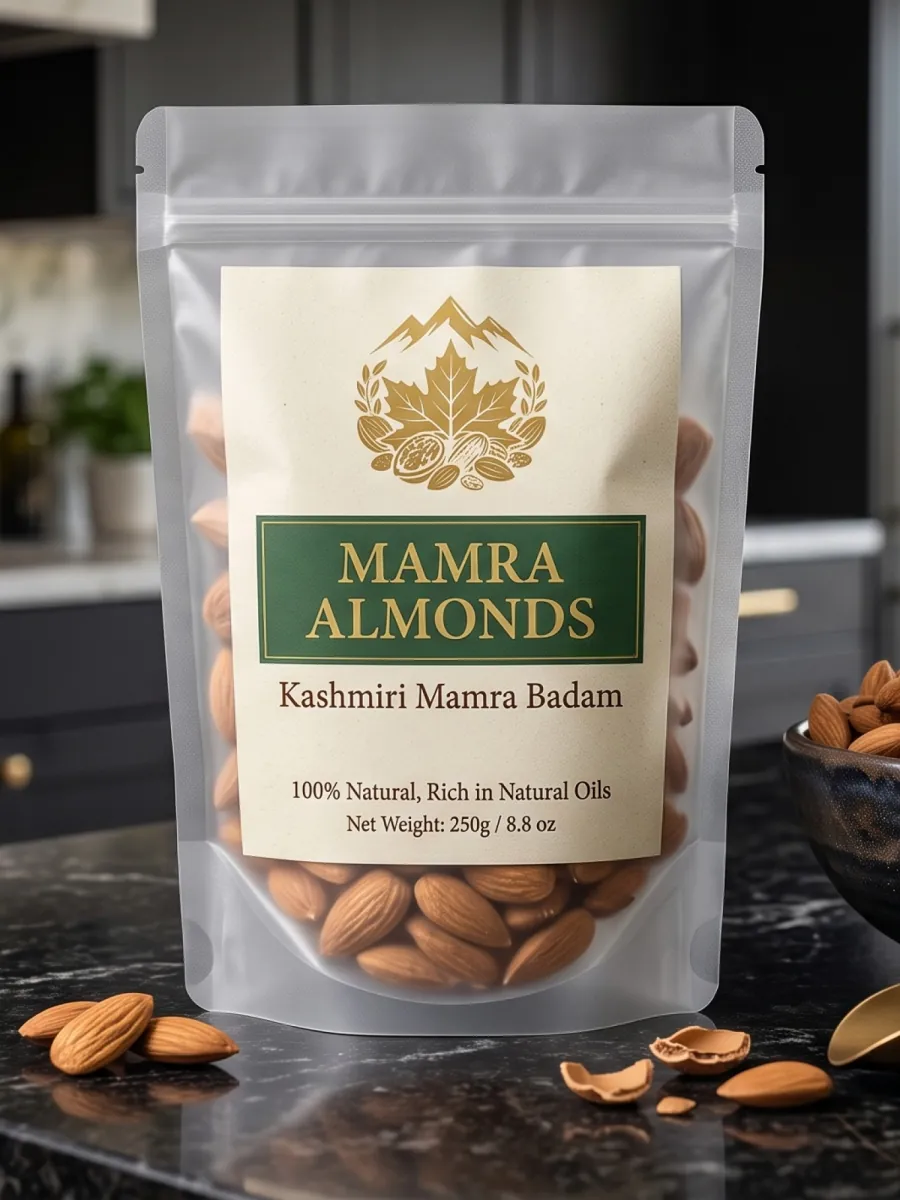
Valley Origin does not sell cashews today, and we will not suggest otherwise. Our hero product is Kashmiri Mamra Badam (almond), and we also sell Kashmiri walnut halves (akhrot) and salted pistachios (pista).
We began as a family business in Kashmir in 1975. Our Mamra Badam is Grade A, hand-graded and hand-inspected, with no additives, no preservatives and no artificial coating. We write about cashew grades because the same habit protects you with every dry fruit: ask for the grade, then buy only what you will use. Read our story to see how we work.
Planning a gift with several nuts? See how to choose a dry fruit gift box and our guide to dry fruits as wedding return gifts.
Frequently asked questions about cashew grades
What does W320 mean?
W320 is a size grade for whole cashew kernels. It means up to 320 kernels in one pound, about 454 g. The kernels are smaller than W240 or W180. It is the common choice for everyday eating and cooking, where large size adds cost without adding use.
The AFI specification puts W320 at 300 to 320 kernels per pound, or about 660 to 706 per kilo.
Is W180 worth the extra cost?
Only if the kernel is seen whole. For a gift box or a plain snack, the larger size looks better and is worth paying for. For gravy, paste or sweets, it is not. Freshness matters more than size, so check smell before you pay.
Bigger grades usually cost more because fewer kernels fit in a kilo and the sorting takes work.
Which cashew grade is best for kaju katli and cooking?
For kaju katli, gravies and pastes, use W450, splits or pieces. The kernel is ground, so size is lost. For pulao and kheer, W320 is enough. Buy larger grades only for garnish you want to show.
Pieces and flour are sold for exactly this use, according to the Global Cashew Council.
Which cashew grade is best for gifting?
W180 or W240, packed whole and even. Large kernels look generous in a gift box. Check the packing date and smell, because stale large kernels still make a poor gift. For quantities and budget planning, see our wedding gift guide.
Our guide to dry fruits as wedding return gifts explains how to plan quantity and budget for many gifts.
Do cashew grades change taste?
Not that we could find. Grades describe size, shape, colour and defects, not flavour. Freshness has the bigger effect: rancid kernels taste sharp or bitter at any size. Smell a handful before you eat, and store the rest airtight.
Cashews are a tree nut. If anyone in your home has a nut allergy, check with your doctor before buying.
Pick the grade for the job, then check the smell
Cashew grades are simple once you see them as size codes. W180 and W240 are for kernels that will be seen. W320 suits daily eating. W450, splits and pieces suit anything you grind.
Spend on size only where it shows, and always check smell and the packing date. Valley Origin does not sell cashews, but you can see our Kashmiri almonds on the Mamra Badam page or browse the full range of products.