A tiny pack of kesar can cost more than a kilo of almonds
Many buyers ask why Kashmiri saffron is so expensive when they see a small tin priced like jewellery. The short reason is that kesar (saffron) is the stigma of a crocus flower, and each flower gives very little. Hand labour, a short harvest and thin local supply do the rest.
This guide explains each cost driver with sources. It also explains the grade names on the pack, and how to tell a fair price from a warning sign.
Valley Origin does not sell saffron. We sell Kashmiri dry fruits direct from growers, and you can see them on our products page. We write this because the same question, “is this price honest?”, applies to every premium food.
Why is Kashmiri saffron so expensive?
Four things push the price up: a tiny yield from each flower, picking by hand, a harvest of only a few weeks, and local supply far below India’s demand. Kashmir’s own quality premium sits on top of these costs.
Take them one at a time.
- Tiny yield. A study in PMC notes that each flower yields only three stigmas. An expert at the Sher-e-Kashmir University of Agricultural Sciences and Technology (SKUAST) told ETV Bharat that each kilogram of saffron comes from 1.6 lakh flowers.
- Hand picking. The same PMC study says genuine saffron is hand-harvested, and links its cost to the intensive manual labour of harvesting and trimming the stigmas. No machine does this job yet.
- A short window. In Kashmir the flowers bloom between October and November. That report also notes that delays in picking reduce stigma recovery.
- Thin supply. The Economic Times reported in April 2025 that India uses about 55 tonnes a year, while Kashmir grows 6 to 7 tonnes. Afghanistan and Iran supply the rest.
Add Kashmir’s reputation. The Tribune’s GI report describes Kashmir saffron as having a longer, thicker stigma, a natural deep-red colour, high aroma and a bitter flavour. It also says the crop grows at about 1,600 metres. Buyers pay extra for that profile.
How much work goes into one gram?
One gram of saffron is roughly 160 flowers, each picked by hand, and every flower must then be stripped of its three red threads. A grower in Pampore told reporters that labour for 250 g of harvest alone came to Rs 35,000.
The flower count is simple arithmetic from the SKUAST figure above. One kilogram needs 1.6 lakh flowers, so one gram needs about 160. A 5 g tin is about 800 flowers.
The labour figure is one grower’s account, not an industry average. ETV Bharat quotes a Pampore farmer saying his 250 g harvest in November 2025 “cannot even cover Rs 35,000 incurred on labour charges”. He had harvested 1.5 kg the year before.
That second number matters. A bad year shrinks the crop while the pickers still need paying.
How much does Kashmir actually grow?
Official figures say 19.58 metric tonnes in 2024-25, but trade reports put Kashmir’s output at only 6 to 7 tonnes. The numbers do not agree, and growers describe 2025 as a very poor year. India imports the gap.
The figures differ because they count different things, or come from different sources. Neither can be called wrong from the reports alone.
- Official: the J&K government told the Assembly in February 2026 that production was 14.94 tonnes in 2022-23, 23.53 in 2023-24 and 19.58 in 2024-25.
- Pampore growers: ETV Bharat reports that 26 Pampore villages produce about 15 tonnes a year, and that output fell from over 17 tonnes to 14 tonnes between 2019 and 2024. Officials called 2025 the lowest yield in decades but released no numbers.
- Trade: the Economic Times figure of 6 to 7 tonnes, quoted above.
The honest reading is that output is small and unstable. Even the highest official number is less than half of the 55 tonnes India uses. That gap explains why so much saffron on Indian shelves comes from Afghanistan and Iran.
What do mongra and lacha mean, and do they change the price?
Mongra is the darkest grade, with the richest aroma and flavour. Lacha mixes red and yellow parts. Mongra costs more because you pay for red stigma and not for pale style. Grade names are trade terms, so ask what a seller means.
The Economic Times, in its April 2025 report, lists three types: mongra, lacha and zarda. It describes zarda as used in beauty products. We did not find an official Indian definition of these names, so read them as trade language.
Lab grading is separate. The international standard ISO 3632 sorts saffron into categories, and a study of saffron quality reports results for colour (crocin), taste (picrocrocin) and aroma (safranal) against it. Our guide to spotting real Kashmiri saffron explains what a lab test result should show.
A fair rule: the grade name tells you what the seller claims. A batch-specific lab test result tells you what is in the tin.
What does a fair price look like?
At the time of writing, the latest figures we could open are from April 2025. Wholesale at the Kashmir saffron trading centre was Rs 3 lakh per kg, and top-grade stock was quoted near Rs 5 lakh. That is Rs 300 to Rs 500 per gram.
Prices move with each crop, so read these as a yardstick, not a quote.
The Economic Times report gives three numbers:
| Price point (April 2025) | Per kg | Per gram |
|---|---|---|
| Wholesale, Kashmir trading centre | Rs 3 lakh | Rs 300 |
| Top grade before the border closure | Rs 4.25 to 4.50 lakh | Rs 425 to 450 |
| Top grade after the closure | About Rs 5 lakh | About Rs 500 |
The Agro & Food Processing report of 1 May 2025 attributes the wholesale figure to a J&K agriculture department officer. It attributes the top-grade figures to a Chennai trader. The rise followed a suspension of trade on the Attari-Wagah route, which disrupted Afghan imports.
Use this as a yardstick. A pack sold as Kashmiri mongra at a small fraction of Rs 300 per gram is hard to explain. Something was added, or the grade or origin is not what the label says.
Is cheap kesar always fake?
No. Cheaper kesar can be an honest product from another origin or a lower grade. But kesar labelled Kashmiri mongra at a price far below wholesale is a warning, because added dyes, turmeric and safflower all lower the cost.
Iran is the clearest example. The Agro & Food Processing report describes Iranian saffron as more affordable than Kashmiri. A fairly priced Iranian pack is not a fraud. A pack that calls itself Kashmiri and is priced like Iranian stock needs an explanation.
The fraud risk is real. The PMC study names turmeric, safflower and paprika powder as the most common adulterants in powdered saffron. It also cites a European campaign in 2021 and 2022 in which 11% of saffron in the spices category was the object of fraud. Powder hides all of it, so whole threads are the safer buy.
Is expensive kesar good value per use?
Often yes. A glass of kesar milk uses only a few threads, so the cost per serving is a few rupees even at wholesale rates. Good value comes from using strong saffron well, not from buying the cheapest tin.
Here is rough arithmetic, not a retail price. Each flower gives three threads, and 1.6 lakh flowers make 1 kg. At the April 2025 wholesale rate of Rs 3 lakh per kg, one flower’s worth of saffron costs under Rs 2. A glass of milk with three threads then costs under Rs 2 of saffron at wholesale. Retail packs will cost more, because sellers add their own costs and margin.
Recipes vary a lot in how many threads they use. Our guide on how many kesar strands go in milk compares them and shows how to bloom saffron so none is wasted.
Fresh, strong threads colour more liquid than old, pale ones. A cheap, weak tin that needs ten threads can cost more per glass than a good one that needs three.
What should you ask a seller before paying?
Ask five things: where it was grown, which grade it is, which harvest it comes from, whether anything is added, and what happens if you are unhappy. A seller with nothing to hide answers each one plainly.
- Origin: ask for the region, not just the word “Kashmiri”.
- Grade: ask what the grade name means and whether a lab test result backs it.
- Harvest: Kashmir’s crop is picked once a year, in October and November, so the seller should name the year.
- Additives: whole threads should have no oil, glycerine or colour added.
- Returns: ask for the written policy before you order.
Then check the price against the table above. If the seller dodges any one question, buy elsewhere.
Where Valley Origin stands on origin and price
Valley Origin does not sell saffron, and we will not imply it. What we can describe is how we handle the same questions for the dry fruit we do sell.
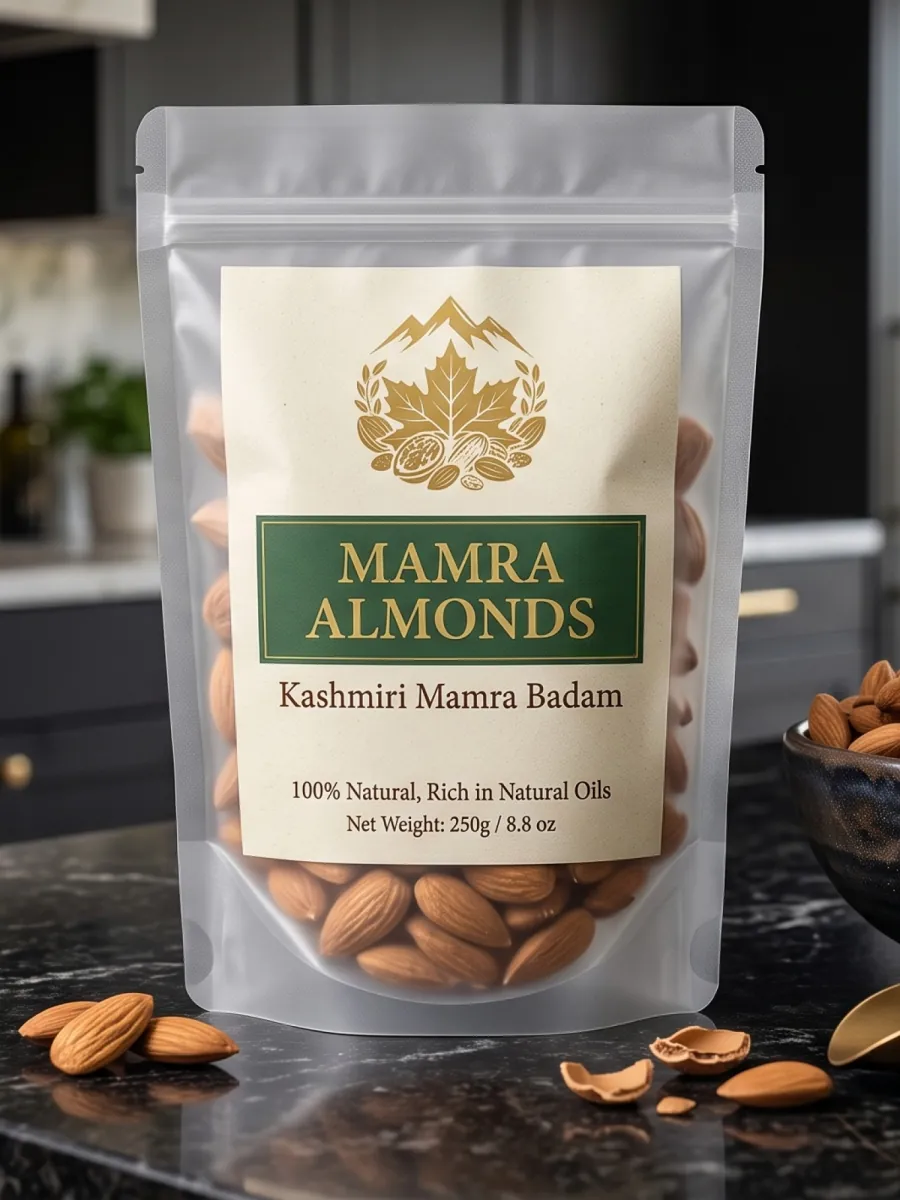
We buy Mamra Badam and walnut halves direct from growers in Kashmir, with no middlemen. Our Mamra Badam is Grade A, hand-graded and hand-inspected. Nothing is added to it: no additives, no preservatives, no artificial coating. Our walnut halves are superior grade and inspected by hand. Our family business began in Kashmir in 1975, and you can read more on our story page.
Those are the answers worth asking from any seller of any premium food, saffron included.
Frequently asked questions about Kashmiri saffron prices
Why does saffron cost so much?
Each crocus flower gives only three threads, about 1.6 lakh flowers make 1 kg, and every thread is picked by hand during a short autumn bloom. Cost follows labour and yield, not marketing.
Supply is the other half. Kashmir grows a small share of what India uses, so prices respond sharply to a poor crop or a trade disruption.
How many flowers make a gram of saffron?
About 160 flowers make one gram, using the SKUAST figure of 1.6 lakh flowers per kilogram. Sources differ slightly, and yield varies by year and by how the stigmas are dried and trimmed.
Read 160 as a working estimate. A different source may give a somewhat different count.
What is the difference between mongra and lacha saffron?
Mongra is the darkest grade, with rich aroma and flavour. Lacha contains both red and yellow parts. Both are trade names with no official definition that we could find, so ask the seller to explain and to show a lab test result.
More yellow style means less red stigma by weight, which is one reason sellers price the two grades differently.
Is cheap kesar always fake?
No. It may be saffron from another origin, an older crop or a lower grade. But very cheap kesar sold as Kashmiri mongra is a warning sign, since turmeric, safflower and dyes are common adulterants.
Ask where it was grown and which harvest it is from. Honest sellers can say.
How much saffron do you actually use per serving?
Recipes range from about two or three threads for a small glass of milk to eight or ten for a full cup. Strong, fresh saffron needs fewer. Start low and add more only if colour and flavour are weak.
Bloom the threads in warm milk or water first. Our guide to kesar in milk shows how.
Pay for proof, not for the word Kashmiri
Saffron is costly for solid reasons: three threads per flower, 1.6 lakh flowers per kilo, hand picking, and a crop that is small and uncertain. A high price is not proof of quality, and a low one is not proof of fraud. Origin, grade, harvest year and a batch-specific lab test result tells you more than the price tag.
The same habit protects you with every premium dry fruit. If you want almonds with a clear origin, see the Kashmiri Mamra Badam page for current sizes and prices.