A Makar Sankranti dry fruit gift should sit beside the til-gud
You are choosing a Makar Sankranti dry fruit gift for the women who come to your haldi kumkum, for relatives in another city, or for the neighbours who send you tilgul every year. Til-gud is the food of the day. A box of nuts has to fit around it.
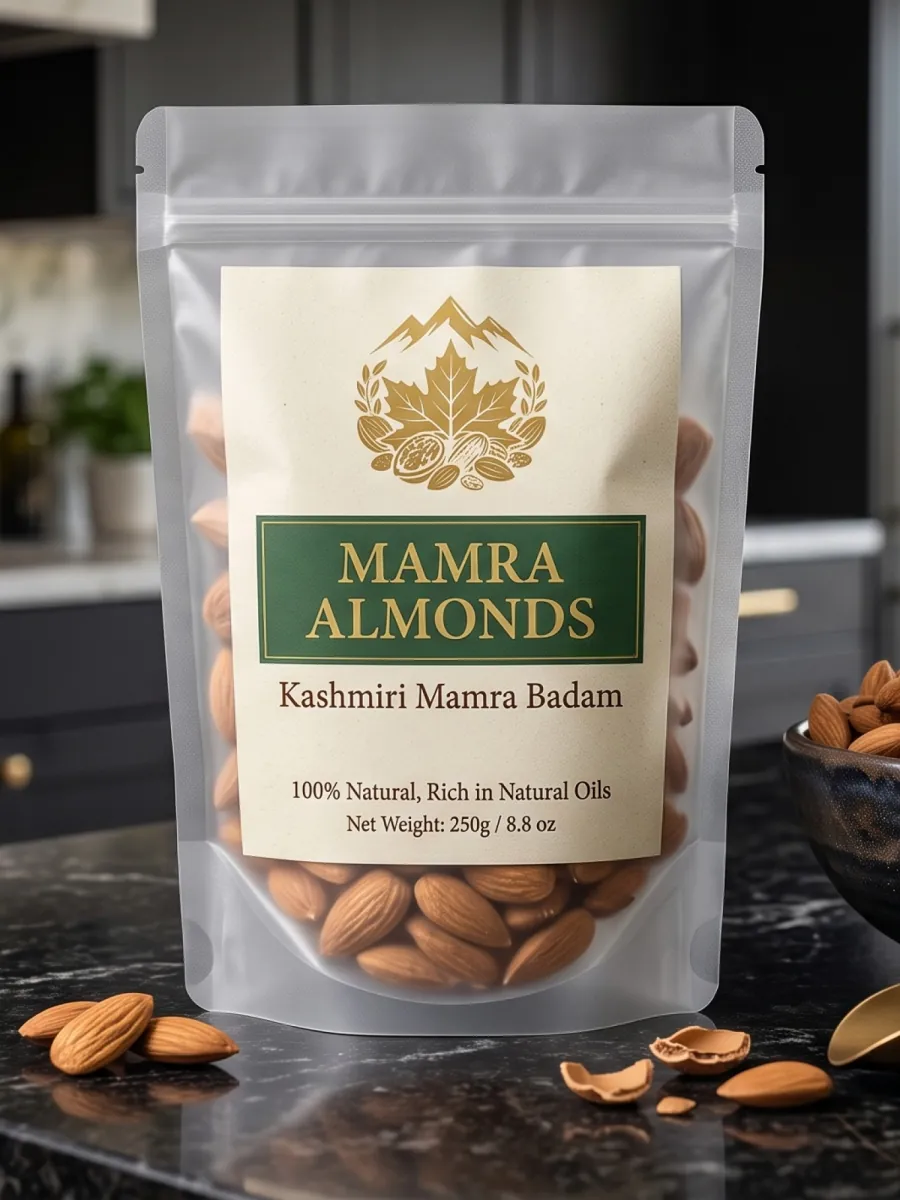
This guide is for families and individual gift buyers. It covers the vaan (the small gift a hostess hands each guest), gifts for relatives, and how to plan quantities and dates. Lohri, the Punjab bonfire festival one day earlier, has its own customs, so we cover it separately in Lohri dry fruit gifts. If almonds are on your list, start with Kashmiri Mamra Badam.
What do you give for Makar Sankranti?
Give something small and edible that belongs to the day: tilgul (sesame and jaggery sweets), plus a sealed pack of dry fruits. Add a useful item for a haldi kumkum vaan. Keep every gift equal in weight across guests of the same kind.
In 2027, Makar Sankranti falls on Friday, 15 January in India. The Sun enters Makara at 9:14 PM IST on Thursday, 14 January, so the festival day is the 15th, according to Hindu Tone’s 2027 guide and Drik Panchang. Some calendars still print 14 January. Check your local panchang.
In Maharashtra, people exchange tilgul with the words “til-gul ghya, god god bola”, which means “take this sweet and speak sweetly”. That one line shapes the gift: it should be small, sweet in spirit and shared widely.
Can dry fruits be a haldi kumkum vaan?
Yes. A small sealed pack of plain nuts makes a good vaan, because it is useful, keeps for weeks and suits most guests. Many hostesses still add a steel box, a small purse or a pouch. The dry fruit pack can be the main gift or the filling.
Haldi kumkum is a gathering of married women who exchange turmeric and vermilion as a symbol of their married status, says Wikipedia’s entry on Haldi Kumkum. It adds that hostesses give gifts such as bangles, sweets, flowers, betel leaves, nuts and coconuts. So nuts are already within the custom.
The practical case is easy. A trinket sits in a drawer. A pack of almonds gets eaten, and the guest thinks of you each morning. The honest counter-point: if your family follows a strict tradition about what a vaan should be, such as a specific item for a first Sankranti after marriage, ask an elder first. Dry fruits then become the extra gift, not the vaan.
What goes alongside til-gud?
Pair a pack of plain nuts with a small portion of tilgul, ladoos or chikki. This keeps the festival food at the centre and adds a pack that stays fresh for weeks, long after the sweets are finished.
Sesame and jaggery are the base of tilgul. Nuts are a natural second item, since both are eaten in the cold weeks of January. A simple gift might hold:
- A plain, firm nut such as badam (almond) or akhrot (walnut), sealed.
- A small portion of tilgul or til ladoo.
- Haldi and kumkum in a small packet, if it is a vaan.
Keep the sweet portion small. Jaggery sweets soften in damp weather, so buy them close to the day. The nut pack is the part that lasts. Pack the two separately, so the nuts do not take up moisture from the sweets.
Our Kashmiri Walnut Halves are shelled kernels, so there is nothing to crack at a party full of guests.
Which dry fruits suit which person?
Give almonds to elders and close family, walnut halves to guests who like a lighter snack, and one plain nut to neighbours. Skip coated, flavoured or salted nuts if you are unsure of the guest’s diet.
This table is a planning guide. It is not a price list.
| Who you are gifting | A sensible choice | What to watch |
|---|---|---|
| Haldi kumkum guests | One plain nut, 50 g to 100 g, sealed | Same pack for each guest |
| Neighbours who sent tilgul | A small nut pack and a sweet | Match their gesture |
| Mother, mother-in-law, elders | A larger almond pack, about 250 g | Packing date and net weight |
| Relatives in another city | Two or three nuts in sealed packs | Delivery time and freshness |
| Newly married daughter or daughter-in-law | A mixed gift with a letter | A personal note matters most |
For a longer checklist on contents and net weight, see our guide to choosing a dry fruit gift box.
How much should you give per guest or family?
Plan 50 g to 100 g per haldi kumkum guest, 100 g for a neighbour, and 250 g for a close relative. This is a rule of thumb, not a standard. Count households, not heads, and add a few spare packs.
Say you invite 30 women to your haldi kumkum. At 50 g each, that is 1.5 kg of one nut. Add 6 neighbours at 100 g (600 g) and 4 relatives at 250 g (1 kg). The total is 3.1 kg. Add three spare 50 g packs for guests you forgot, and the total is about 3.25 kg.
Count the list first, then divide the budget. Buying first and rationing later is how one guest gets a smaller pack than the next.
Weigh the nuts, not the box. A box marked 250 g may include the packing.
When should you order, and how do you send gifts to relatives in another city?
Order about three weeks before 15 January. Standard delivery can take longer in busy weeks, so give the address in full and add a phone number. Then call your relative, so someone is home to receive the parcel.
Haldi kumkum is a season, not a single day. Hostesses hold it on different days around Sankranti, so the parcel for a relative can arrive a little after the festival and still be useful. Even so, a gift that arrives on the morning is better.
For a gift to another city, work in this order:
- Choose firm nuts that travel well: almonds, walnut halves, pistachios.
- Check the seller delivers to the PIN code. Our shipping policy lists how Valley Origin ships.
- Give the full address, a landmark and a mobile number that someone will answer.
- Tell the receiver the day it ships.
Our guide to sending a dry fruit gift to another city goes deeper on packing and freshness. If your list has many addresses, read sending gifts to multiple addresses.
What separates a premium gift from a cheap one?
A premium gift has plain, graded nuts, a clear packing date, a sealed pack and an honest net weight. A cheap one hides small or broken nuts under a large box and bright wrapping. Judge the nuts first and the box last.
Open one pack before you order many. Fresh almonds smell mild and sweet and snap cleanly. A sharp, paint-like smell or a bitter taste means the oils have turned.
Ask where the nuts were grown and what grade they are. Valley Origin’s Mamra Badam is grown in Kashmir above 1,800 metres, and it is Grade A, hand-graded and hand-inspected. Our walnut halves are superior grade and inspected by hand. Ask any other seller the same questions.
How does Valley Origin handle Sankranti gifting?
Valley Origin is a family business that began in Kashmir in 1975. It sells a Dry Fruits Gift Pack and takes bulk and festive orders by enquiry on the gifting page. Send quantity, pack size, date and delivery city.
The Dry Fruits Gift Pack is a box of 4, 6 or 8 types of dry fruits, 250 g of each type, with a personalised letter of up to 600 characters written at checkout. The 4-type box holds Kashmiri Mamra Badam, Kashmiri walnut halves, salted pistachios and raisins. See the product page for current prices.
Any order can also be sent as a gift. Tick “Send this as a gift” at checkout and enter the recipient’s name, mobile and address in India. The address must be in India. Standard delivery takes 8 to 14 business days after 1 to 2 business days of dispatch. Quick delivery, 3 to 4 days, costs Rs 200 extra per order. Shipping is free above Rs 999.
For a large haldi kumkum list or a group of relatives, send a gifting enquiry. Replies come within 1 to 2 business days.
What mistakes should you avoid?
The common mistakes are ordering late, giving uneven gifts, choosing by the box, buying coated nuts and forgetting allergies. Each has a simple fix: order early, set one base gift, check net weight, keep to plain nuts and name what is inside.
Ordering late. Orders pile up in January. Order early and leave a few days to check the packs.
Uneven gifts. Guests compare vaans. Give each guest the same base gift.
Choosing by the box. A large box can hold a small amount of nuts. Compare net weights.
Coated or soft fruit. Sugar-coated nuts and soft fruit take up moisture. Plain nuts hold up better.
Forgetting allergies. Sesame, peanuts and tree nuts are common allergens, and tilgul contains sesame. Add a line on the card naming what is inside, so an allergic guest can pass it on. If a guest has diabetes, check with her or her doctor before giving sweets.
Tell the receiver to keep the nuts in a cool, dry place and move them to an airtight jar once opened.
Frequently asked questions about Makar Sankranti dry fruit gifts
What is the best dry fruit to gift for Makar Sankranti?
Almonds are the safest single choice, followed by walnut halves. They are firm, familiar and keep well in January. Pick the nut your guest already eats, in a sealed pack with a clear packing date.
Pistachios in the shell suit guests who like a snack to share.
Is Makar Sankranti on 14 or 15 January in 2027?
In 2027, most careful panchangs place Makar Sankranti on Friday, 15 January, because the Sun enters Makara at 9:14 PM IST on the 14th. Some calendars still print the 14th. Check your local panchang before you fix the date.
Lohri falls on the evening of the 14th in Punjab.
How much should I spend on a haldi kumkum vaan?
There is no fixed amount. Set one base gift for all guests, keep it modest, and spend a little more only on elders and close relatives. Fairness matters more than the price.
A small nut pack plus a tilgul sweet is a sensible base.
Can I gift nuts to someone with diabetes or a nut allergy?
Skip nuts for anyone with a nut or peanut allergy and choose a non-food gift. For diabetes, plain unsalted nuts are the milder choice and sweets are best avoided, but check with the person or their doctor first.
If you are unsure, ask.
Can I send a Sankranti gift to a relative in another city?
Yes. Order about three weeks before the festival, give a full address and a working phone number, and use sealed packs. Valley Origin lets you tick “Send this as a gift” at checkout for any address in India.
See our guide to sending a dry fruit gift to another city for more.
Keep the gift small, equal and sealed
A good Makar Sankranti dry fruit gift is simple. A sealed pack of one plain nut, a small portion of tilgul, and the same quality for every guest of the same kind. Count the list, pick one or two nuts, check the packing date and order about three weeks before the 15th.
To see the quality Valley Origin holds itself to, start with Kashmiri Mamra Badam or the Dry Fruits Gift Pack. When you know your list and your date, send a gifting enquiry.